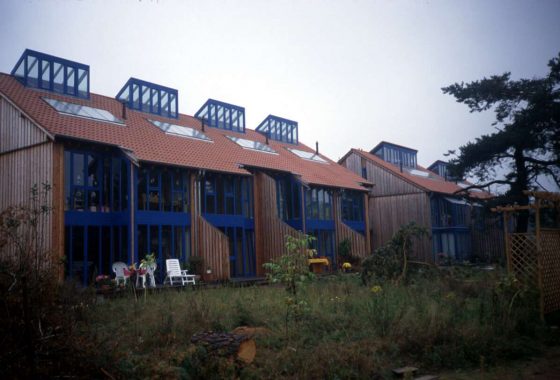
It was to be the first 6-storey wooden building in NRW, now 5 storeys are being realised as student accommodation with 32 units in passive house standard. The building is located not far from Bonn's main railway station and is implemented with a car sharing concept.
5:18 min, First broadcast: 11/19/2020, Available until 11/20/2021.
Wir im Saarland - The Magazine ∙ SR Television
"A quarter of a century ago, Bernd Janes looked for like-minded comrades-in-arms and founded an ecologically oriented housing estate on the outskirts of Kohlhof. At first, the new neighbors were eyed critically by the surrounding community. No wonder, because the houses were built in wood, four families shared one house and the gardens were not separated from each other by fences, but merged seamlessly into each other."
Is economic growth compatible with sustainability? A new report by the European Environmental Bureau (EEB), DNR and the Institute for Sustainable Economies (ZOE) clearly shows: No! Resource consumption, which is responsible for increasing environmental degradation, cannot be decoupled from economic growth. With a comprehensive analysis of scientific data, the report "Decoupling debunked - Evidence and arguments against green growth as a sole strategy for sustainability" dispels the myth of decoupling and shatters the dream of green growth as an engine for prosperity and sustainability.
Prosperity in Europe has so far been achieved through the continuous growth of the economy and consumption. The side effects have been soil erosion, species extinction and climate disruption. In the search for more environmentally friendly alternatives, the idea of green growth, of decoupling the consumption of natural resources and environmental damage from economic growth through technological progress and structural change, is gaining momentum.
In an analysis of more than 100 scientific papers, the report shows that absolute decoupling of economic growth from resource-intensive production has never occurred, nor will it occur in the future. "To actually stop the collapse of the world's ecosystems, decoupling must be absolute, permanent, global and fast enough," the report says. There is "no scientific evidence whatsoever that such decoupling can be expected," it said.
"The findings of the decoupling report shatter the dream of green growth in great detail and with scientific evidence: Absolute decoupling of growth and the use of nature is not possible. A green efficiency economy cannot save the planet. The report thus shakes the foundations of our economy: in future, prosperity can no longer be achieved through growth. What is really needed for the future of prosperity is not a growth-fixated society, but an adult one" Prof. Dr. Kai Niebert, President of the German Nature Conservation Ring
It was the great acceleration of economic growth after World War 2 that drove us into the climate, plastics, transport and agricultural crises. Now we need to find ways to counteract these crises. The report shows impressively that the growth paradigm is not sustainable.
Climate change and biodiversity loss can only be mitigated if policy makers develop alternatives to green growth and translate them into political action.
Great joy in Aachen: One of the central urban development projects is awarded special federal funding.
Mayor Sibylle Keupen: "This is a super message for our city!"
The Büchel old town quarter is one of 24 projects nationwide that are now being supported with a total of 75 million euros.
98 cities and municipalities had applied.
A most welcome piece of news reached the city of Aachen this morning (17 March 2021): Federal Minister Horst Seehofer has announced this year's selection of the "National Projects of Urban Development" and announced that the development of the Büchel old town quarter will receive up to 5.5 million euros in funding. Aachen is thus one of four municipalities in NRW to have been awarded the contract. With the amount of funding, the city is in third place nationwide.
Great news from Berlin: The federal government wants to support the development of the Büchel in Aachen's city centre with up to 5.5 million euros. Photo: City of Aachen / Andreas Herrmann
OBin Keupen: "We feel the spirit of optimism!"
"This is a great message for our city," says Mayor Sibylle Keupen in her first reaction. "We have long felt the spirit of optimism around the Büchel in Aachen. The demolition of the multi-storey car park is imminent, the planning workshop was a great success, many groundbreaking political decisions have been made, and more are on the horizon. Above all, many city makers are on board and want to be involved in a very concrete way. They want to participate, to shape, to plan, to build. The fact that this high level of commitment of all those involved here on site has now also triggered such a response at federal level encourages us to continue on the path of 'making a city at Büchel'."
City Planning Director Burgdorff: "Aachen can play in the Bundesliga!"
The municipal councillor for urban development, construction and mobility, Frauke Burgdorff, adds: "I am extremely pleased that Aachen, if it sticks together, can also play in the Bundesliga! Aachen's politicians have united behind the project and have given their backing to the state and federal governments. Thank you for that! But I would also like to express my sincere thanks to those who have done the substantive work here on site, to the municipal project manager Nils Jansen as well as to Christoph Guth and Antje Eickhoff, who have done an excellent job on the part of the municipal development company SEGA."
Making town at the Büchel
A special piece of the city at eye level is to be created at Büchel. It is being developed together with many committed people and institutions. With this approach, it has also precisely met the requirements of the call for proposals. The Federal Ministry's project overview states: "Knowledge, living, meadow" are the keywords under which a mixed-use, urban quarter is to be created in the heart of Aachen's old town in a cooperative and exemplary development process that is wanted and supported by the urban community.
The basis for the development is the exploratory procedure "Stadt machen am Büchel" (Making a city at Büchel), which the city of Aachen launched in spring 2020. City Planning Director Burgdorff sums up: "A multi-storey car park has been blocking the development of the old town for decades. We are tearing it down and building a new urban quarter. The urban community itself is developing the programme, urban design and investment strategy. This project offers a unique opportunity to find answers to the question of how a major wound in the old city can be healed with contemporary building-cultural responses."
The next steps
Following today's basic commitment by the federal government to fund the project, the detailed applications for funding will be drawn up in phase 2. In this ongoing process - and on the basis of upcoming landmark decisions of Aachen's municipal politics - it will now be worked out how the Büchel of the future will take shape with the funding millions.
National urban development projects
National urban development projects are nationally and internationally visible, larger-scale urban development projects with clear impulses for the respective municipality or city, the region and urban development policy in Germany as a whole. They are characterised by a special quality standard with regard to the urban development approach, the building culture aspects and the participation processes, contribute to the realisation of the federal government's building policy objectives and have innovation potential. National urban development projects are projects that generally solve tasks and problems of considerable financial dimension. The focus is on the major challenges currently facing cities and municipalities in Germany (e.g. preservation of existing buildings, conversions, sustainable neighbourhood development).
A total of 24 projects for forward-looking urban development are being funded by the federal government with a total of around 75 million euros. 98 cities and municipalities from all over Germany applied for the funding.
More info Interesting facts about the Büchel can be found on the Internet at www.buechel-aachen.de
From Aprill 2021 the Demolition work on the Büchel multi-storey car park. All the info on this has been presented as part of an online event. The stream is still available on the YouTube channel of the city of Aachen: https://youtu.be/KQqFq6v_edA.
Within the framework of a cooperative planning workshop, three teams of experts developed three exciting designs for the Büchel, each with a focus on the major themes of "knowledge, living, meadow". The final presentation of the planning workshop, which took place digitally in January 2021, is also still available as a stream: https://youtu.be/AWSb5Gx3gKA.
We use cookies to optimize our website and services.
Functional
Always active
Technical storage or access is strictly necessary for the legitimate purpose of enabling the use of a particular service explicitly requested by the subscriber or user or for the sole purpose of carrying out the transmission of a communication over an electronic communications network.
Preferences
The technical storage or access is necessary for the legitimate purpose of storing preferences that have not been requested by the subscriber or user.
Statistics
The technical storage or access, which is solely for statistical purposes.Technical storage or access used solely for anonymous statistical purposes. Without a subpoena, voluntary consent from your Internet service provider, or additional records from third parties, information stored or accessed for this purpose cannot generally be used alone to identify you.
Marketing
Technical storage or access is necessary to create user profiles, to send advertising or to track the user on a website or across multiple websites for similar marketing purposes.