Purchase premium in Munich now also for private eCargobikes
Published
The state capital of Munich will also pay up to 2,000 euros in purchase premiums for privately used eCargobikes from January 2017.
On 1 April 2016, the Munich-based Electromobility funding guideline into force. It introduced purchase premiums for commercial e-vehicles from pedelecs to e-cars. Since then, there has been a subsidy of 25 percent of the purchase price up to a maximum of 1000 euros for commercially used eCargobikes. In the first five months 86 applications approved. In addition, there is a 1000 euro scrapping premium if a car with an internal combustion engine is demonstrably permanently withdrawn from circulation.
The funding programme runs until 31 December 2020.
From 2022, all new public buildings must consist of at least 50 percent wood or other sustainable building material. For buildings with more than eight storeys, the supporting structure must even be made entirely of wood.
It was also decided that 90 ecological neighbourhoods and 100 urban farms should be created in Paris.
The new Development Loans of NRW.BANK is aimed at all condominium associations (WEGs) in NRW that want to modernise or rehabilitate the housing they mainly use themselves, have no commercial landlords as members and consist of at least five owners. Smaller WEGs can make use of the NRW.BANK.Gebäudesanierung promotion programme.
The usability of the credit extends over investments in
Energy efficiency, for example:
Renewal of the heating system or its components
Installation of new windows and insulation
Facade renovation
Environmental protection, for example:
Pollutant clean-up
Resource conservation, for example through new sanitary installations
Structural measures for flood protection
Accessibility, for example:
Change of the building layout
Removal of barriers
Retrofitting with lifts and stairlifts
and the financing of maintenance measures.
How does the WEG loan work?
WEGs can finance individual measures with up to 10 million euros through the funding programme. A maximum of 30,000 euros is available per housing unit. The loan term is 10 years with a grace year and a fixed interest rate over the entire term. The loan is applied for by the property management company through the WEG's chosen principal bank. NRW.BANK assumes 50% of the risk of the principal bank.
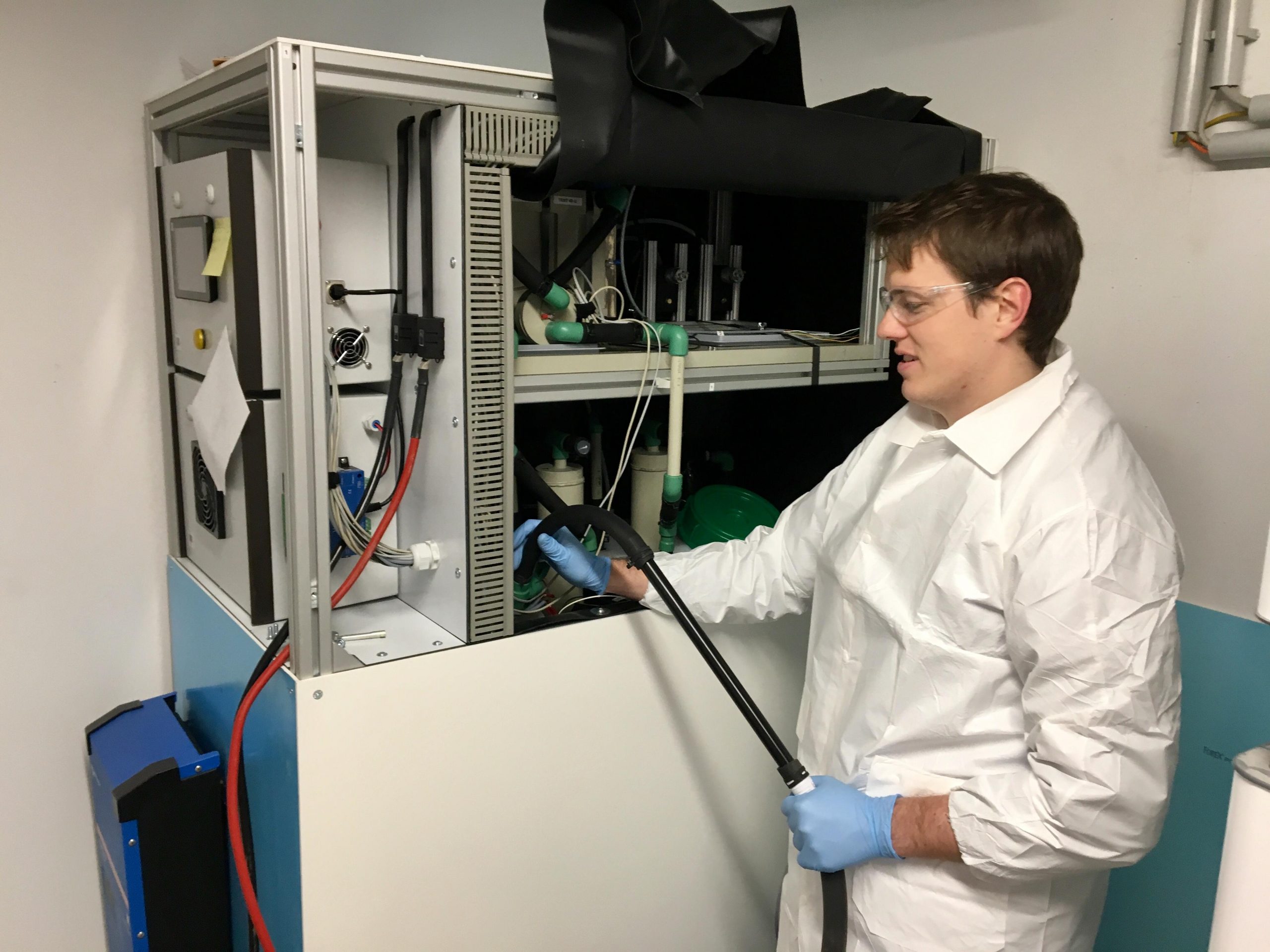
Developer Daniel Manschke from Volterion fills the electrolyte into the battery storage units in the climate quarter of Stadtwerke Herne. Photo: Stadtwerke Herne
Violet, green, blue and yellow - inside the innovative battery storage systems now available in the Climate quarter of the municipal utility company, will be colourful in the future. The electrolyte, which can store up to ten kilowatt hours of self-produced solar power, changes color depending on the state of charge.
Each of the new storage tanks holds 500 litres of the storage liquid. Redox-flow batteries in the cellars of the seven houses. The developers of the Dortmund-based manufacturer Volterion, a spin-off of the Fraunhofer Institute UMSICHT, installed and filled them themselves in Herne. This is because the climate district is an interesting technical demonstration object for them: Up to now, they have only installed battery storage systems in large-scale projects. In the single-family homes in Sodingen, the battery is only about the size of a two-door wardrobe.
Compared to conventional rechargeable batteries Redox-flow batteries are characterized by high operational reliability and extreme durability. Even a complete discharge does not harm them.
"With the battery, our energy concept of solar system and heat pump is now complete," explains Stephan Becker, project manager at the developer Stadtwerke Herne. "The climate quarter is now entering the home stretch." The final inspection with the future residents is scheduled to take place in about two weeks.
In April of last year, the municipal utility company began construction of the seven modern plus-energy houses. The small car-free model settlement combines the latest storage technology with renewable energy generation. The supply concept varies in individual details. With scientific support, the most efficient combination is to be found after the residents have moved in.
The Holzbaunetzwerk München organized a guided tour through the ecological model settlement in Prinz Eugen Park in Munich on 24.05.2019. In 2009, on the initiative of the Green Party, the City Council of the City of Munich decided to build an ecological model settlement with 600 apartments in timber construction in the new district on the site of the former Prinz Eugen barracks in Bogenhausen. Based on the urban design by GSP Architects with Rainer Schmidt Landscape Architects, eight developers, the municipal housing associations GEWOFAG and GWG München, building communities and building cooperatives have developed timber construction projects ranging from atrium houses to seven-storey residential buildings. Today, all projects are under construction and some will be completed this year.
The Holzbaunetzwerk München could welcome about 400 guests. The architects of the model settlement presented their projects to interested visitors, builders, urban planners, timber construction companies, architects, investors and citizens in two parallel guided tours on 24.05.2019 in the course of a tour through the quarter. The various timber construction methods, from pure timber construction to hybrid construction methods with reinforced concrete staircases to reinforced concrete skeleton construction with timber facades, were vividly explained using the projects.
Presented were the projects of the building cooperative WOGENO with the Quartierszentrale by Mr. Florian Lünstedt from the office Atelier 5 Architekten Bern, the GEWOFAG by Jakub Pakula and Eduard Fischer, Pakula & Fischer Architekten Stuttgart, the GWG München by Stefan Rapp, Rapp Architekten Ulm, the building community Team3 by Architekturwerkstatt Vallentin München Dorfen, the building community München GbR by Sibylle Hüther, H2R and PlanZ Architekten from Munich, the Baugemeinschaft Gemeinsam Größer II by Markus Borst, agmm Architekten+Stadtplaner Munich with Hable Architekten, the Baugenossenschaft Bürgerbauverein München eG by Markus Lager, Kaden + Lager Architekten Berlin and the Baugemeinschaft Der kleine Prinz by Ulf Rössler, dressler mayerhofer rössler architekten und stadtplaner GmbH Munich.
Afterwards, at 6 p.m., a panel discussion with the city councillors Ms. Heide Rieke (SPD), Mr. Herbert Danner (Die Grünen), Ms. Ulrike Klar, (City Director, Department of Urban Planning of the City of Munich) and Ms. Gerda Peter (Managing Director of GWG Munich) on the future of timber construction in Munich rounded off the event. It was discussed how the path taken can become a model for further new building areas, what lessons can be learned from the Ecological Model Settlement and how a promotion of timber construction can be designed for the future planning areas of the Bayerkaserne, the urban extensions in the east and north and the redevelopment area of Neuperlach. To this end, the Holzbaunetzwerk München wants to launch the Holzbaustadt München 2030 initiative with at least 2030 residential units in timber construction. How it works could be seen in the Prinz Eugenpark on 24.05.2019.
The Holzbaunetzwerk München was founded in 2018 by Andreas Lerge (Wood Real Estate GmbH) Thomas Kapfer Architekt and Ulf Rössler Architekt (dressler mayerhofer rössler architekten und stadtplaner GmbH). The Holzbaunetzwerk wants to work to connect the stakeholders from politics, administration, planning and business, to engage in the further promotion of timber construction in Munich and to initiate the vision of the timber construction city Munich 2030.
We use cookies to optimize our website and services.
Functional
Always active
Technical storage or access is strictly necessary for the legitimate purpose of enabling the use of a particular service explicitly requested by the subscriber or user or for the sole purpose of carrying out the transmission of a communication over an electronic communications network.
Preferences
The technical storage or access is necessary for the legitimate purpose of storing preferences that have not been requested by the subscriber or user.
Statistics
The technical storage or access, which is solely for statistical purposes.Technical storage or access used solely for anonymous statistical purposes. Without a subpoena, voluntary consent from your Internet service provider, or additional records from third parties, information stored or accessed for this purpose cannot generally be used alone to identify you.
Marketing
Technical storage or access is necessary to create user profiles, to send advertising or to track the user on a website or across multiple websites for similar marketing purposes.