Germany's largest cooperative housing project in Berlin
28:58 Min. Video available until: Dec. 02, 2020. first broadcast on: 2.12.2019
Living in the metropolis, in a large community, according to its own rules. Central, energy-saving, ecological, cosmopolitan, integrative. The residents of Möckernkiez in Berlin-Kreuzberg have fulfilled this dream.
Note from sdg21 editors:
In the documentary you will see
- beautiful aerial views of the residential neighborhood,
- by means of individual portraits, how life is in such a living environment and what the difference is to normal living
- which advantages the car-free mobility concept has
- how the ecological energy concept with solar power and BHKWs works, the energy centre is very impressive!
- how the financing as a housing cooperative works
- what financing problems there were with the large cooperative project
- what it means to implement self-determination in the neighbourhood
- and how the mix of uses was realised
At least 18 million birds die each year from bird strikes on glass. It is more than disconcerting that the 100,000 to 200,000 victims of wind energy are discussed so intensively, but the main causes of bird deaths are not.
"Glass kills non-specifically, i.e. potentially all bird species, because it is obstructed at almost any flight altitude. It kills birds regardless of species, age, sex and time of day. Studies from the USA prove this. Of course, one can say that birds that occur often ("common species") are naturally affected often, birds that occur rarely not so often, but this is only due to the number of birds present. Many bird stations regularly have glass bird strike victims from a wide variety of species: birds of prey, woodpeckers (even very often), songbirds, woodcocks, migratory birds, site-faithful birds... simply everything ... up to a stork where the collision was even observed live," says Dr. Judith Förster, project manager of the BUND NRW project "Avoiding bird strikes on glass".
Two other major causes of bird population decline:
The number of insects has already decreased by up to 80% in some areas of Germany and this of course also has an impact on bird life. Birds such as swallows or swifts live on insects. Insects are particularly important for a large number of small birds in the rearing phase. The massive and alarming global and nationwide insect mortality is depriving (not only) swallows, swifts and bats of their food basis and leading to a massive decline in populations. When an important part of the food base disappears, this has extreme effects on all species at the bottom of the food chain. The lobbyists of the agro-poison industry have a massive (and well-organised) interest in ensuring that this does not become an issue.
The loss of nature and habitats and the increasingly intensive agriculture in the context of globalisation and free trade pose a particular threat to birdlife.
Two studies on renewable energies have announced something this week that concerns everyone. The one in the journal Joule calculates for 139 countries, how the switch to 100 per cent energy from solar, wind and hydropower by the year 2050 could work out.
This would 24 millions more jobs would be created than lost, millions more people would not die every year from air pollution, the earth's atmosphere would no longer be 1,5 degrees Celsius compared to pre-industrial times, an important climate target that the world set itself two years ago in Paris.
And what is standing in the way? The authors see social and political resistance in particular. You could also say that society lacks the willpower. This is also proven by the second studypublished by the journal Nature Energy was presented.
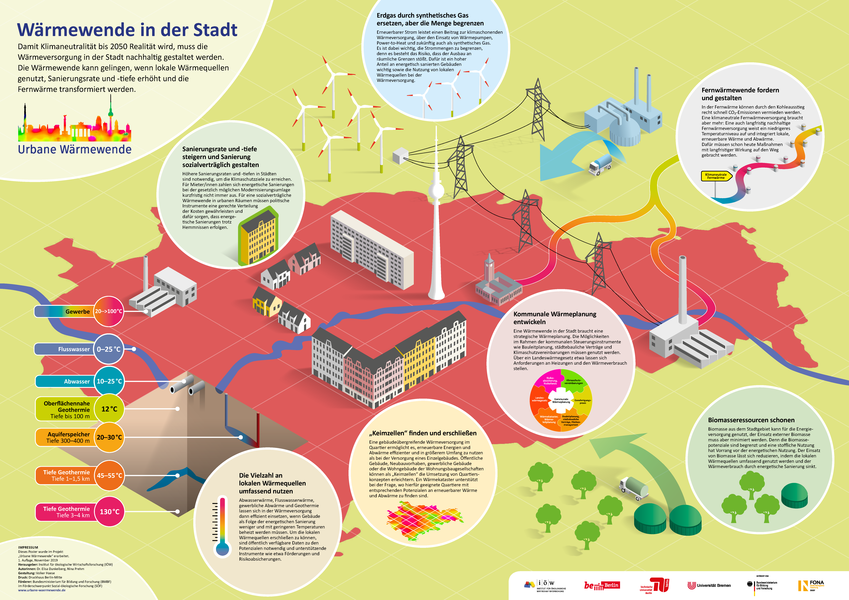
Berlin, 9 January 2020 - One of the Herculean tasks in achieving the climate targets is to radically reduce CO2 emissions from the heating supply. A research group led by the Institute for Ecological Economy Research (IÖW) is showing how cities can move away from coal, oil and gas in a socially responsible way. The "Urban Heat Transition" project analysed possible contributions from renewable energies and local heat sources in Berlin's urban districts. "Waste heat from businesses, heat from waste water or geothermal energy have hardly been utilised to date. The key to such environmentally friendly heat are neighbourhood concepts and heating networks," says project manager Bernd Hirschl from the IÖW. "An important prerequisite is a more efficient building stock. Only if the heat demand is significantly reduced can environmentally friendly heat sources be utilised efficiently."
In the three-year project, the project team from the IÖW, the University of Bremen and the Technical University of Berlin worked together with the Berlin Senate Department for the Environment, Transport and Climate Protection with funding from the Federal Ministry of Education and Research to develop local heating concepts for three Berlin neighbourhoods. At the end of 2019, they discussed their results with the heating industry in Berlin, and the documentation of the conference is now available online at www.urbane-waermewende.de.
Developing nuclei for the heat transition
"Previous neighbourhood concepts were often too complex, had too many different stakeholders and often ended up in a drawer. That's why we recommend a nucleus approach," says Elisa Dunkelberg from the IÖW. These could be public buildings, new construction projects, commercial buildings or housing associations and co-operatives.
The researchers show what a neighbourhood concept can look like for an old building district in Charlottenburg-Wilmersdorf: Firstly, the heat demand must be reduced through energy-efficient refurbishment. The heat can be generated using a wastewater heat pump, which is partly powered by solar electricity generated on site, in combination with combined heat and power generation. "Particularly in the case of public buildings, which have a pioneering role - enshrined in law in Berlin - it should always be checked in the case of refurbishment and new buildings whether they are suitable as a nucleus for a neighbourhood concept and the co-supply of surrounding buildings," emphasises Dunkelberg.
Climate-neutral district heating: utilising waste heat and renewables
District heating plays a major role in urban areas. "To become climate-neutral, it is important to integrate more local heat sources from wastewater, river water and geothermal energy as well as waste heat into district heating," says Hirschl, adding that attention must also be paid to the resilience of the heat generation system. A joint case study with the Neukölln district heating plant shows that it is possible to utilise local heat sources. But it needs to be tested technically and requires supporting financial measures. The next steps should now be test drilling for deep geothermal energy, for example, as well as pilot plants that use large heat pumps to provide wastewater or river water heat for district heating. Strategies for funding and risk protection are needed for investment in these technologies, some of which are untested and highly expensive.
Heat transition requires municipal strategic heat planning - and social compatibility
"Municipal heat planning, which has long been standard practice in pioneering countries such as Denmark and in other federal states and municipalities for some time, helps to tap into the identified potential," emphasises Hirschl. The basis for this is a heat register that visualises heat sources such as waste water and commercial waste heat. This can also be used to identify neighbourhoods for cross-building concepts. With sector coupling, it is also important that local authorities and cities plan across infrastructures. Instruments such as urban land-use planning and urban development contracts must be geared towards climate neutrality.
Low refurbishment rates in recent years show that purely incentive-based measures are not enough to ensure energy modernisation. The researchers therefore recommend implementing the regulations more strongly and developing a step-by-step plan to guide the building stock towards climate neutrality. At the same time, subsidies must be increased and conditions for passing on rent must be made more socially acceptable. A step-by-step plan under the conditions of a rent cap must be designed in such a way that energy modernisation is economically reasonable for both landlords and tenants.
Federal Ministry of Education and Research funds "Urban Heat Transition" project for another two years
The Federal Ministry of Education and Research is funding the project in a new partner constellation for a further two years in order to test solution strategies for the central obstacles to implementation and to anchor the research results in municipal heat planning. In addition to the IÖW, the partners are Berliner Wasserbetriebe and the law firm Becker Büttner Held.
State Secretary of Finance Dr Silke Schneider: "The Competence Centre is an important partner for districts and municipalities in sustainable procurement".
State Secretary for the Environment Dr Dorit Kuhnt: "With this service offer for municipalities, the state is creating the best conditions for a more sustainable administration at all levels."
Since 17 December 2019, the "Competence Centre for Sustainable Procurement and Awarding" (KNBV) has been supporting municipalities and other public administration bodies in Schleswig-Holstein in taking sustainability into account. The tasks range from paperless procurement processes and PVC-free office supplies to electric service vehicles including a charging station concept or sustainable services such as plastic-free, fair and regional catering. The KNBV provides advice, information and support on all questions relating to these processes, products or committee and public relations work. Interested municipalities and other public administration bodies will find competent answers for concrete projects as well as a wide range of training courses and events.
State Secretary for Finance Dr. Silke Schneider explained: "Especially in public administration, resource protection and sustainability play a central role. In this respect, the Competence Centre is an important partner for the municipalities. In this centre, we bundle expertise and practical support in the challenge of procuring sustainable products economically as well."
State Secretary for the Environment Dr. Dorit Kuhnt said: "The federal and state governments are committed to the Global Sustainability Goals. In this context, the state is creating the best conditions for a more sustainable administration at all levels with this service offer for municipalities. In doing so, the competence centre is intended to make it easier for those responsible to be transparent and thus make better decisions."
In future, the tasks of the KNBV will include a.o.:
Product-related advice on specific procurement measures as well as on profitability calculations in the context of sustainable procurement and as preparation for committee decisions
News and tips on sustainable procurement
Market survey on sustainable products and services
Operation of a joint website as a "networking platform" for all participating agencies, including contact form, "suggestion box" and calendar of events for sustainable issues and further training opportunities.
Specifications on sustainable products
Also:
Planning and implementation of joint actions and information events
Further development of overarching "sustainability standards" of the Land and municipalities, together with interested departments, especially in districts and cities
Focus topics such as e.g. "e-Mobility in (small) municipalities".
Publications in the media of the municipal state associations
Maintaining contacts with NGOs and business organisations (IHK, HWK, etc.)
The competence centre, based in Kiel, is initially limited until the end of 2021.
Further information www.knbv.de
We use cookies to optimize our website and services.
Functional
Always active
Technical storage or access is strictly necessary for the legitimate purpose of enabling the use of a particular service explicitly requested by the subscriber or user or for the sole purpose of carrying out the transmission of a communication over an electronic communications network.
Preferences
The technical storage or access is necessary for the legitimate purpose of storing preferences that have not been requested by the subscriber or user.
Statistics
The technical storage or access, which is solely for statistical purposes.Technical storage or access used solely for anonymous statistical purposes. Without a subpoena, voluntary consent from your Internet service provider, or additional records from third parties, information stored or accessed for this purpose cannot generally be used alone to identify you.
Marketing
Technical storage or access is necessary to create user profiles, to send advertising or to track the user on a website or across multiple websites for similar marketing purposes.