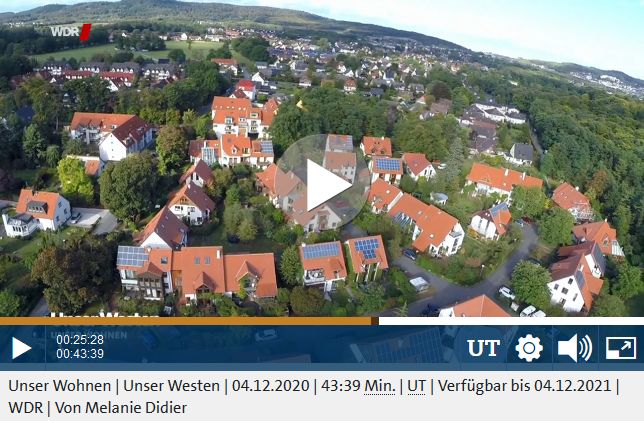
WDR documentary (2020) about the Waldquelle eco-settlement
Published
Our home. Our West. Broadcast from 7.2.2020
43:39 Min Available until 07.02.2021
WDR. By Melanie Didier
From minute 25 to 29:50 the ecological settlement Waldquelle in Bielefeld is shown. Ute Möller, one of the founders, leads a tour through the ecological settlement and reports on the experiences and developments in the now almost 25-year-old settlement with lots of wood, greenery and solar cells on the roof.
12/2013: Specialist advice on timber construction
The specialist timber construction advice service of the INFORMATIONSDIENST HOLZ provides individual and company-neutral assistance in planning and building with timber - from fundamental questions in building design to details in execution. These can be technical properties of building products, building law issues, design and structural issues or building physics contexts.
Architects and engineers, public and private building decision-makers, students and teachers as well as media representatives can obtain qualified and unbureaucratic information from experts whose knowledge is up to date.
Project outlines, especially for public buildings, municipal properties and urban districts, can be submitted until 29 July as part of the new funding initiative "Solar Building & Energy Efficient City".
The funding announcement "Solar Construction/Energy Efficient City" can be downloaded from the press page of the Federal Ministry of Economics and Technology.
Further information
EnEff.Gebäude.2050 funding initiative
Information from the project management organisation Jülich with contact persons and information on funding www.ptj.de/eneff-gebaeude-2050
Research initiative EnOB - Research for energy-optimised construction www.enob.info
Research initiatives EnEff:Stadt - Research for the energy-efficient city and EnEff:Wärme - Research for energy-efficient heating and cooling networks
www.eneff-stadt.info
The animation was created for the Viennese initiative @platzfuerwien to support them in their commitment to an environmentally friendly and people-friendly city.
Parliamentary State Secretary Rita Schwarzelühr-Sutter of the BMUB (3rd from left) hands over the grant notification for 10.4 million euros to SWLB. On the photo: Ursula Keck (Deputy Chairman of the Supervisory Board of SWLB and Mayor of Kornwestheim, left), Werner Spec (Chairman of the Supervisory Board of SWLB and Mayor of the City of Ludwigsburg, 2nd from left), Managing Director of SWLB, Bodo Skaletz (3rd from right), Steffen Bilger (Member of the Bundestag, 2nd from right), Jürgen Walter (Member of the Bundestag, right).
Stadtwerke Ludwigsburg-Kornwestheim is building one of the largest solar thermal plants in Germany with a collector area of over 10,000 m². The way is clear for another forward-looking project in Ludwigsburg: Stadtwerke Ludwigsburg-Kornwestheim GmbH (SWLB) has won the funding call for municipal climate protection model projects as part of the national climate protection initiative of the Federal Ministry for the Environment, Nature Conservation, Building and Nuclear Safety in Berlin.
Their funding application for the SolarHeatGrid model project for the 'construction and connection of one of the largest solar thermal plants in Germany to an optimised heating network', in which the City of Ludwigsburg is involved as a cooperation partner, was approved. The official handover of the Municipal Climate Protection Model Project grant to Bodo Skaletz, Managing Director of SWLB, took place on 12 May 2017 by Rita Schwarzelühr-Sutter, Parliamentary State Secretary of the Federal Ministry for the Environment, Nature Conservation, Building and Nuclear Safety, in the presence of the Lord Mayor of the City of Ludwigsburg and Chairman of the Supervisory Board of SWLB, Werner Spec, and the Lord Mayor of the City of Kornwestheim and Deputy Chairman of the Supervisory Board of Stadtwerke.
"In terms of the amount of funding, our solar thermal project is the front-runner in the ranking of the seven projects that were also approved. The federal government is contributing 10.4 million euros to the realisation of Ludwigsburg's large-scale project, which should inspire imitation throughout Germany," says a delighted Bodo Skaletz, Managing Director of SWLB.
"This renewal of the district heating network with solar heat is particularly forward-looking with regard to the feasibility of municipal heat supply with renewable energies. Swapping fossil for renewable - it works. I congratulate Ludwigsburg on this major high-tech piece of the puzzle, also in terms of CO2 savings and improved energy efficiency," confirms Parliamentary State Secretary Rita Schwarzelühr-Sutter.
"The 'SolarHeatGrid' is an important building block in the implementation of our overall energy concept for Ludwigsburg," explains Mayor Werner Spec. "We are thus significantly expanding our heat supply on a renewable basis and linking it across municipal boundaries. This is entirely in the spirit of sustainable settlement development: as cities, we must continue to commit ourselves locally with all our strength to environmental and climate protection."
The official start of this lighthouse project is 1 June 2017. The model project is scheduled to take a total of three years. As part of the project, the existing Ludwigsburg district heating network, which already provides heat for large parts of the city using mainly renewable raw materials, will be merged with the Rotbäumlesfeld, Technische Dienste Ludwigsburg (Gänsfußallee 21) and Kornwestheim-Nord networks, which are currently still supplied with fossil fuels. The construction of the solar thermal plant in connection with a large heat storage tank, which is to be built at the location of the CHP plant, will additionally feed high-quality, regeneratively generated heat into the expanded interconnected grid. This will further increase the amount of heat from renewable energies. With the help of the heat storage facility, the energy generated will also be available when there is little or no solar radiation.
The base load heat of the fossil-fuelled heating centres of the individual grids can thus be replaced by the largely regeneratively generated heat of the expanded interconnected grid. Approximately five kilometres of new district heating pipes will be laid over the next three years to connect the solar thermal system and the interconnected grid. In addition to the CO2 savings that will be achieved through the growing share of renewable energies in the expanded district heating network, the declared goal of the large-scale project is to increase energy efficiency. "In order to ensure that energy is used as efficiently as possible, it is not only the heat generation and distribution by SWLB that is decisive, but also the consumer side," Skaletz explains and adds: "As part of the network interconnection, measures are therefore to be implemented to reduce the so-called return temperatures, on which the performance of our district heating network depends to a large extent."
SWLB submitted the funding application in November 2016. The project aims to increase the share of renewable energies in the district heating network and to actively promote local climate protection and the energy transition at the local level by reducing CO2 emissions. More information on the municipal climate protection model project at: www.swlb.de/solar-heat-grid
PM of the Stadtwerke Ludwigsburg-Kornwestheim from 12.05.2017
We use cookies to optimize our website and services.
Functional
Always active
Technical storage or access is strictly necessary for the legitimate purpose of enabling the use of a particular service explicitly requested by the subscriber or user or for the sole purpose of carrying out the transmission of a communication over an electronic communications network.
Preferences
The technical storage or access is necessary for the legitimate purpose of storing preferences that have not been requested by the subscriber or user.
Statistics
The technical storage or access, which is solely for statistical purposes.Technical storage or access used solely for anonymous statistical purposes. Without a subpoena, voluntary consent from your Internet service provider, or additional records from third parties, information stored or accessed for this purpose cannot generally be used alone to identify you.
Marketing
Technical storage or access is necessary to create user profiles, to send advertising or to track the user on a website or across multiple websites for similar marketing purposes.

 12/2013: Specialist advice on timber construction