2 min, post from September 15, 2020
Tim is a photographer, father of Liam and rides his cargo bike all over Graz.
Keywords: Car Free, Bike-/Velo-City, Movies, Movies < 4 Min, Mobility, News Blog Austria, Sufficiency

2 min, post from September 15, 2020
Tim is a photographer, father of Liam and rides his cargo bike all over Graz.
CO2-Emissions should be reduced by 65 percent over the next ten years compared to 1990 in order to achieve climate neutrality - Energy system must be converted to 100 percent renewable energies by 2040 - Investment of 3,000 billion euros required to meet European Green Deal and Paris climate targets - German EU Council Presidency can ensure that Corona aid packages link economic stimulus with climate protection
The European Green Deal sets the bar very high: Europe is to become climate neutral by 2050. However, these targets can only be achieved if CO2-emissions by 2030 not only by 40 percent compared to 1990, but by 65 percent. To achieve this, energy production would have to be completely converted to renewable energies by 2040. The necessary investments are high, but they will pay off. These are the most important results of a new study by the German Institute for Economic Research (DIW Berlin). On the occasion of the German EU Council Presidency, the economists from DIW Berlin and the Technical University of Berlin involved in the study have calculated under which circumstances the goals of the European Green Deal could be achieved and what costs this would entail. "So far, the EU Commission has assumed a CO2-reduction target of 40 percent. But this will not make Europe climate-neutral by 2050, as our calculations show. The targets must be much more ambitious," says study author Claudia Kemfert.
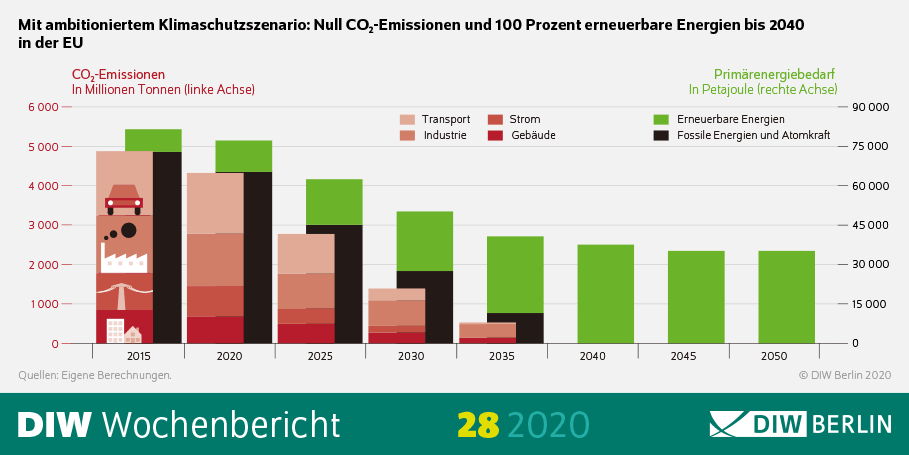
The authors have therefore compared a baseline scenario of 40 percent with a climate protection scenario that assumes a CO2-reduction of 65 percent by 2030 compared to 1990, as demanded by some groups in the EU Parliament. In fact, the calculations show that under these circumstances, the climate neutrality targeted in the Green Deal could be achieved. "However, this is only possible if we switch our energy system to 100 percent renewables - and do so already by 2040," says study author Karlo Hainsch. Even with a complete switch to renewables, the energy supply would remain secure, as the study's hourly calculations show - even for countries that still rely heavily on fossil or nuclear energy, such as Poland and France.
"The German EU presidency could kill two birds with one stone: economic recovery and climate protection." Christian von Hirschhausen
Such a scenario would save around 60 billion tonnes of CO2. "However, a switch to 100 percent renewable energy cannot be had for free. Extensive investments will have to be made," says study author Leonard Göke. According to the calculations, the investment required for renewable energies amounts to around 3000 billion euros. This is an enormous amount, but it is offset by savings of almost 2000 billion euros alone, which would no longer have to be spent on importing fossil fuels. Since both the EU and most national governments in Europe have put together extensive aid packages because of the Corona crisis, these could form a good basis for supporting the necessary investments.
"The German EU Presidency could kill two birds with one stone: economic recovery and climate protection," says study author Christian von Hirschhausen. "To do so, it must ensure that the extensive stimulus packages under the European Green Deal are used for investments in renewable energies and energy efficiency." In addition, there is still the Just Transition Fund, which the EU has set up to provide financial support for structural change in the regions of Europe that are affected very differently by the measures. "Particular care must be taken to ensure that the funds are channelled into sustainable climate-neutral projects and not used for the de facto stabilisation of fossil fuel development paths," warns study author Pao-Yu Oei. The current economic crisis, which is setting new parameters worldwide and across sectors, could now be used to decisively tackle the necessary measures towards climate neutrality.
Source: DIW press release of July 8, 2020
Keywords:
Renewable, Funding, Climate protection, Mobility, Sustainable management, News Blog Europe (without DE), Resource efficiency, Transition Town, Environmental policy
12/2009: TU Darmstadt holt zum 2. mal SolarDecathlon-Preis www.solardecathlon.tu-darmstadt.de
11/2009: neues Buch über Grüne Häuser von Manfred Hegger und Isabell Schäfer erschienen
10/2009: Nicht nur für Gutmenschen. Beitrag von Yvonne von Hunnius, St. Gallen www.nachhaltigkeit.org/…
9/2009: Ausstellung „Bauen mit nachwachsenden Rohstoffen“ auf Deutschlandtour www.bau-natour.de
8/2009: NABU-Projekt StadtKlimaWandel
Der NABU-Bundesverband führt seit April 2009 ein von BMU und UBA gefördertes Projekt mit dem Titel StadtKlimaWandel durch. Auf der Homepage www.stadtklimawandel.de werden Initiativen und Maßnahmen zur Verbesserung des StadtKlimas vorgestellt sowie Hintergründe dazu erläutert.
www.stadtklimawandel.de
7/2009: Neues Buch zur Geschichte des ökologischen Bauens erschienen: Peter Steiger (2009): Chancen und Widerstände auf dem Weg zum nachhaltigen Planen und Bauen
6/2009: ENERGYMAP der DGS – aktuelle Zahlen zur Energiewende
Die Energiewende ist im vollen Gange, die EnergyMap der DGS zeigt, wie nahe wir dem Ziel von 100% Erneuerbaren Energien bereits gekommen sind.
www.energymap.info
5/2009: Holzzuwachs veranschaulichen: die Holzuwachsuhr zeigt an wie viel Kubikmeter Holz in Deutschland oder eines seiner Bundesländer je Sekunde nachwächst und je nach Einstellung, wieviele Holzhäuser daraus gebaut werden können
www.infoholz.de => Holz-Uhr
4/2009: Nachhaltig Bauen: seit April ist die neue sachsenweite Informationskampagne „Mach mit. Bau nachhaltig“ gestartet. Das auf drei Jahre angelegte Programm richtet sich an alle Bauherren, Hauseigentümer und Wohnungsunternehmen
www.bau-nachhaltig.de
3/2009: „Bauen ohne Dämmung“. Kurzfilm über die Einfachheit der Kybernetikhäuser von Professor Günther Pfeifer und Professor Christoph Kuhn
» architekturclips.de
2/2009: neue Bilder und ein Kurzfilm über den Bauablauf des derzeit weltweit höchsten Holzhauses, dem 9-geschossige Wohnturm Murray Grove timber tower in London mit 8 Geschossen in Holzbauweise gibts unter:
» waughthistleton.com
1/2009: Der größte Stadtteil in achtgeschossiger Holzbauweise mit 2.000 WE entsteht derzeit im schedischen Växjö
» zu den Fotogalerien
Keywords:
DE-News
Funding is available for greening facades and roofs and for unsealing on private, public (with the exception of municipal) and commercial properties in the Hannover urban area.
Keywords:
Greening / climate adaptation, Procurement, Soil & land consumption, Funding, Near-natural open space design, News Blog Lower Saxony, Quarters, Settlements, City
"Every year, 1.2 million people die in road accidents worldwide. This makes car accidents the ninth most common cause of death overall."
The contribution from Anna Bezrogova from 11 August 2016 read on goodimpact.org/magazin/null-toleranz-f%C3%BCr-den-tod-im-auto (Article is no longer online)
Keywords:
Bike-/Velo-City, Mobility, Quarters, Environmental policy, Ecology