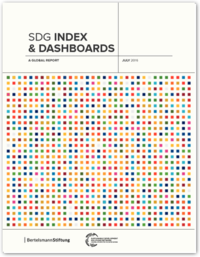
According to a new study, the world is still a long way from achieving the United Nations' Sustainable Development Goals. Sweden is in the best position, according to the report published by the Bertelsmann Stiftung and others. The study compared 149 countries. Sweden is closest to the goals, followed by Denmark and Norway. Germany came in sixth place. The UN Sustainable Development Goals are intended to help combat extreme poverty, climate change and discrimination by 2030.
The study was produced in collaboration with the renowned economist and UN special advisor Jeffrey Sachs and the United Nations Sustainable Development Solutions Network (SDSN). It was presented at a United Nations sustainability conference in New York on 20 July and handed over to UN Secretary-General Ban Ki-moon.
"I am certain that the SDG Index from SDSN and the Bertelsmann Stiftung will make a valuable contribution to making the world a more peaceful, just and sustainable place."
33 architectural firms from Germany, the Netherlands and Switzerland, among others, have presented the design for WerkBundStadt Berlin. Around 1,100 new apartments are to be built in 38 buildings on 2.8 hectares of land. A critique of the project in the deutsche bauzeitung (db) reminds readers of the historical heritage in which the project stands: "It is laudable that the Deutscher Werkbund is speaking out with a contribution. After all, it is precisely the Werkbund housing estates from Stuttgart to Breslau, Prague, Vienna and Zurich that stand for the experimental living worlds of modernism. It was about housing for the subsistence level, small apartments, variable floor plans, new building materials and prefabrication, and last but not least about the coexistence of generations and society." The WerkBundStadt is quite clearly a break in content from the previous less dense WerkBundSiedlungen and for this reason alone an important statement, particularly with regard to the mix of uses and building density. Nevertheless, the designs are not very innovative in terms of sustainability. Unfortunately, the designers make it too easy for themselves by treating the issue solely with the concept of natural ventilation and a high building density. In this way, the WerkBundStadt falls far behind the standards developed in recent decades for sustainable housing. If this building exhibition is to have any charisma, if it is to communicate groundbreaking transferable concepts, then many of the themes of sustainable urban development and housing are missing. If the WerkBundStadt remains as it is at present, the building exhibition would probably become an interesting collection of contemporary architectural sculptures on an urbanistic scale, but it would lack central themes of the 21st century!
In the past decades, resolutions towards sustainable development have been repeatedly made the subject of discussion and politically adopted, also by the worldwide architecture and urban planning associations. In 2003, it was the "New Athens Charter. Vision for the Cities of the 21st Century." by the European council of town planners. And in 2007 the "Leipzig Charter on Sustainable European Cities".
In terms of world politics, the most recent three agreements should be mentioned:
2015 the UN World Summit on Sustainable Development in New York and the adoption of the SDGs 2030
2016 Paris Climate Conference
and also in 2016 the world settlement conference Habitat III in Quito (New urban agenda).
These agreements clearly state that the sustainable conversion/design of existing and new settlements and neighbourhoods will play a central role in achieving the agreed policy objectives.
BN - Is the roof of my house or company building suitable for a photovoltaic system or a solar thermal system? This question can now be answered quickly and conveniently online with the help of the new solar roof cadastre of the city of Bonn. In a building-specific map display, a coloured marker indicates whether and to what extent a roof is suitable for energy generation by means of solar power. Step by step, further information, for example on the economic efficiency, can be retrieved via a yield calculator.
The suitability of the roofs of all 129,000 buildings in the city for solar energy generation was recalculated using the latest, improved data. For this purpose, elevation grid data was used, which was determined by the district government of Cologne by means of laser scanning in spring 2016. Compared to the previous version from 2010, the new Bonn solar roof cadastre features, among other things, a fourfold higher resolution and a more differentiated designation of the roof areas.
The suitability of the roof surfaces for electricity generation via photovoltaic systems as well as for domestic water heating and, for the first time, also for supporting building heating via solar thermal collectors was calculated. The calculations also took into account the current changes in the framework conditions with regard to feed-in tariffs and self-consumption of generated solar power.
How the application works
In the city map, the installable system size and many additional data such as yields and savings potentials can be displayed for each building. In a newly developed yield calculator, costs and yields can be calculated and compared by entering additional user-specific information such as electricity consumption or household size. In this way, every owner can quickly gain an overview of the suitability of his or her building for the use of solar energy. Detailed instructions are available at www.bonn.de/...solardachkataster.php.
The City of Bonn points out that the information from the solar roof cadastre is an initial non-binding assessment. Essential prerequisites for a decision to build a system, such as the condition of the roof or the static suitability, can only be clarified by suitable specialist companies or qualified consulting organisations. Information on this can be found on the website of the solar roof register.
Bonn roofs have potential
According to the potential analysis of the solar roof cadastre, 6,800,000 square metres in Bonn are suitable for solar power generation. This corresponds to about the size of 950 football fields. Approximately 800,000 megawatt hours of electricity could be generated on this area. This could cover about 50 percent of the total electricity consumption in Bonn. For solar thermal energy, the result of the potential analysis shows 88,461 buildings in Bonn that could be used for this form of energy generation. This corresponds to about 70 percent of the buildings in Bonn.
Photovoltaic systems are already a financially rewarding investment for homeowners today. Coupled with a solar power storage system, the profit will increase even more in the future. This is because storage systems are on the verge of becoming economically viable. This is the result of calculations by the Solar Cluster Baden-Württemberg.
The limit is 1000 euros/kWh
In the last twelve months, the costs for storage batteries for PV systems have fallen by an average of more than 10 %. "In the first quarter of 2017, they were in some cases only around 1150 euros per kWh of storage capacity," says Carsten Tschamber from Solar Cluster. The limit below which the small storage systems bring in more than they cost when used for 20 years is around 1000 euros, assuming a small increase in electricity prices. If you subtract the KfW subsidy, which decreases every six months, the first storage products already reach economic viability with good planning. By the end of the subsidy in 2018, the batteries could become up to 20 % cheaper - a purchase would then be worthwhile for the consumer even without government subsidies.
The cost of solar electricity from new PV systems on residential buildings has now fallen to as low as 8 Ct/kWh - household customers pay more than three times that for grid electricity. That is why it is worthwhile for them to consume as much of it as possible themselves. Solar batteries help to double self-consumption from 30 to 35 to up to 70 %.
Source: Post from 23.5.2017 on www.geb-info.de (no longer online, as of January 2021)
We use cookies to optimize our website and services.
Functional
Always active
Technical storage or access is strictly necessary for the legitimate purpose of enabling the use of a particular service explicitly requested by the subscriber or user or for the sole purpose of carrying out the transmission of a communication over an electronic communications network.
Preferences
The technical storage or access is necessary for the legitimate purpose of storing preferences that have not been requested by the subscriber or user.
Statistics
The technical storage or access, which is solely for statistical purposes.Technical storage or access used solely for anonymous statistical purposes. Without a subpoena, voluntary consent from your Internet service provider, or additional records from third parties, information stored or accessed for this purpose cannot generally be used alone to identify you.
Marketing
Technical storage or access is necessary to create user profiles, to send advertising or to track the user on a website or across multiple websites for similar marketing purposes.
 According to a new study, the world is still a long way from achieving the United Nations' Sustainable Development Goals. Sweden is in the best position, according to the report published by the Bertelsmann Stiftung and others. The study compared 149 countries. Sweden is closest to the goals, followed by Denmark and Norway. Germany came in sixth place. The UN Sustainable Development Goals are intended to help combat extreme poverty, climate change and discrimination by 2030.