Book review "Wohnquartier in Holz - Mustersiedlung in München" DBU Bauband 4
Published
Publisher: German Federal Foundation for the Environment / Sabine Djahanschah
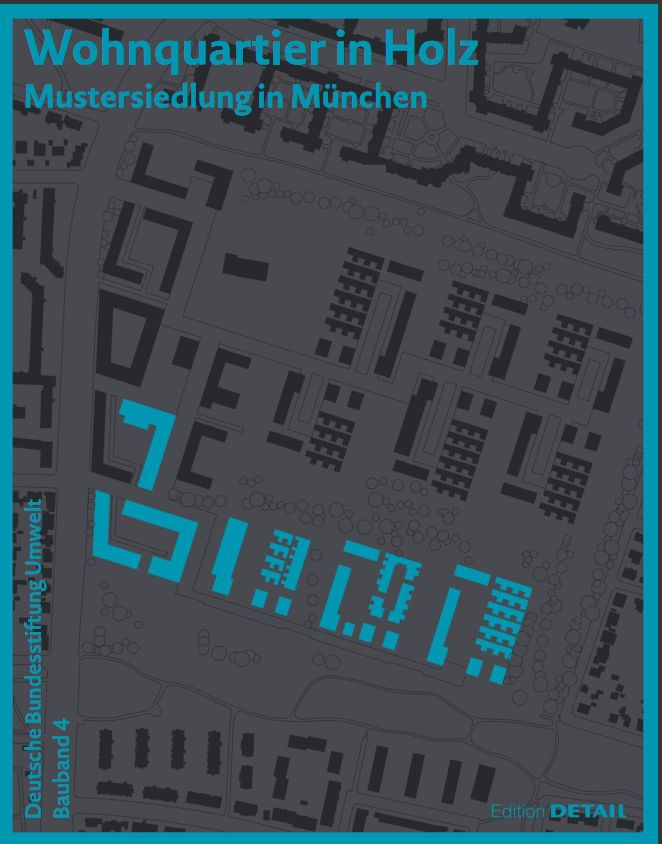
The ecological model settlement "Prince Eugene Park"on a former barracks site in Munich sets new standards in timber construction. Various timber construction methods and building types up to seven storeys are being tested side by side in eight building projects with the aim of a final scientific evaluation. Timber frame, timber frame and timber hybrid construction methods are being used.
Close cooperation with the Deutsche Bundesstiftung Umwelt (DBU) and research commissions from the Ruhr Universität Bochum (RUB) and the Technische Universität München (TUM) ensure a sound evaluation of the monitoring accompanying construction. Beyond the realization of living space, the project makes an active contribution to climate protection and sustainable urban development.
Embedded in the surrounding parkland, the new quarter will also offer an attractive range of social, cultural and commercial infrastructure. Building volume 4 presents the eight building types and examines the potential of the different construction methods in detail.
Authors: Zeno Dietrich, Sabine Djahanschah, Annette Hafner, Wolfgang Huß, Ulrike Klar, Wolf Opitsch, Arnim Seidel and Michael Storck
First edition: 2020 Format: 112 Pages, German, 21 x 27 cm, Swiss brochure Publisher: Detail Business Information GmbH, Munich
Thuringia is making six million euros available this year for investments in municipal climate protection. The funding comes from the state's "Climate Invest" program, which has already kick-started more than 15.5 million euros in investments in municipalities since the start of 2018, the Environment Ministry announced in Erfurt on Thursday. 312 funding applications have been approved.
At the same time, Siegesmund encouraged Thuringian municipalities to take part in the nationwide "Climate Active Municipality 2020" competition. The Federal Ministry for the Environment has started a new round in the competition of ideas for climate protection. Cities, counties and municipalities are called upon to submit exemplary ideas. Prize money totalling 25,000 euros awaits the winners.
"What is that actually, "the good life"? On 27 February 2017, sociologist Hartmut Rosa spoke about growth constraints, alienation and the moment of unavailability as a condition of resonance."
21.01.2020 Everyone is talking about sustainability - including the construction industry. A prize that the Federal Ministry for the Environment, Nature Conservation and Nuclear Safety (BMU) and the Federal Environment Agency (UBA) have been organising since today provides the perfect talking point: With the new "Federal Environment and Building Prize", which will be awarded for the first time in 2020, the initiators want to recognise projects that are exemplary in terms of sustainability - not only in the classic areas of existing and new buildings, but also in five other categories. All players in the construction sector can apply. The closing date for entries is 15 April 2020 and the patron of the competition is the Federal Minister for the Environment, Nature Conservation and Nuclear Safety, Svenja Schulze.
The desire of more and more building owners and planners to combine high utility value and architectural quality with Climate - and environmental protection has resulted in many exciting projects. They demonstrate by practical example that sustainable construction offers many advantages over the life cycle - also in terms of costs.
Federal Environment Minister Svenja Schulze: "This is precisely where the Federal Environment and Building Award comes in. On the one hand, the prize is intended to illustrate the spectrum of what is already structurally and technically possible today. On the other hand, it is intended to raise awareness of the outstanding examples through the award and thus invite imitation."
Professor Dirk Messner, President of the Federal Environment Agency: "It's about holistic solutions that incorporate the technology, the design of the building and its surroundings. Individual 'greenfield' projects are expressly not supported. In no other competition is the interplay between the environment and building assessed in such a way as in the Federal Environment & Building Award."
About the Federal AwardIn order to show the breadth of sustainable building, the Federal Award comprises the categories "Residential buildings", "Non-residential buildings", "Neighbourhoods" and "Sustainability and innovations". The first two categories focus in particular on the energy-efficient refurbishment of existing buildings, as this is where the greatest need for action exists from a climate protection perspective.
In addition to these competition categories, the BMU and UBA also award three special prizes for particularly innovative approaches. Under the headings "Resilience" and "Sufficiency", the focus is on adaptation to climate change and strategies for reducing the use of resources. Building projects that take particular account of aspects of biodiversity and thus make a substantial contribution to the protection and implementation of "urban nature" are also to be honoured. The third field "Building envelope & building product" is intended for novel solutions with innovative materials and building constructions.
Conditions of participationDue to the thematic breadth, all players in the construction sector are invited to apply: from clients and property developers to architecture, building services, urban and landscape planning offices, manufacturers and research institutions. The competition is aimed at buildings or neighbourhoods completed in Germany that are at an advanced stage of planning; multiple applications in different categories are possible.
What awaits the winnersThe award winners can look forward to public recognition on several levels. The award ceremony will take place on 29 September at a congress on sustainable building at the Federal Ministry for the Environment, Nature Conservation and Nuclear Safety in Berlin, where the award-winning projects will be presented to experts and the media. The award-winning projects and their plus points will also be presented on the websites of the UBA and the Federal Ministry for the Environment - including in the form of videos: This is because the UBA is having films made about the award-winning sustainability examples, which the winners can then use for their own public relations work. In addition, all award-winning projects will be documented in a book.
Interested parties can find more information on the conditions of participation in the Federal Environment & Building Award and the selection procedure on the UBA website: www.umweltbundesamt.de/bundespreis-umwelt-bauen-start
We use cookies to optimize our website and services.
Functional
Always active
Technical storage or access is strictly necessary for the legitimate purpose of enabling the use of a particular service explicitly requested by the subscriber or user or for the sole purpose of carrying out the transmission of a communication over an electronic communications network.
Preferences
The technical storage or access is necessary for the legitimate purpose of storing preferences that have not been requested by the subscriber or user.
Statistics
The technical storage or access, which is solely for statistical purposes.Technical storage or access used solely for anonymous statistical purposes. Without a subpoena, voluntary consent from your Internet service provider, or additional records from third parties, information stored or accessed for this purpose cannot generally be used alone to identify you.
Marketing
Technical storage or access is necessary to create user profiles, to send advertising or to track the user on a website or across multiple websites for similar marketing purposes.
 The ecological model settlement "Prince Eugene Park"on a former barracks site in Munich sets new standards in timber construction. Various timber construction methods and building types up to seven storeys are being tested side by side in eight building projects with the aim of a final scientific evaluation. Timber frame, timber frame and timber hybrid construction methods are being used.