3:42 min, 06/23/2015, Ed: Munich Press Office
Project Info: http://sdg21.eu/db/muenchen-freiham
Keywords: DE-News, Movies, Movies < 4 Min, News Blog Bavaria, Housing policy

3:42 min, 06/23/2015, Ed: Munich Press Office
Project Info: http://sdg21.eu/db/muenchen-freiham
12:56 min, from 11/5/2020
Keywords:
Construction and operating costs, Building materials / Construction, DE-News, Movies, Movies 11 to 45 Min, Wood construction, NaWaRohs, Economics
The 88th Conference of Environment Ministers has just passed a resolution in Bad Saarow on the "Promotion of Building with Wood", which was introduced by Rhineland-Palatinate. The document calls on the federal government to improve the framework conditions for timber construction. The German Timber Industry Council e. V. (DHWR) expressly welcomes this initiative.
According to the Rhineland-Palatinate Minister of the Environment, the positive climate protection properties of renewable raw materials are to be taken into account in building energy law, among other things.
This would be more than desirable, because the draft bill for the Building Energy Act (GEG) recently presented by the Federal Ministry for the Environment, Nature Conservation, Building and Nuclear Safety (BMUB) missed the opportunity to finally take the entire life cycle of buildings into account in the amendment.
In the manufacturing, recycling and disposal process of certain building materials, a large amount of CO2 is released - often more than is consumed in the entire use. In terms of climate policy, it is therefore incomprehensible that this is neither taken into account in the draft Building Energy Act, nor in the energy balance of the building according to the Thermal Insulation Ordinance, nor in the preparation of the energy certificate.
"The Federal Government and the Länder have an equal role to play in sustainable management and the future-oriented use of resources. We see the current resolution of the Conference of Environment Ministers as an important step in the right direction - this should serve as a signpost for both the current and the future federal government."
Read more:
Source PM Deutscher Holzwirtschaftsrat DHWR (5.5.2017):
www.dhwr.de/presse_pressemitteilungen.php?id=519
Keywords:
Stakeholders, Greening / climate adaptation, DE-News, Wood construction, Climate protection, Environmental policy, Ecology
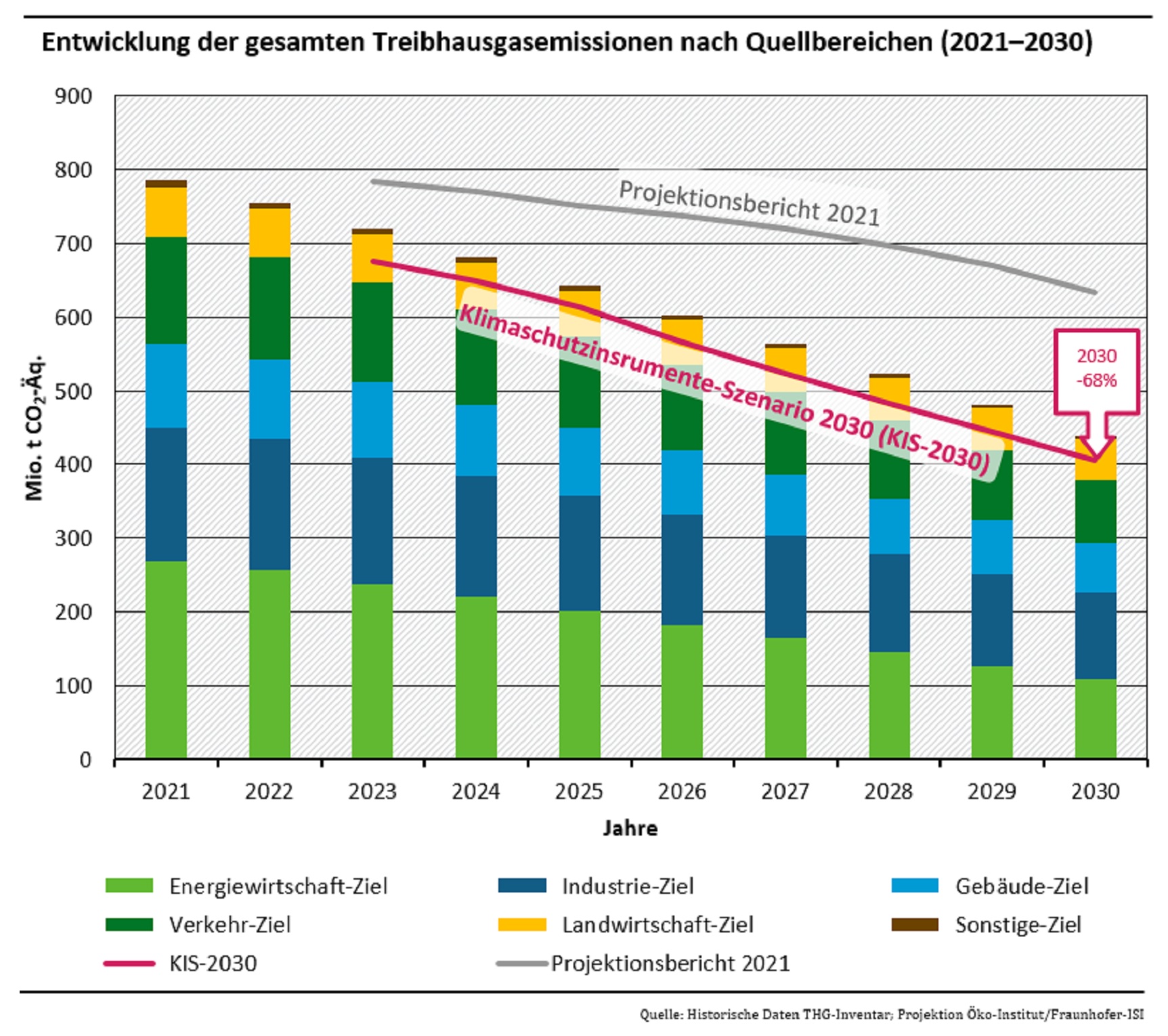 Germany can still achieve its climate targets by 2030. This is shown in a new analysis by the Federal Environment Agency (UBA). This would require, among other things, more rail transport, a reform of the motor vehicle tax and the restriction of fossil heating. In addition, all emissions would have to be priced and charged to the polluter. In the so-called Climate Protection Instruments Scenario 2030 (KIS-2030), the UBA has examined how additional emissions can be saved in the building, mobility, energy and industry sectors. "The model calculation clearly shows that we have a lot of catching up to do in some sectors," says UBA President Dirk Messner. "We now urgently need a constructive dialogue about where emissions can be reduced, otherwise we will miss the legal savings targets. We also need to talk honestly about how to cushion the financial burden on lower-income groups and distribute it more fairly. Currently, low-income households are often asked to pay disproportionately. Understandably, this does not exactly increase acceptance for more climate protection.
The German Climate Protection Act (KSG) provides for a 65 per cent reduction in climate-damaging emissions by 2030 compared to 1990. By 2040, emissions are to be reduced by 88 percent and net greenhouse gas neutrality is to be achieved in 2045. To this end, the KSG sets annual reduction targets by 2030 for the individual sectors. The latest projection report of theUBAfrom 2021 has shown that with the currently planned climate protection instruments, both the climate targets in 2030 and the annual savings targets will be missed.
UBA's cross-sectoral CIS-2030 now shows which concrete instruments the individual sectors can use to achieve their annual savings targets by 2030 after all. With price instruments, support programmes and new and stricter legal regulations, the course can be set at an early stage to achieve the legally prescribed savings.
In the transport and building sectors, for example, significantly greater efforts will be needed in the future to reduce greenhouse gas emissions in the coming years. The climate protection instruments used in the model calculation in these sectors only fulfil the minimum requirements. In the case of transport and buildings, the prescribed targets will probably not be met, even with a mix of very ambitious instruments and measures. In order to achieve the interim targets on the path to 2030, additional instruments that are effective in the short term would therefore be necessary.
At the same time, the HIS-2030 shows concrete options for action with which the sectoral climate targets can still be achieved: The measures described in theScenarioThe predominantly economic instruments modelled in the transport sector should be flanked by a comprehensive expansion of rail transport and a strengthening of the environmental network of primarily buses and trains.
The KIS-2030 is based on instruments similar to those currently under political discussion - such as mandatory municipal heating planning or the minimum efficiency standards for buildings currently under discussion at EU level. The KIS-2030 also assumes a ban on new monovalent oil (from 2023) and gas boilers (from 2025), which goes beyond the current government drafts for the Building Energy Act.
Based on the scenario, it is recommended for the industrial sector to use subsidies for CO2-and -free technologies. Support programmes should be designed in such a way that they do not lead to negative environmental effects due to incorrectly set framework conditions or incentives.
Source: UBA-PM of 3.7.2023
Keywords:
CO2-neutral, DE-News, Renewable, Climate emergency, Climate protection, New books and studies, SDG 2030, Solar thermal, Environmental policy

NATURSTROM is expanding its largest local heating project to date in Markt Erlbach, Franconia. In future, the eco-energy supplier will supply more than 130 customers with sustainable and locally generated heat - not only households but also municipal buildings and a large commercial enterprise. On 2,400 m2 Bavaria's largest solar thermal plant is being built for this purpose.
In the current second construction phase, NATURSTROM is connecting more than 70 new heat consumers, including the largest customer, the honey bottler Breitsamer & Ulrich GmbH & Co. KG. The company is providing the land for an energy centre and Bavaria's largest solar thermal plant with an area of 2,400 m2 available.
"The current turbulence on the European energy markets shows that we in Germany absolutely have to make ourselves less dependent on imports of fossil fuels," says NATURSTROM CEO Dr Tim Meyer. "With the heating turnaround towards decentralised renewable energies, we are not only doing the climate a great favour, but also ourselves and our economy. The local heating supply in Markt Erlbach is a great example of how the changeover can succeed."
Since 2019, NATURSTROM has been supplying 40 consumers with ecological heat at long-term stable prices via a wood pellet heating centre. After completion of the second construction phase, the local heating network will be 6.4 kilometres long. In addition to numerous private households and the Breitsamer company, the heat consumers also include smaller businesses and municipal buildings such as the school, the indoor swimming pool and an event hall. "We are pleased that so many and such different players in Markt Erlbach want to be part of the local heat turnaround," says Meyer.
After connecting all consumers, the total heat demand in the network is around 5,350 megawatt hours (MWh) per year; by covering this demand from renewable sources, approx. 1,800 tonnes of CO2 saved. In addition to solar heat, NATURSTROM uses wood pellets from the region as fuel in the existing energy centre, and regional wood in the form of wood chips will also be used in the second energy centre once the second construction phase is completed. "With the raw material supply from the region, we can provide affordable and sustainable energy for our citizens in the long term. Especially for future generations, it is important to act decisively for climate protection," emphasises Markt Erlbach's First Mayor Dr Birgit Kreß.
The two energy centres and the local heating network are designed to be open to new technologies, so that modernisation and expansion to supply new consumers are possible.
The impetus for planning the local heating supply came from a renovation of the main street. The connection to the local heating network will mainly replace old, climate-damaging oil heating systems. Particularly due to the lack of gas supply infrastructure, more than 80 percent of the inhabitants in Markt Erlbach still used heating oil before the start of the first construction phase.
Source: PM Naturstrom AG
Keywords:
DE-News, Renewable, Climate protection, News Blog Bavaria, Solar thermal