1:32 min., video from 15.01.2021
Keywords: DE-News, Movies, Movies < 4 Min, Wood construction, Environmental policy, Certification & Labels

1:32 min., video from 15.01.2021
Classic building material in a flexible system
Wood is considered a visually and haptically appealing material, it is sustainable, renewable and usually readily available. However, the fact that timber is also almost entirely suitable for use in multi-storey building construction is new and requires a creative approach to the previously practised construction method. Modern timber construction" is moving away from traditional categorisations such as timber frame construction, timber frame construction etc. and allows a mixture of different construction methods to be used within a project as required. This opens up completely new possibilities for timber construction architecture.
The focus of this publication is therefore on multi-storey timber construction. This atlas provides architects, engineers and timber specialists with the essential specialist knowledge on the new system and construction methodology, from design and prefabrication to on-site joining. It creates mutual understanding among all project participants for the necessary cooperation in the integral planning and construction process and provides the necessary technical expertise to convincingly represent modern timber construction.
- Construction and design methodology in multi-storey timber construction
- New system for timber and timber hybrid construction
- Elements, layer structure, tectonics
- Prefabrication and joining
- Detailed project example section with individual documentation
Authors: Hermann Kaufmann, Stefan Krötsch, Stefan Winter
Published: on 30 June 2017
280 pages with numerous photos and drawings in DETAIL style
Format 23 x 29.7 cm
Hardcover
ISBN 978-3-95553-353-3
Order at buecher.de
Keywords:
DE-News, Wood construction, New books and studies
An important milestone in the Federal Environment Ministry's international nature conservation and climate protection policy has been reached. The so-called "Bonn Challenge" initiated by Germany to rebuild forests has succeeded in getting countries to pledge a total of 150 million hectares. The goal was reached yesterday at the first Bonn Challenge regional conference for Asia in Palembang, Indonesia. There, Bangladesh, Mongolia, Pakistan and Sri Lanka announced further contributions to forest reconstruction. In Bonn in 2011, on Germany's initiative, numerous countries agreed to restore 150 million hectares of destroyed forests worldwide by 2020.
Environment State Secretary Jochen Flasbarth, who attended the conference on behalf of Germany, congratulated Alex Noerdin, Governor of South Sumatra Province and host of the regional conference: "The Bonn Challenge has created incredible global momentum for forest restoration. When we launched the Bonn Challenge in 2011, no one could have imagined that we would reach the 150 million hectare target three years ahead of schedule. The encouragement that countries in the region here in Palembang have given to the Bonn Challenge, and that they are also using it for their national initiatives, shows that in 2011 we kicked off a groundbreaking development for global forest restoration with the Bonn Challenge."
Further information about the Bonn Challenge can be found at
www.bonnchallenge.org/content/challenge
Source: BMUB press release, 11.05.2017
Keywords:
Stakeholders, Greening / climate adaptation, Soil & land consumption, Wood construction, Climate protection, News Blog Europe (without DE), Environmental policy, Ecology
 Berlin, 18 October 2019 - Hardly any other topic has been as prominent in recent months as climate protection. A major building block in stopping man-made climate change is the implementation of the energy transition. "Renewable energies can make a huge contribution to reducing greenhouse gas emissions in Germany, in the electricity, transport and heating sectors," says Dr Robert Brandt, Managing Director of the Renewable Energy Agency (AEE). "The German population knows how important renewables are for this. Our new acceptance survey shows that people want the energy transition."
In the current representative survey of the Agency for Renewable Energies (AEE), which was conducted by the opinion research institute YouGov*, nine out of ten citizens (89 percent) are in favour of greater use of renewable energies in Germany. 66 percent even stated that the increased use and expansion of renewable energies was very and extremely important.
Only six per cent consider them to be less important or not important at all. "Citizens have clearly positioned themselves on the role of renewables in the climate issue," says AEE Managing Director Dr Robert Brandt: "Renewable energies are the most important part of the solution."
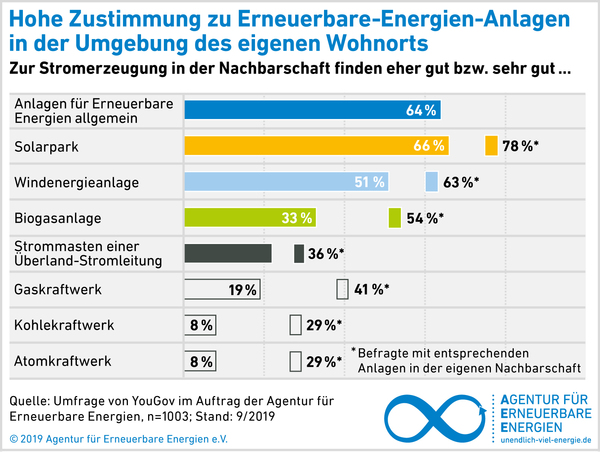
The approval of renewable energies is also reflected in the fact that 64 per cent of respondents would find it very good or somewhat good if renewable energy plants were located in their neighbourhood. This figure is only eight per cent for coal and nuclear power plants. "It is particularly remarkable that approval even increases if the respondents already have experience with these plants in their neighbourhood," says Brandt. For example, support for a solar park in one's own neighbourhood increases from 66 to 78 percent if there is already a solar park in the immediate vicinity. This positive effect can also be seen with wind energy and biogas plants.
The results of the 2019 acceptance survey clearly show that the German population is far more open to change than is generally assumed.
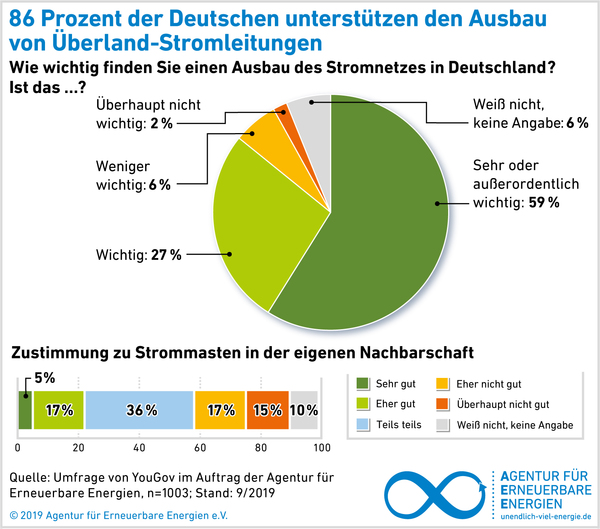
A total of around 6.4 billion euros was invested in the expansion and maintenance of the electricity grid in 2018. Although there have been protests against the construction of new overland power lines in recent months, overall acceptance of their expansion is very high.
86 per cent of respondents consider the expansion of overland power lines to be important or very and extremely important. For only eight per cent, this is less or not at all important.
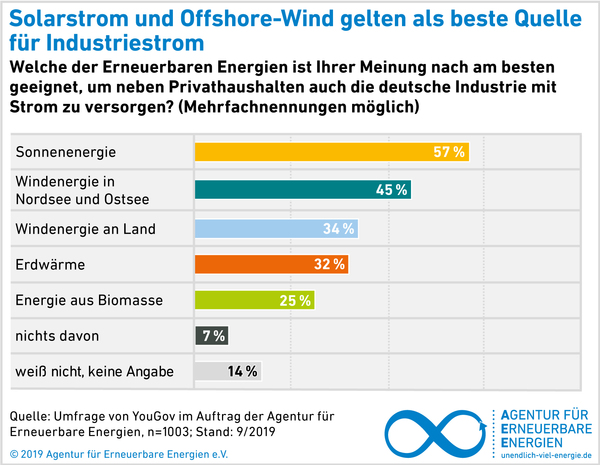
However, it is not only electricity generation for private households that is crucial for the implementation of a successful energy transition in the fight against climate change, but also for industry. After all, final energy consumption for electricity totalled 530 billion kilowatt hours in 2017. 57 per cent of citizens surveyed believe that solar energy is the best source for industrial electricity, while 45 per cent consider offshore to be ideal. "Our acceptance survey this year shows that the majority of citizens are behind renewable energies," summarises Brandt. "We can and must show the renewables sector with words and deeds that the German population and politicians recognise and value their role in the much-needed energy transition."
Methodology
The AEE acceptance survey is a Germany-wide, population-representative survey conducted by YouGov on behalf of the Agency for Renewable Energies. A total of 1,003 people aged 18 and over were surveyed online. The survey was conducted between 10 and 13 September.
*This year, the Agency for Renewable Energies has changed the survey institute and the type of survey for its acceptance survey: Instead of the telephone survey by Kantar Emnid among people aged 16 and over, the online survey by YouGov was now conducted among people aged 18 and over. In this respect, comparability with the results from previous years is not readily possible.
Keywords:
100% EEs, Stakeholders, DE-News, Renewable, Climate protection, New books and studies, Transition Town, Environmental policy
On Saturday 14.4.2018, around 13,000 to 15,000 people took to the streets in Berlin under the slogan "Resistance - together against displacement and rent madness". 254 initiatives and organizations (see mietenwahnsinn.info/initiativen) called for the protest march. Many Berliners fear for their existence due to high housing costs.
Article "Large demonstration in Berlin - thousands against rent madness" in the taz:
http://taz.de/Grossdemonstration-in-Berlin/!5498560/
3 min. video (Länderspiegel ZDF):
www.zdf.de/...grossdemonstration-in-berlin-rund-13-000-gegen-mietenwahnsinn-100.html
Keywords:
Stakeholders, Construction and operating costs, DE-News, Communities, News Blog Berlin, Social / Culture, Housing policy, Economics