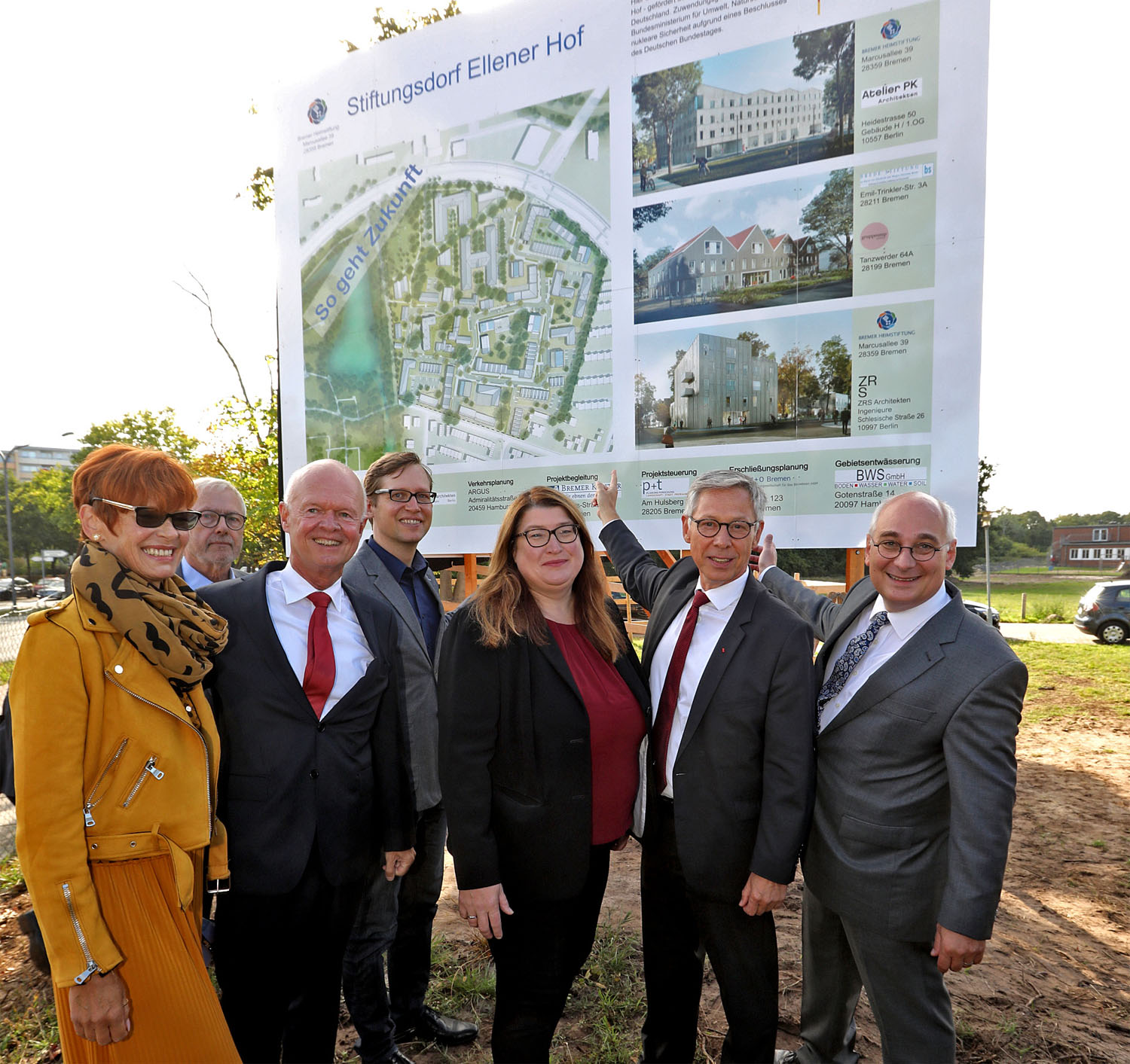
Further information about the Ellener Hof Foundation Village:
http://sdg21.eu/db/stiftungsdorf-ellener-hof-oekologisch-gebaut-bunt-gemischt
Keywords:
Further information about the Ellener Hof Foundation Village:
http://sdg21.eu/db/stiftungsdorf-ellener-hof-oekologisch-gebaut-bunt-gemischt
"The development on the housing markets puts the German Bundesbank on alert. The crisis traffic light would meanwhile be "on yellow or even dark yellow". In order to counteract a real estate bubble in time, Bundesbank board member Andreas Dombret is calling for stricter measures for real estate financing."
Read the full article from 5 May 2017:
www.immobilien-zeitung.de/1000042980/wohnungsmarkt-bei-bundesbank-laeuten-alarmglocken
Keywords:
DE-News, Sustainable management, Housing policy, Economics
The member states of the United Nations want to agree on a new urban agenda as part of the Habitat III conference in Quito. This "New Urban Agenda" is intended to serve as a political guideline for urban development over the next two decades. Federal Building Minister Barbara Hendricks takes part in the official opening of the Habitat III conference together with Friedrich Kitschelt, State Secretary at the Federal Ministry for Economic Cooperation and Development.
Hendricks: "All over the world, people are moving to cities. Cities therefore hold the key to a sustainable and climate-friendly world. It is important to invest in the right infrastructure today. Cities need support for this. They must be put in a position to fulfil the demands of their inhabitants for decent housing, access to energy, clean water or sewage and waste disposal, but also for education and participation. This is what I will be campaigning for in Quito."
Half of the world's population already lives in cities today. By 2050, this figure is expected to rise to two thirds. Around 90 per cent of this growth is taking place in developing and emerging countries. At the same time, cities are responsible for around 70 per cent of global greenhouse gas emissions. Habitat III is a UN process that addresses the development of cities around the world against the backdrop of urbanisation and places it in the context of the global sustainability goals of the 2030 Agenda and the Paris Climate Agreement. The "New Urban Agenda", which is to be adopted in Quito, will provide governments, cities and local and regional actors with a globally applicable framework for action for the sustainable development of cities.
The Federal Government is committed to ensuring that cities are recognised as development actors in an integrated urban development policy. Only if cities and regions are strong and have a say in their urban development concerns can they offer a high quality of life for their citizens and enable democratic participation. In the negotiations at Habitat III, Germany will contribute its experience with the principle of subsidiarity, local self-government with the provision of adequate financial resources, urban development and housing promotion and the model of the compact European city.
The World Conference of Cities takes place every twenty years. Habitat III follows on thematically from the two previous conferences in Vancouver (1976) and Istanbul (1996). Around 30,000 participants from 180 countries are expected to attend the conference in Quito, including delegates from governments, academia and civil society organisations. On the third day, Federal Building Minister Hendricks will be travelling on to Costa Rica. State Secretary for Construction Gunther Ad-ler will accompany the German delegation together with State Secretary for Development Kitschelt until the end of the conference on 20 October.
Source: BMUB press release, 12 October 2016
Keywords:
DE-News, Communities, Media, New books and studies, News Blog Europe (without DE), Quarters, SDG 2030, Settlements, City, UN (United Nations), Environmental policy, Housing policy

The exhibition marking the halfway point of the IBA Heidelberg has opened: A rich accompanying programme attracted almost 1000 visitors from Thursday to Saturday, many of whom were visiting the exhibition venue, the Mark Twain Center in Heidelberg's Südstadt, for the first time.
The IBA SUMMIT, the biennial meeting of mayors, university rectors and urban planners from international "Knowledge Pearls" in Heidelberg, heralded the opening days of the IBA interim presentation on 26 April. Prof. Dr Eckart Würzner, Lord Mayor of the City of Heidelberg welcomed the guests from Stanford, Cambridge, Lund and Leuven with an introduction to the IBA: "The IBA Heidelberg is on an excellent path. It demonstrates how various strengths of our city can be interwoven. These include, for example, promoting education, developing environmentally friendly mobility, creating new living space and promoting climate-neutral urban development. The IBA has made a significant contribution to the sense of a new beginning in Heidelberg.
The vernissage of the exhibition took place at the Mark Twain Center on the evening of 27 April. Gunther Adler, State Secretary for Building, Housing and Urban Development in the Federal Ministry of the Interior spoke on the occasion about the "IBA" format from the federal government's point of view. According to Adler, the IBA is an important piece of German building culture that enjoys international renown and is worth every effort to pursue its claim to excellence. The IBA tradition encompasses many aspects: International relevance, next-practice projects, sustainable impact on the region and building culture standards. For the IBAs currently underway, it is sometimes difficult to fully meet these claims to excellence under the given framework conditions. "Nevertheless, we are seeing overwhelming results, which encourage us as a federal government to continue the quality offensive together - also within the framework of the IBA Heidelberg," the State Secretary emphasised. "We need the IBA to show us how we can find answers to relevant questions of current urban development using new and unusual methods and means - this is more urgent today than ever. The IBA's courage to experiment and to go beyond existing boundaries is important to address the quality of living, working and living in our cities in the future."
Jürgen Odszuck, First Mayor of the City of HeidelbergThe IBA's interim presentation provides an excellent overview of what it is doing in Heidelberg: it gives important new impulses on how we can further develop Heidelberg as the knowledge city of tomorrow. It promotes excellent building projects in our city. And it offers innovative approaches on how we can design processes more effectively and lead to even better results."
Michael Braum, Managing Director of the IBA Heidelberg, was pleased about the great response to the exhibition opening and welcomed the guests: "Innovation in the knowledge society uses its intellectual and creative resources. This changes the value system of the industrial society, in which diligence stood above creativity. Today, in the knowledge society, creativity may be more important than diligence. This also has implications for the city. Our cities will change more dynamically in the 21st century than they did in the course of industrialisation. This requires a new way of thinking in urban planning and architecture. The IBA would like to make a contribution to this, which can now be seen in this exhibition."
Carl Zillich, Curatorial Director of the IBA Heidelbergexplained the exhibition concept: "Before we present realised building projects for the knowledge city of tomorrow in 2022, we have focused at the halfway point on the actors, processes and ideas of the first five years. Together with the exhibition makers from 'Stiftung Freizeit', we have developed analogue and at the same time interactive forms of presentation. Thus, for different interests, individual glimpses behind the scenes of the IBA, the urban development of international science cities, but also Heidelberg institutions and initiatives are on offer. Numerous architectural models, pictures and plans have already aroused curiosity about the construction sites, which are now marked all over the city."
The opening days closed on Saturday, 28 April with a colourful programme, during which many young families in particular got an impression of the exhibition and the IBA projects.
The exhibition of the IBA interim presentation is now open until 8 July daily from Tuesdays to Sundays from 15.00 - 20.00, including public holidays.
More information about the exhibition, guided tours, registration or booking of individual group tours at:
www.iba.heidelberg.de
Keywords:
News Blog Baden-Württemberg
More climate protection with the renewable raw material wood. Timber construction in Freiburg is an important instrument in climate protection and indispensable for achieving the city's ambitious climate protection targets. Timber construction can make an effective contribution to reducing CO2 emissions.
For this reason, Environment Mayor Gerda Stuchlik and Building Mayor Martin Haag are today presenting the new timber construction guide and the planned timber construction funding programme, which will be presented to the municipal council for approval at its meeting on 22 October. "18 years after the introduction of the successful "Energy-conscious refurbishment" funding programme, the city is launching another municipal funding programme for more climate protection and sustainability in the building sector with the timber construction funding programme," explains Environment Mayor Gerda Stuchlik. And Building Mayor Martin Haag: "Timber buildings are not only traditional buildings, but also innovative buildings that harbour great potential. For this reason, I am certain that our timber construction funding programme will provide a massive boost, especially in Freiburg's residential construction sector."
The wood that grows and is harvested in the city forest and also in the region can be used in many ways in the construction sector. Wood can easily be used instead of energy and resource-intensive materials such as concrete, steel or aluminium.
Freiburg's municipal forest and the utilisation and use of its wood reduce the carbon footprint by binding, storing and avoiding carbon dioxide. This means that a total of over 2 million tonnes of carbon dioxide can be stored or avoided by 2050. For this reason, the city council wants to further promote the use of wood in the construction sector. In 2017, the municipal council commissioned the administration to launch a municipal timber construction promotion programme and to create a timber construction guide, which presents already completed and pioneering timber construction projects in the city district.
Both building blocks are now available, the new timber construction guide and the planned timber construction support programme
The new timber construction guide presents 29 already realised and pioneering timber construction projects in Freiburg. The innovative buildings are intended to inspire and convince interested clients, project organisers, architects, planners and students to take a closer look at timber construction and discover its aesthetics, cost-effectiveness and potential for climate protection and ultimately implement it in their own projects.
pdf-Download Timber Construction Guide (10 MB)
The projects for the timber construction guide were selected by a jury of representatives from the Chamber of Architects, the Architecture Forum, a timber construction engineer, the forestry office and proHolz Schwarzwald. The variety of projects, from the canteen of the Loretto School to the extension of the Breisacher Hof in the city centre, shows how great the potential of timber construction is. From the summit of Schauinsland, where the observation tower and the radionuclide station are two pioneering timber construction projects for their time, to the residential homes in modular timber construction in Merzhauser Strasse and Höllentalstrasse, the projects spread across Freiburg show that even extremely demanding structural challenges can be solved using timber construction.
The timber construction guide not only explains technical details, but in addition to planners and builders, the residents and users of the selected buildings were also asked about their experiences. The timber construction guide was produced in collaboration with proHolz Schwarzwald.
"It is an important signal that the city of Freiburg, with its pioneering role in climate protection and sustainability, is increasingly focusing on timber construction and setting up a municipal funding programme. This strengthens craftsmanship and the timber construction industry in the region as well as sustainable forest management and thus climate protection and regional value creation beyond the city limits," explains Michael Hafner from proHolz Schwarzwald.
The planned timber construction funding programme, for which around 300,000 euros in funding will be available in 2020, which will be partly financed from climate protection funds from the concession fee, is intended to realise even more timber buildings in the future, especially in residential construction in Freiburg.
Builders and planners are currently increasingly discovering the possibilities and designing pioneering timber buildings or timber hybrid buildings. With the amendment to the state building regulations that came into force on 1 August 2019, the state government has made a further contribution to facilitating the use of wood and putting wood on an equal footing with other building materials in Baden-Württemberg.
However, the city wants to promote the use of wood not only for design reasons, but above all for ecological reasons. The city's timber construction programme consists of three components: The financial promotion of timber construction, the timber construction prize and the promotion and support through advice, networking and advertising of timber construction. The city has already created an additional half-time architect position for this purpose, which is based at the Building Law Office and starts work on 1 December.
The city wants to promote specific timber construction projects with the planned timber construction funding programme. The aim is to bind as much CO2 as possible in the long term in order to counteract climate change. The new programme is also intended to promote residential construction projects with four or more residential units as well as additional living space in existing buildings through extensions. The funding programme has easy-to-understand criteria so that there is as much time as possible to advise those wishing to build. Funding is based on the mass of the building.
The second component of the timber construction programme is the awarding of a timber construction prize. The aim of the prize is to highlight individual buildings in Freiburg and thus present building with wood to a wider public. The city's timber construction prize will be awarded for the first time in early 2021 for buildings completed in 2019 and 2020.
In addition to the new funding programme and the future timber construction prize, the timber construction funding office in the Building Law Office will advise interested parties and organise consultations in future.
Keywords:
Building materials / Construction, DE-News, Funding, Wood construction, Climate protection, Communities, NaWaRohs, Sustainable management, News Blog Baden-Württemberg, Quarters, Settlements, Housing, Housing policy, Life cycle assessment, Ecology