Federal prizes for timber construction plus awarded
Published
For the third time, the BMEL honoured innovative and pioneering construction projects that made significant use of wood and other renewable raw materials. A ten-member jury selected eight outstanding construction projects and a further 12 special competition entries from a total of 127 submissions. The eight winners in the new construction and refurbishment categories were each awarded prize money of €6,000 by the BMEL. The builders of the 12 special buildings received an unendowed honourable mention.
The jury's assessment focused on the exemplary function and character of the realised building projects. The winners demonstrate holistic concepts with excellent use of renewable raw materials in construction, insulation and finishing.
All winning projects are listed in the Winner brochure of the BMEL.
Production in the city is not a new phenomenon. Urban production - in its various forms and development paths - is one of the constitutive features of a city. The concept of the Productive City opens up the possibility of using a strategic approach to link the central aspects of the changing socio-economic basis of cities (development of new forms of production and work) with the goals of a compact and functionally mixed city.
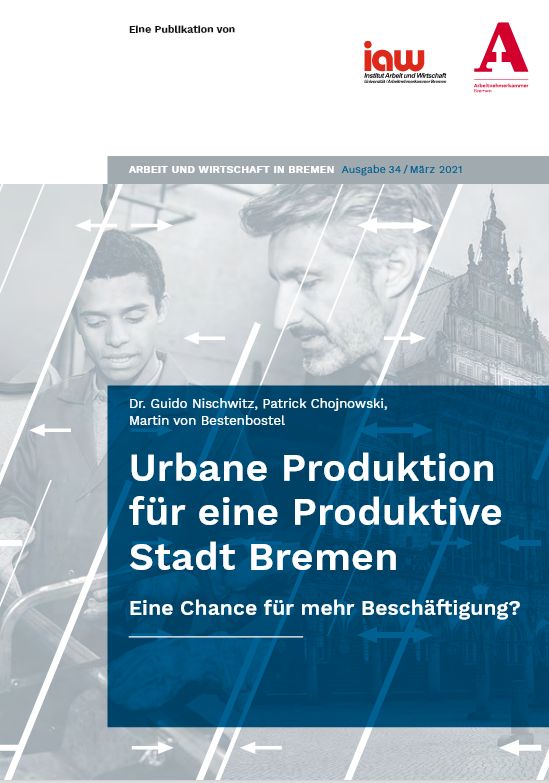
In a research project of the iaw, the conceptual foundations of urban production and the productive city were prepared with a view to the situation in Bremen and analysed in their impact structure. The study makes proposals for describing and recording urban production that is compatible with the city and embedding it in an urban development policy model of a productive city. On the basis of seven reference cities (Vienna, Zurich, Stuttgart, Hamburg, Frankfurt am Main, Wuppertal, Bochum), corresponding activities were filtered out and their transferability to the city of Bremen was examined. In the city of Bremen, eight locations and neighbourhoods (including the Tabakquartier and Kellogg-Areal) were examined with regard to their potential for implementing a productive city.
Arbeitnehmerkammer Bremen (ed.), authors: Nischwitz, Guido; Chojnowski, Patrick; von Bestenbostel, Martin (2021): "Urbane Produktion für eine Produktive Stadt Bremen. An opportunity for more employment?" Series Work and Economy in Bremen 34/2021, Bremen. 202 pp.
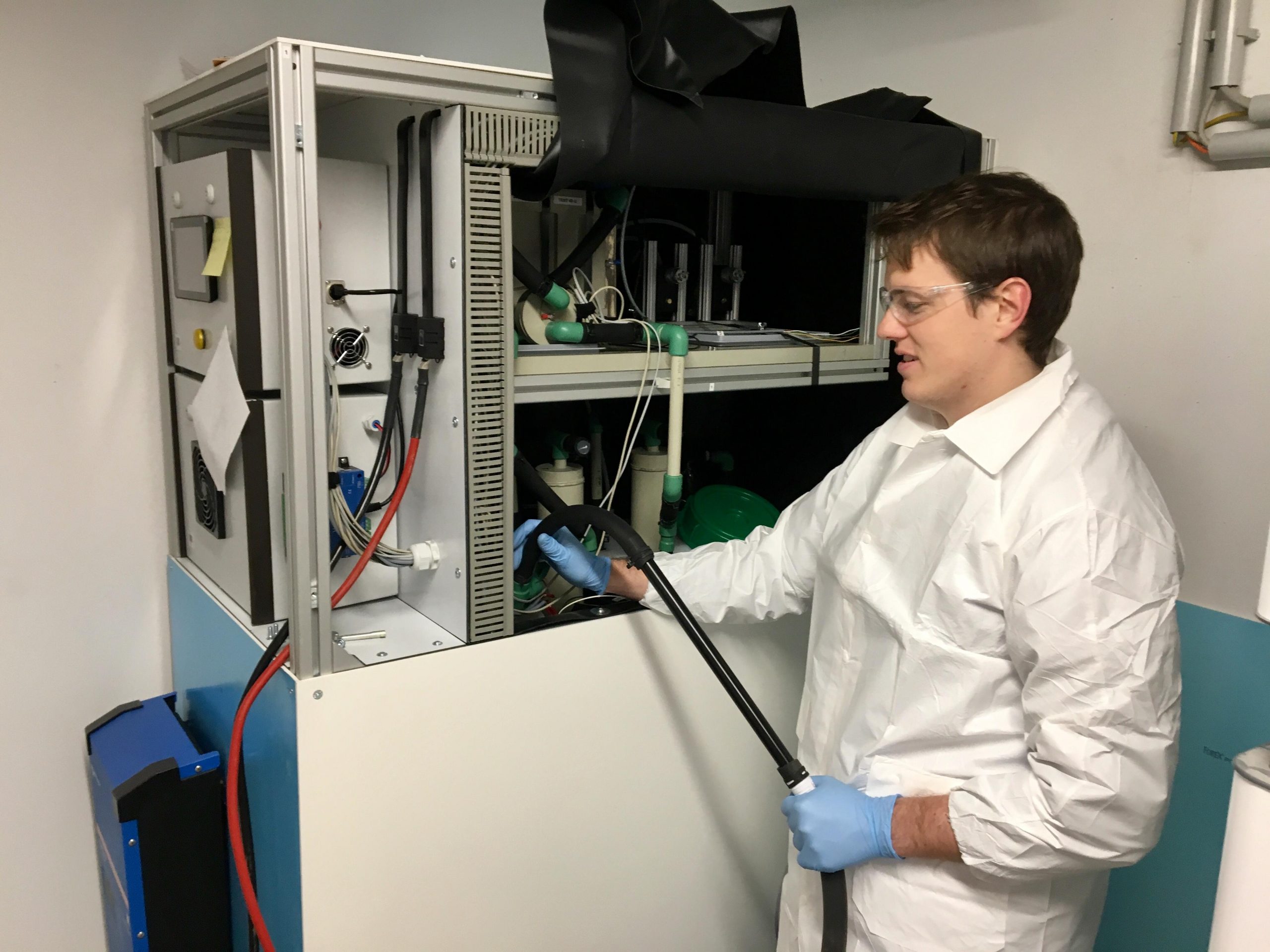
Developer Daniel Manschke from Volterion fills the electrolyte into the battery storage units in the climate quarter of Stadtwerke Herne. Photo: Stadtwerke Herne
Violet, green, blue and yellow - inside the innovative battery storage systems now available in the Climate quarter of the municipal utility company, will be colourful in the future. The electrolyte, which can store up to ten kilowatt hours of self-produced solar power, changes color depending on the state of charge.
Each of the new storage tanks holds 500 litres of the storage liquid. Redox-flow batteries in the cellars of the seven houses. The developers of the Dortmund-based manufacturer Volterion, a spin-off of the Fraunhofer Institute UMSICHT, installed and filled them themselves in Herne. This is because the climate district is an interesting technical demonstration object for them: Up to now, they have only installed battery storage systems in large-scale projects. In the single-family homes in Sodingen, the battery is only about the size of a two-door wardrobe.
Compared to conventional rechargeable batteries Redox-flow batteries are characterized by high operational reliability and extreme durability. Even a complete discharge does not harm them.
"With the battery, our energy concept of solar system and heat pump is now complete," explains Stephan Becker, project manager at the developer Stadtwerke Herne. "The climate quarter is now entering the home stretch." The final inspection with the future residents is scheduled to take place in about two weeks.
In April of last year, the municipal utility company began construction of the seven modern plus-energy houses. The small car-free model settlement combines the latest storage technology with renewable energy generation. The supply concept varies in individual details. With scientific support, the most efficient combination is to be found after the residents have moved in.
One million electric cars are to be on the road in Germany by 2020, at least that's what the German government wants. Sales figures are still lagging behind expectations. In addition, important questions arise about the origin of electricity and raw materials. ZDF has devoted a report to these questions in the series "planet e" entitled "Electric cars - top or flop?" and also interviewed ifeu Heidelberg. The programme is available in the ZDF Mediathek until 28.1.2017.
In addition to important aspects of the environmental balance, the paper also discusses the App My eDrive which is currently being developed by ifeu and the ADAC Technical Centre with funding from the Federal Ministry for the Environment (BMUB).
Link to video:
www.zdf.de/…Elektroautos—Top-oder-Flop%253F
No stopping, no weaving through, no suddenly opened car doors: With the expansion of motorways for bicycles only, Norway's government wants to create an incentive to take the bike more often.
Norway's goal: less harmful emissions, and soon. Pollutant emissions from traffic and transport are to be reduced by as much as 50 per cent. For car traffic in the city, this means: It should not grow any further without restricting the mobility of citizens. In this context, the Norwegian government speaks of a "zero-growth" target.
Link to the article from (unfortunately no longer online; as of 10/2020):
We use cookies to optimize our website and services.
Functional
Always active
Technical storage or access is strictly necessary for the legitimate purpose of enabling the use of a particular service explicitly requested by the subscriber or user or for the sole purpose of carrying out the transmission of a communication over an electronic communications network.
Preferences
The technical storage or access is necessary for the legitimate purpose of storing preferences that have not been requested by the subscriber or user.
Statistics
The technical storage or access, which is solely for statistical purposes.Technical storage or access used solely for anonymous statistical purposes. Without a subpoena, voluntary consent from your Internet service provider, or additional records from third parties, information stored or accessed for this purpose cannot generally be used alone to identify you.
Marketing
Technical storage or access is necessary to create user profiles, to send advertising or to track the user on a website or across multiple websites for similar marketing purposes.



 Video available until 28.01.2017, 16:30
