DBU: Affordable energy-efficient housing and transport transition as key to sustainable development
Published
"Well-insulated and energy-efficient modern housing must remain affordable for poorer people. This is crucial, said DBU Secretary General Dr Heinrich Bottermann at the expert forum "Urban spaces in the face of climate change", to ensure that society does not become divided. He also emphasised how important it is for climate-neutral and resource-conserving neighbourhood development to rely more on timber construction and to push back concrete buildings. "If concrete, then only recycled concrete," emphasised Bottermann."
Dr Lars Grotewold, climate protection expert at the Mercator Foundation, spoke out in favour of a transport revolution in cities. Despite all efficiency efforts, transport still causes as many emissions as it did 25 years ago. Grotewold's ambitious demand: "By the middle of the century, the transport sector must be completely CO2-be free."
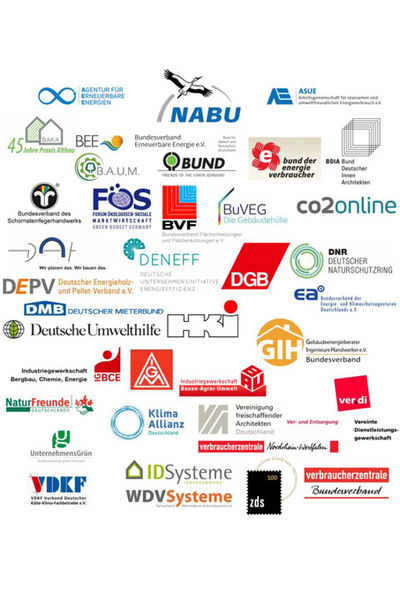
The associations and organisations involved in the Building Alliance (Graphic: NABU)
The energy transition in the building sector has stalled. Less and less is being invested in energy-efficient refurbishment and the Paris climate protection targets are in jeopardy. The reason for this is inadequate advice and the uncertainty of many consumers on the one hand, as well as inadequate government regulations and poorly managed subsidies on the other. For almost two years now, the Building Alliance, an association of environmental and consumer organisations with energy consultants, tradesmen, trade unions, the building industry, architects' associations and the construction industry, has been positioning itself against this. Under the leadership of the Nature and Biodiversity Conservation Union (NABU), numerous natureplus members such as BUND, BAUM e.V. and IG Bau are also working together in favour of more climate protection in the building sector.
In a recent statement, the Building Alliance calls on a new German government to "make the neglected third of the energy transition in the building sector an integral part of an integrated climate protection and energy policy". So far, politicians have "missed the opportunity to make energy-efficient building refurbishment the largest value creation and value retention programme in Germany and thus a real job engine for the domestic economy", criticises Jörg-Andreas Krüger, Deputy Federal Managing Director of NABU. Residential and non-residential buildings must now be addressed more strongly and more specifically than before by the three pillars of "information and advice", "support" and "demand".
A "lack of prioritisation and reliability" has unsettled investors, homeowners, tradespeople and businesses. In order to create reliability, "more transparency is needed in the assessment of buildings" through a standardised, optimised energy performance certificate. In addition, "high-quality, quality-assured advice from trained experts" in accordance with national standards is needed. Politicians must "set the course for reliable and permanent funding for high-quality consulting services and refurbishment measures". The refurbishment costs should be "shared equally between the state, landlords and tenants". At the same time, however, "new, market-based incentives are needed to mobilise additional investment and provide smart incentives", concludes NABU.
The Federal Ministry of Housing, Urban Development and Construction today announced the Federal Urban Greening Award 2022. This year, the focus is on the topic of "Climate adaptation and quality of life".
Federal Minister Klara Geywitz: "Climate change is a stress test for our cities. We need more trees for a better urban climate, we need soils that can absorb heavy rainfall, we need less sealed land also for more biodiversity and against the heating up of residential neighbourhoods. With the Federal Urban Greening Award 2022, we are honouring the pioneering work that is already shaping the necessary transformation of cities today."
The award recognises best practice examples that show how municipalities can use their urban green spaces to positively influence the urban climate and reduce the negative effects of extreme weather conditions. The award also recognises innovative concepts for climate-adapted and vital urban green spaces that have already been tried and tested. The award is looking for open spaces that can be used by the public and that also meet the other requirements for the use of open spaces in cities and municipalities, including as spaces for recreation and social cohesion and as elements of an attractive network of cycle paths and footpaths. Cities and municipalities in Germany can now apply with their projects. Planning offices, citizens, universities, research institutions, initiatives or associations can participate in cooperation with their municipalities.
Subject to the funds available in the 2022 federal budget, the federal prize is endowed with prize money totalling up to 100,000 euros. In addition to exemplary implemented projects, the courage to experiment with promising new approaches is also rewarded.
An independent jury will decide in June 2022 which projects will be awarded prizes and recognition. It is composed of experts from the fields of garden and landscape architecture, climate adaptation, urban development and urban planning, representatives of the municipal umbrella organisations and from the Federal Ministry of Transport, Building and Urban Affairs. The award ceremony is scheduled to take place in Berlin in September 2022.
The Federal Urban Greening Award is an important building block in the implementation of the Federal Ministry of Transport, Building and Urban Affairs' White Paper on Urban Greening. It is supported by the German Association of Cities and Towns, the German Association of Towns and Municipalities and the German Association of Districts. The Federal Institute for Research on Building, Urban Affairs and Spatial Development (BBSR) implements the Federal Urban Greening Award and provides technical support.
The district of Paderborn has achieved a climate target that can currently only be dreamed of nationwide. It has a green electricity supply of more than 100 per cent. This year, with the help of wind, sun, biomass and water, for the first time as much renewable electricity is being generated as is being consumed. Since the end of June, it has been exactly 112 per cent.
Annual consumption: 2.3 billion kilowatt hours
This is what the State Association for Renewable Energies in OWL determined. The association used figures from the State Agency for Nature, Environment and Consumer Protection (LANUV) as well as current data from the district of Paderborn. According to these figures, the more than 500 wind turbines, 11,500 photovoltaic systems and 53 biomass power plants generate slightly more electricity on an annual average than private individuals, trade and industry in the district of Paderborn require over the year: Almost 2.3 billion kilowatt hours.
Second place for Höxter district with 63 per cent green electricity
This puts the Paderborn district in the Champions League nationwide: "There are very few regions that already fulfil the 100 per cent green electricity quota - in NRW, we are the first and so far the only one," says Kerstin Haarmann (Paderborn), Managing Director of LEE OWL. This is particularly remarkable because the district of Paderborn has a national average electricity consumption due to its share of industry. Smaller districts with little industry and commerce would naturally find it easier to reach 100 per cent. In a comparison of East Westphalia, the district of Paderborn is the lone leader: the district of Höxter is in second place with 63 per cent green electricity, followed by the district of Lippe with 23.5 per cent, Gütersloh with 20.8 per cent, Minden-Lübbecke with 17 per cent and Herford with 6.5 per cent. Bringing up the rear is the city of Bielefeld with a 4.5 per cent share of green electricity in electricity consumption.
Renewables account for 27 per cent of total energy demand
The district of Paderborn has even achieved its climate target, which was unanimously approved by the district council in 2011, ahead of schedule. The plan was for electricity consumption to be completely renewable by 2020. "However, we don't have time to rest on our laurels in the fight against climate change," explains Jürgen Wrona (Delbrück) from the LEE OWL board. Measured in terms of total energy demand (electricity, heat and transport), the proportion of renewables in the Paderborn district is currently only around 27 per cent. "There is room for improvement, especially in the areas of heating and transport," says Wrona.
Source: Press release from the NRW Energy Agency dated 8 August 2018
We use cookies to optimize our website and services.
Functional
Always active
Technical storage or access is strictly necessary for the legitimate purpose of enabling the use of a particular service explicitly requested by the subscriber or user or for the sole purpose of carrying out the transmission of a communication over an electronic communications network.
Preferences
The technical storage or access is necessary for the legitimate purpose of storing preferences that have not been requested by the subscriber or user.
Statistics
The technical storage or access, which is solely for statistical purposes.Technical storage or access used solely for anonymous statistical purposes. Without a subpoena, voluntary consent from your Internet service provider, or additional records from third parties, information stored or accessed for this purpose cannot generally be used alone to identify you.
Marketing
Technical storage or access is necessary to create user profiles, to send advertising or to track the user on a website or across multiple websites for similar marketing purposes.