EnergiespeicherPLUS - Berlin funding programme for electricity storage goes online
Published
The aim of the EnergiespeicherPLUS programme is to drive forward the expansion of photovoltaics in Berlin and to increase the share of renewable energies in electricity consumption, even in times of low sun and low wind. This benefits climate protection, as CO 2 -emissions can be avoided. The Berlin Energy and Climate Protection Programme provides subsidies for the investment costs of electricity storage systems if a photovoltaic system is installed at the same time. The
IBB Business Team GmbH implements the program. Since 1 January 2020, an electronic application for funding can now be submitted quickly and easily to the IBB Business Team GmbH under www.energiespeicherplus.de be put.
Energy Senator Ramona PopEvery Berliner can make a contribution to the energy transition in our capital city. We support this with our Energy Storage PLUS funding programme. I am pleased about the great interest. Since October, over 200 preliminary applications have already been submitted. Every new photovoltaic system helps us get one step closer to our goal of becoming climate neutral."
We subsidise the purchase and commissioning of solar energy storage systems of up to 15,000 euros. If the storage system has a forecast-based operating strategy, a bonus of 300 euros is added. The prerequisite for a subsidy is that a photovoltaic system is purchased and commissioned at the same time as the storage system. The subsidy can be combined with other funding, e.g. from the Funding programme for business-oriented electromobility or from the green roof funding programme, can be combined. All owners of buildings in Berlin can apply for the funding.
3.1.2020 | Source: Berlin Senate Department for Economic Affairs, Energy and Operations
Solarserver reports on the world's largest solar heating plant, which has been in operation in China since 2016. It consists of parabolic trough collectors.
On the roof of a XuChen factory hall next to the company headquarters, there are 22,000 m2 collector area, a further 71,000 m2 collector area are implemented as ground-mounted systems. Together they deliver an output of 65 MWth. With concentrating collectors, it would thus be the largest solar heating plant of its kind. An even larger one is the Danish Silkeborg plant (110 MWth)which, however, is equipped with a different collector technology.
TU Dortmund University conducted an excursion to Paris from 27 to 31 March 2017 as part of the research project "Co-Housing Initiatives in Europe". There, the researchers met French colleagues Anne Labit (Orléans University), Sabrina Bresson (ENSA Paris Val-de-Seine) and Claire Carriou (Paris Nanterre University)."
"While in Germany the number of community housing projects has been steadily increasing for the last 30 years and a number of communal and other support structures have developed in parallel, a similar development has only been observed in France since the early 2000s."
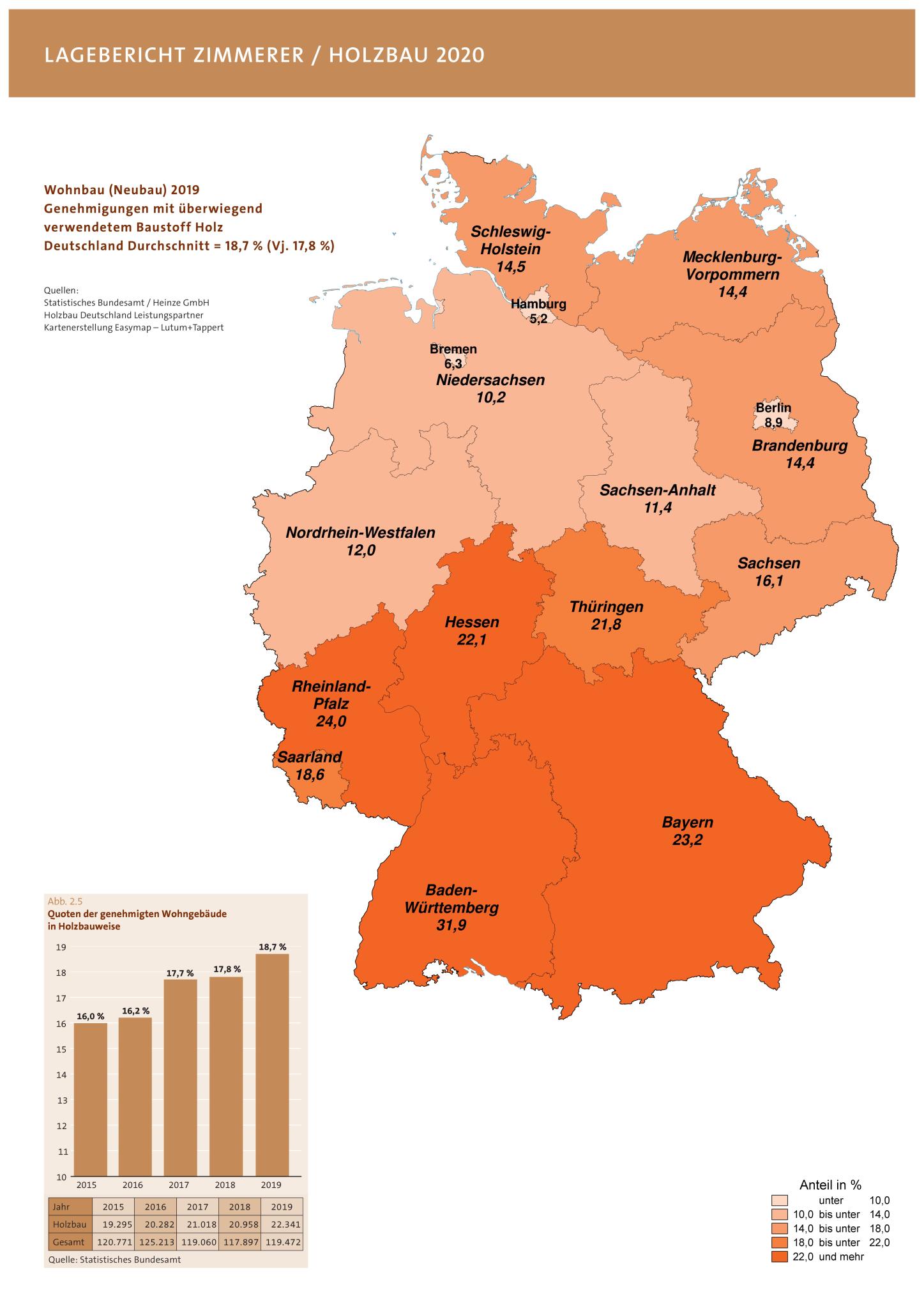
The discussion about climate change and the growing demand for living space have increasingly brought timber construction into the focus of planners, architects and developers over the past year. After all, sustainable timber construction can make a significant contribution to climate protection and the creation of living space. The increased interest in timber construction is also reflected in the industry figures: the turnover of companies grew by 7 percent in 2019 compared to the previous year, the number of employees increased from around 68,000 to around 70,000 and the timber construction rate continued to grow in both residential (new construction) and non-residential (new construction) construction.
Holzbau Deutschland has published these and other facts, figures and forecasts on the structure of the sector, market and economic trends, the business situation and financing, as well as training and careers in the carpentry and timber construction trades in its "Situation Report Carpenters / Timber Construction 2020" published. It can be downloaded free of charge from the Association's website in the Business Administration section.
Even after Corona: Continue to drive forward climate protection
At the conclusion of the 11th Petersberg Climate Dialogue last week, German Chancellor Angela Merkel appealed that in the period after the Corona crisis, "when we launch economic stimulus packages, we should always keep climate protection firmly in mind and make it clear that we are not cutting back on climate protection, but investing in technologies that are fit for the future."
Timber construction has long been one of the sustainable technologies that can make an essential contribution to achieving climate protection goals. "Ecological, sustainable and resource-saving construction with wood must therefore continue to be the focus in residential construction as well as in redensification and gap filling in existing buildings. In order for timber construction to be recognized as an alternative on an equal footing with other construction methods, the framework conditions must be further improved and the building codes of the federal states must be adapted to the current state of the art," demanded Peter Aicher, Chairman of Holzbau Deutschland.
The current and further development in timber construction
Until the outbreak of the Corona pandemic, the mood in the timber construction industry was good. The satisfaction of carpentry and timber construction companies is also reflected in the Holzbau Deutschland business survey, in which almost 370 companies took part at the turn of the year 2019/2020. Their order backlog at the beginning of the year already averaged 17 weeks (previous year 15 weeks). The current exceptional situation in the wake of the Corona pandemic has not changed this much: According to recent surveys, most businesses are going about their work without any significant restrictions and in compliance with clearance and hygiene rules. Builders are also sticking to their construction projects. Many timber construction companies are currently benefiting from the existing high order backlog. For some of them, the workload will last until next year.
How turnover in timber construction will develop in 2020 and beyond, and what impact the Corona pandemic will have, cannot be reliably assessed at the present time. Regardless of the current situation, the timber construction industry has assumed a further 5 percent increase in sales by the beginning of March. The value is also based on the cautious confidence of the entrepreneurs from the economic survey of Holzbau Deutschland.
We use cookies to optimize our website and services.
Functional
Always active
Technical storage or access is strictly necessary for the legitimate purpose of enabling the use of a particular service explicitly requested by the subscriber or user or for the sole purpose of carrying out the transmission of a communication over an electronic communications network.
Preferences
The technical storage or access is necessary for the legitimate purpose of storing preferences that have not been requested by the subscriber or user.
Statistics
The technical storage or access, which is solely for statistical purposes.Technical storage or access used solely for anonymous statistical purposes. Without a subpoena, voluntary consent from your Internet service provider, or additional records from third parties, information stored or accessed for this purpose cannot generally be used alone to identify you.
Marketing
Technical storage or access is necessary to create user profiles, to send advertising or to track the user on a website or across multiple websites for similar marketing purposes.