EU trends: Are eco-insulation materials on the rise?
Published
BauInfoConsult surveyed 6,000 architects
On the insulation market, so-called "natural" insulation materials such as wood wool, hemp, cork, granulates and co. are still niche products. However, they are on the rise throughout Europe, at least from the architects' point of view: According to a survey of 1,600 European planners, the use of natural insulation materials is likely to increase in seven out of eight countries. The future prospects for mineral wool, the market leader, are also favourable in this country. According to the architects' forecast, other insulation materials will have a much harder time.
Natural insulation materials are expected to grow strongly in Germany and most countries - which is certainly related to the trend towards sustainable building, which was also highlighted as a strong development by architects in the same study. Mineral wool is also seen as an insulating material with a future in Germany and most countries - this is certainly also related to the market position of the large mineral wool manufacturers in Europe. PUR/PIR systems, on the other hand, are somewhat weaker - in Germany, planners even expect a slight decline in demand.
In most countries, the architects surveyed do not believe that insulation with EPS/XPs currently has strong growth potential - despite the relatively long service life of polystyrene-based core insulation, which has made these insulating materials so economical and popular. The image problems of the materials, which have come under fire because of fire hazards and also do not seem to fit in well with the current trend towards sustainable building with their somewhat anachronistic "Styrofoam" image, are too high.
Exceptions here, however, are Poland and the Netherlands, where plastic-based insulation is still popular. The EPS industry has also managed to gain ground there in terms of sustainability: It is certainly no coincidence that the first large European recycling plants for EPS insulation materials were launched in the Netherlands.
The internationally renowned electrosmog expert Dr. Klaus Trost explains which electromagnetic radiation is emitted by PV systems, the magnitude of this radiation and what to look out for when installing the system components.
Klaus Trost: "I am not aware of any special findings or studies on health risks due to electrosmog from photovoltaic systems. I also do not expect any particular risks, since at night, when the sensitivity to electromagnetic field immissions is greatest, the sun is not shining, consequently no current flows in the PV modules and no magnetic fields are generated. Electric fields are only generated at night if the inverter does not galvanically isolate the modules from the power grid. However, as already mentioned, electric fields are well shielded by the roof structure and do not penetrate into the house."
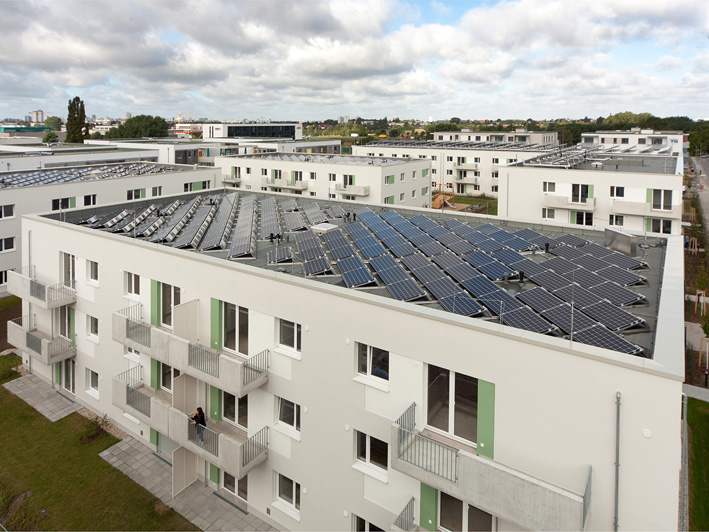
In a recently written short study, scientists from the Department of Energy System Analysis at the Fraunhofer Institute for Solar Energy Systems ISE prepared an evaluation of the Market Master Data Register (MaStR) and the EEG system master data for photovoltaics (PV). Important findings of the analyses were that with 38 percent of the newly installed capacity, the increase in capacity in Germany is increasingly taking place in the segment of rooftop systems larger than 100 kW, 22 percent of the newly built PV systems are erected in a west, east or east-west direction and 19 percent of these systems have tilt angles smaller than 20 degrees.
Relative shares of the different orientations in the construction of new plants. Source: Own calculation based on MaStR data registered as of 31.01.2019 (as of 03.03.2020).
The Market Master Data Register (MaStR) is the register for the German electricity and gas market. Since January 2021, all electricity generation units connected to the general supply grid must be entered in it. This also applies to the steadily growing number of photovoltaic systems in Germany. In addition to the master data on output and location of a PV system, which has already been recorded in the Renewable Energy Sources Act register (EEG system master data), the market master data register records further information such as orientation, inclination and output limitation.
These parameters have now been analyzed by scientists at Fraunhofer ISE. The evaluation covers the period from 2000 to the present day and shows the development over time in terms of number, power, location by federal state, orientation, inclination and power limitation. Different evaluation criteria were taken into consideration, which allow statements to be made on the following aspects: Plant addition, power addition by plant class, plant addition by federal state, plant orientation and inclination angle.
Fraunhofer ISE evaluates these central parameters at regular intervals and makes the results publicly available. In addition, the Institute offers further evaluations of this database on request.
82 percent of the added systems are smaller than 10 kW
The evaluation of the installation of new systems by system class essentially shows that the <10 kW size range has remained constant since 2014 with an average share of 82 percent. Rooftop systems over 10 and up to 100 kW had a heyday between 2004 and 2011, when their share of new installations - in relation to the number of systems - averaged 43 percent.
Growing part of the added capacity is due to large rooftop systems
When examining the increase in capacity by plant class, it becomes clear that the high share of the <10 kW plant class in terms of the number of plants is only reflected in a high increase in capacity to a limited extent. The share of the plant class has remained fairly constant at an average of 19 percent since 2014. One system segment whose relative share of capacity growth has increased sharply is the system class of rooftop systems from 100 to 750 kW. From 17 percent in 2012, their share has more than doubled to 38 percent in 2019. In contrast, the importance of ground-mounted systems has declined from 45 percent in 2012 to 20 percent in 2019.
More than half of the PV systems will no longer be built in Bavaria and Baden-Württemberg
The two states of Bavaria and Baden-Württemberg accounted for an average of 59.6 percent of new installations in Germany between 2000 and 2009, and this share declined to an average of 44.5 percent between 2010 and 2019. Over the same periods, North Rhine-Westphalia increased its average contribution from 14.1 to 18.3 percent, Lower Saxony's share rose from 6.5 to 9.2 percent, and Brandenburg's share increased from 0.7 to 2.2 percent. All the remaining federal states also recorded increases, albeit to a lesser extent. Despite the decline in their share, Bavaria and Baden-Württemberg remain in first and second place in terms of new installations in 2019, with 24.4 percent and 18.6 percent respectively. This is followed by North Rhine-Westphalia, Lower Saxony and Hesse with 17.9 percent, 9.2 percent and 6.1 percent respectively.
73 percent of newly installed PV systems are limited in their capacity
Only around a quarter of the newly installed plants in 2019 do not have any output limitation. According to the EEG, 66 percent of newly installed plants may only feed a maximum of 70 percent of their output into the grid because they do not have remotely controllable feed-in management. This proportion has grown by an average of 4 percentage points per year since 2014. The remaining output-limited plants have even higher limitations of 60 to 50 percent as a result of the combination with a battery storage system.
Increasing proportion of PV systems facing east and west
While the share of PV systems with southern orientation decreased from 61 percent in 2000 to 42 percent in 2019, the share of systems with eastern and western orientation increased at almost the same rate: east from 1 percent in 2000 to 7 percent in 2019, west from 3 percent in 2000 to 9 percent in 2019, east-west from 1 percent in 2000 to 6 percent in 2019.
Plants are increasingly being built with a lower angle of inclination.
The share of added PV systems (rooftop and ground-mounted) with a tilt angle of less than 20 degrees averaged 10 percent between the years 2000 and 2009. Subsequently, between 2010 and 2019, the share increased to an average of 19 percent. Systems with 20 to 40 degrees of tilt accounted for an average of 63 percent between 2000 and 2009, falling to 54 percent between 2010 and 2019.
We use cookies to optimize our website and services.
Functional
Always active
Technical storage or access is strictly necessary for the legitimate purpose of enabling the use of a particular service explicitly requested by the subscriber or user or for the sole purpose of carrying out the transmission of a communication over an electronic communications network.
Preferences
The technical storage or access is necessary for the legitimate purpose of storing preferences that have not been requested by the subscriber or user.
Statistics
The technical storage or access, which is solely for statistical purposes.Technical storage or access used solely for anonymous statistical purposes. Without a subpoena, voluntary consent from your Internet service provider, or additional records from third parties, information stored or accessed for this purpose cannot generally be used alone to identify you.
Marketing
Technical storage or access is necessary to create user profiles, to send advertising or to track the user on a website or across multiple websites for similar marketing purposes.