Europe-wide overview of cargo bikes to rent or buy
Published
More and more cargo bikes can be rented throughout Germany. For good reason: if you only need a transport bike occasionally or want to test it out in detail first, you don't need to buy one right away. For this case, cargo bike sharing systems or rental offers are particularly attractive.
An up-to-date list of cargo bike sharing systems in cities in Germany, Austria and Switzerland can be found on the blog cargobike.now.
Anyone looking to buy a cargo bike will find a comprehensive overview of the market here: Nutzrad.de. Interesting transport solutions with trailers are also presented there.
The prize has been organised since 2005 by the Senator for the Environment, Building and Transport in cooperation with the Federal Chamber of Architects. Previously known as the Bremer Bauherrenpreis, the competition recognises the commitment of builders in Bremen and Bremerhaven. The aim is to showcase the range of services offered by housing construction in the state of Bremen and to provide impetus for future building projects.
The next award ceremony will take place in spring 2018.
Cooperation between municipal utilities and berlinovo for largest German tenant electricity project
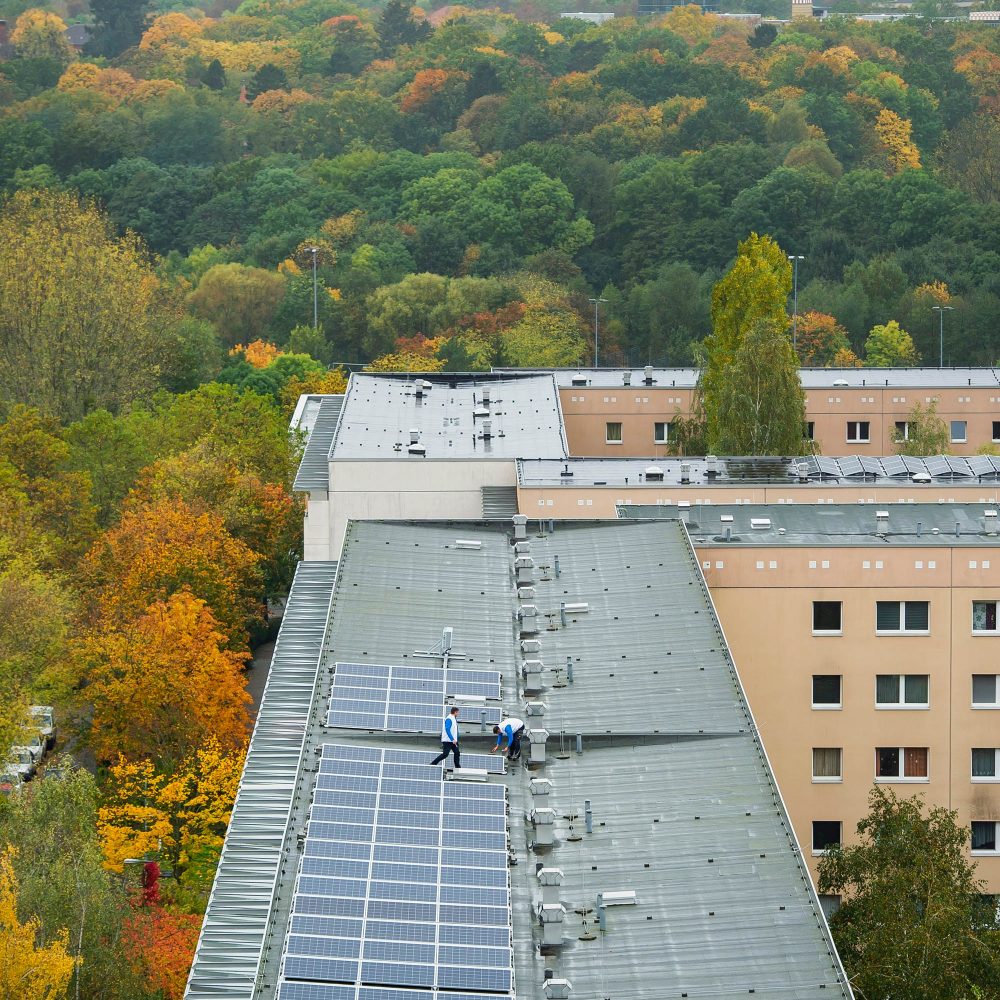
Mietersonne Kaulsdorf, Germany's largest tenant power project with almost 3.4 megawatts (MW) of capacity, is being built by Berliner Stadtwerke for the Berlin housing association berlinovo in Marzahn-Hellersdorf. Tenants of 4,300 apartments will be able to benefit from the green electricity generated directly on their roofs.
The dimensions of the project, consisting of 39 solar systems on one hundred residential buildings in the district between Wuhletal and Hellersdorfer Strasse, speak for themselves: a total of 27,000 m² are covered with modules, which corresponds to 3.8 times the area of a football pitch. The yield is estimated at around 2.9 million kilowatt hours per year, which is equivalent to the entire electricity requirements of 1,200 two-person households. This means that approx. 1,580 tons of CO2-emissions were avoided. Berliner Stadtwerke is investing around €3.75 million in this project. This year, 2.0 MW of the total 3.4 MW will be installed, around 60 percent of which have already been installed on the roofs since May. A further 1.4 MW is to follow in 2020 and 2021.
Photos: Pritzkuleit
"Berlin is catching up," says Berlin's energy senator Ramona Pop. "We still have a lot of space on our roofs that we can use to work sustainably and efficiently for the energy transition here in the city. Until the federal government finally meets the requirements of the urban energy transition, we cannot wait, after all, the climate crisis is not waiting either. We are working at full speed to expand solar energy in Berlin. With the Mietersonne project, we are taking the biggest step on this path so far."
Finance Senator Dr. Matthias Kollatz explains: "In order to achieve Berlin's ambitious climate protection goals, we must double the speed of the energy transition. Relying on private initiatives alone is not enough. The commitment of the public sector is required. This example of municipal cooperation is exemplary - and an important driver in a very central climate protection area."
"We built the largest part of the facility this year," says Stadtwerke Managing Director Dr. Kerstin Busch. "Important for the success of the project is a high level of acceptance among the tenants, which we are also promoting on site with our own customer center at the Spree Center, among other things." Including the Mietersonne Kaulsdorf project, Stadtwerke will install around 4 MWp on Berlin roofs this year.
"Thanks to the cooperation with Berliner Stadtwerke, berlinovo tenants in the Kaulsdorf district will in future be able to obtain cheap local and clean electricity 365 days a year. At the same time, we are making the plat-ten buildings fit for the future and helping to achieve Berlin's climate targets," emphasises Alf Aleithe, Managing Director of berlinovo.
Berlin public utility company
Berliner Stadtwerke is a subsidiary of Berliner Wasserbetriebe. They are committed to consumer-oriented energy generation and environmentally friendly supply concepts based on renewable energies. To date, Berliner Stadtwerke has invested €30.4 million in renewable energies, in Berlin primarily in new solar power plants in the districts. This means they have built more than 40 percent of the solar capacity installed in Berlin since 2016. Information about and registration for the environmentally friendly "berlinStrom" at www.berlinerstadtwerke.de
About berlinovo
berlinovo was formed in 2012 from BIH Berliner Immobilien Holding GmbH, founded in 2006, and its subsidiaries. berlinovo is an investment of the State of Berlin. The portfolio includes 246 properties, one of which is abroad. Nationwide, berlinovo manages 23,500 rental units with a total rental area of 2.55 million m² and an annual target rent of over €249.0 million. These include around 15,200 apartments, 6,500 furnished apartments and 1,800 commercial units (as of 31 December 2018). berlinovo employs around 340 people.
With the successful implementation of the state program "Area-wide Safety Charging Network for Electric Vehicles" (SAFE), Baden-Württemberg is the first state to have an area-wide charging network for electric cars in a 10-kilometer grid. The SAFE charging network consists of more than 450 charging stations.
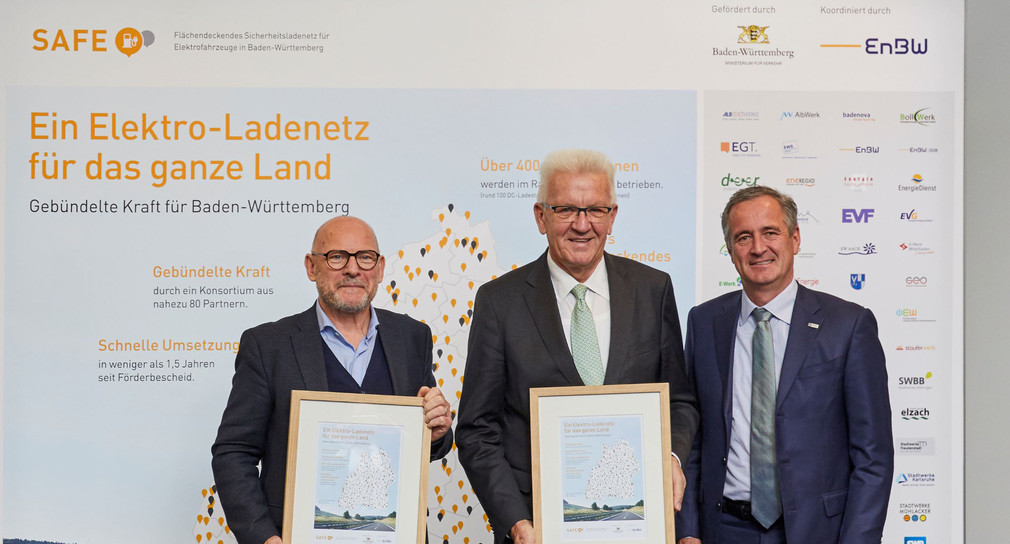
While the construction of public charging infrastructure for electric cars is still being discussed elsewhere, Baden-Württemberg has built up a comprehensive charging network in recent months. A reliable charging infrastructure with more than 450 charging points now covers the entire state in a 10-kilometre grid. A consortium of 77 municipal utilities and suppliers as well as three municipalities had joined forces under the leadership of EnBW and successfully implemented the state programme "Area-wide Safety Charging Network for Electric Vehicles" (SAFE). The final event was held today (04.11.2019) in Stuttgart to take stock.
Electromobility is not only suitable for the big city!
"I am extremely pleased that we have taken electric mobility in Baden-Württemberg an important step forward with the SAFE project. Because with the nationwide expansion of the charging infrastructure, we are showing: Electromobility is not only suitable for the big city! I was able to see this for myself during my charging stop in Bad Urach today. SAFE, which was realised within the framework of Baden-Württemberg's strategy dialogue on the automotive industry, thus illustrates that electric mobility in the state is not only a clean and efficient, but also a reliable form of mobility," said Minister President Kretschmann. A consortium led by EnBW had been awarded the contract for the project in May 2018. "The parties involved have managed to set up a nationwide network of charging stations in one and a half years. I would like to thank EnBW as the project leader and its many project partners for this remarkable achievement. Together we are showing that we are pushing ahead: We are stepping on the gas and advancing electromobility in Baden-Württemberg step by step," Kretschmann continued.
Transport Minister Winfried Hermann explained: "E-charging must be as safe as it is simple. Above all, the charging points must work. With the nationwide SAFE charging network, we are creating the basis for the electrification of passenger car traffic in cities and rural areas. In this way, we are facilitating the switch to climate-friendly e-mobility."
81 Partner on behalf of the State of Baden-Württemberg
The SAFE charging network consists of more than 450 charging stations and will be operated by the project partners for at least six years. More than 250 already existing normal charging stations and more than 60 fast charging stations could be included in the network. But the consortium also built around 40 new fast charging stations and 88 normal charging stations. In addition, twelve existing charging stations were upgraded.
"This is how the mobility revolution must be managed," says EnBW CEO Dr. Frank Mastiaux, summing up the cooperation in the project. "With clout and teamwork, 81 partners have built up a powerful and reliable charging network within just 18 months. Complex infrastructure projects not only need a reliable framework, but also a planned and coordinated interaction between different players. SAFE is an example of how this can be achieved: through a high level of prioritisation by each project partner on site, as well as with the state of Baden-Württemberg as the key driver and funding provider."
The central requirement of the SAFE programme was: In a grid of ten by ten kilometres, there is at least one charging station with 22 kilowatts of power. In a second grid of 20 by 20 kilometres, there is also at least one fast charging station with 50 kilowatts of power. SAFE thus provides an area-wide charging network for drivers of electric cars: On average, there is a charging station every ten kilometres throughout the province - even in rural areas. All e-car drivers have easy access to the SAFE charging stations via the connected electromobility providers.
Starting signal for the further expansion of the charging infrastructure
SAFE has laid another foundation stone for the expansion of the charging infrastructure in Baden-Württemberg. In order to drive this forward, the Charging Infrastructure Network BW will bundle the exchange in the state even more strongly. Current challenges will be discussed and solutions developed via this open platform. The state agency for new mobility solutions and automotive Baden-Württemberg e-mobil BW GmbH is coordinating the new network, in which the experiences and findings of SAFE will be taken up and continued. In addition to its own commitment to the rapid expansion of charging infrastructure, EnBW will also remain closely associated with the new network as a partner. The state of Baden-Württemberg is thus directly taking the next step to prepare the charging infrastructure in the southwest of the republic for the ramp-up of e-cars. To this end, it had also launched the Charge@BW funding programme for non-public charging points launched.
On the SAFE website you will also find a Map overview of all SAFE charging stations between Wertheim in the north and Constance in the south, and Kehl in the west and Giengen an der Brenz in the east of Baden-Württemberg.
Building culture is becoming a recognised goal in the real estate industry: with support from the real estate and housing industry, the Institute for Corporate Governance in the German Real Estate Industry (ICG) and the Federal Foundation for Building Culture initiated and developed the Code for building culturea voluntary commitment for the responsible performance of tasks by companies in the real estate industry.
In its role as project developer, planner, builder, owner, etc., the real estate industry bears particular responsibility for the design of our living spaces. At the same time, building culture values and social acceptance form the basis for economic success. The Codex for Building Culture now supports companies in the real estate industry in assuming social responsibility for the consequences of real estate business activities and for the built results on their own initiative and within the framework of self-regulation. The fact that building culture offers added value for the real estate industry has now entered people's minds - but is not always put into practice. In the survey of the participation process for the code, for example, 98% of the companies surveyed stated that the appreciation of historic properties is seen as relevant or at least relevant to a certain extent - only half of the respondents, however, stringently implement this in practice.
Building culture is always closely linked to process quality, which is why the initiators of the Code for Building Culture were keen to involve the players in the real estate industry in the drafting process. Since a personal discussion of the contents was not possible due to the Corona pandemic, companies in the real estate and housing industry were asked in the summer of 2020 to provide feedback on the draft of the Code for Building Culture by means of an online survey and were thus involved. Scientific support was provided by IREBS at the University of Regensburg.
Prof. Dr. Sven Bienert, Chairman of the Institute for Corporate Governance in the German Real Estate Industry /IREBS Institute at the University of Regensburg, is in favour of this code because: "In times of rising land prices and ever higher building densities, the issue of a "good building culture" is becoming increasingly important. This form of social responsibility will also increasingly concern the real estate industry in the future in the ever more important after-use and conversion - for example of churches that are increasingly coming onto the market."
"Our goal is to make the real estate industry fit for the future," says Karin Barthelmes-Wehr, Managing Director of the ICG. "This includes encouraging the players in the industry to deal with all the requirements of ESG (Environment Social Governance) and to forge new alliances in this regard. For this, the Code for Building Culture we have presented provides a very good basis in the field of planning, development and construction."
Reiner Nagel, Chairman of the Board of the Federal Foundation for Building Culture, emphasises: "The Code for Building Culture now focuses on the responsibility of real estate business activities for the spatial impact of the built environment on us and the resulting consequences, with which companies grow in their building culture competence. As a result, the quality of the built environment benefits from the Code for Building Culture that is now available."
The complete "Code forBuildingCulture" and documentation of the participation process can be found at on our website. It contains the following demands (abbreviated).
Attitude and Values:
- Holistic building culture
- Prudent action in new construction and portfolio development
- Appreciation of already existing building culture
Visions and goals:
- Use stocks
- go easy on resources
- Promoting diversity and mix
Processes and Means:
- life cycle assessment
- quality assurance
- Cooperative collaboration
Supporters of the Codex for Building Culture already include:
- Art Invest
- reason of value
- Landmarken AG
- COPRO Project Development GmbH
- PRIMUS developments GmbH
Source: PM of the Bundesstiftung Baukultur from 17.5.2021
We use cookies to optimize our website and services.
Functional
Always active
Technical storage or access is strictly necessary for the legitimate purpose of enabling the use of a particular service explicitly requested by the subscriber or user or for the sole purpose of carrying out the transmission of a communication over an electronic communications network.
Preferences
The technical storage or access is necessary for the legitimate purpose of storing preferences that have not been requested by the subscriber or user.
Statistics
The technical storage or access, which is solely for statistical purposes.Technical storage or access used solely for anonymous statistical purposes. Without a subpoena, voluntary consent from your Internet service provider, or additional records from third parties, information stored or accessed for this purpose cannot generally be used alone to identify you.
Marketing
Technical storage or access is necessary to create user profiles, to send advertising or to track the user on a website or across multiple websites for similar marketing purposes.