from 24.3.2020 - 43 min.
Keywords: Building materials / Construction, DE-News, Movies, Movies 11 to 45 Min, NaWaRohs, Thermal insulation
from 24.3.2020 - 43 min.
 Since April 2020, the Öko-Institut has been conducting research into how urban neighbourhoods can be sustainably transformed, using two neighbourhoods in the swarming city of Darmstadt as examples, in the project Transformative Strategies for Integrated Neighbourhood Development (TRASIQ 2). The Federal Ministry of Education and Research is funding the project, which is led by the Öko-Institut and involves the City of Darmstadt, the Institute for Regional and Urban Development Research (ILS) and the "Team Ewen" agency.
The project focuses on the research topics of mobility, heat supply and efficient use of living space. Heat supply is an important key to climate-friendly living. How and where, for example, can district heating be expanded in existing properties? How can we increase the share of renewable energies in the heat supply? The size of the living space also contributes to how environmentally friendly a person lives. What needs to be done to ensure that people have the living space they need in their particular phase of life through intelligent apartment swaps? How can neighbourhoods be redesigned so that residents can organise their mobility ecologically?
In September 2020, the project partners with stakeholders from the Urban Planning Office, the Office of Economic and Urban Development and the Mobility Office of the City of Darmstadt, the Urban and Transport Planning Department, HEAG mobilo, Bauverein AG, GHW Wohnungsgesellschaft Hessen, the Tenants' Association and the Office of the Ombudsman, developed and exchanged initial ideas for the two neighbourhoods as part of TRASIQ 2 at a workshop.
Citizens are involved at an early stage. The instrument of the planning forums makes it possible to select citizens with different perspectives and interests - from the residents, from the city as a whole and from those wishing to move in.
The aim of the project is to transfer the results from the TRASIQ 1 project, which focused on a future quarter on a conversion site, to the transformation of two existing quarters. "The challenge here is that the successful implementation of transformation processes in existing neighbourhoods is more difficult than in new-build neighbourhoods. In existing neighbourhoods, the starting point is the urban planning conditions and the local people," says project leader Dr. Matthias Buchert from the Öko-Institut.
The existing neighbourhoods are Darmstadt's Martinsviertel and Kranichstein-Süd. That the measures and models that TRASIQ 2 will produce can be transferred to other neighborhoods and other cities is an overarching goal. "Darmstadt is a sought-after place to live and work. The pressure on the housing market is high. The sustainable design and further development of existing neighbourhoods is therefore an important and often underestimated component of a smart and balanced strategy for the Darmstadt of tomorrow," says the Lord Mayor of the City of Science Darmstadt, Jochen Partsch.
Roadmaps" are to be created in the process. The idea is based on the existing renovation roadmaps for residential buildings. In these, building owners are shown the steps of an energetic refurbishment up to a climate-neutral building. "This idea is being developed further here. On the one hand, it will be transferred to neighbourhoods, and on the other hand, other sustainability aspects beyond the energy perspective, such as land use, mobility, resource use and greenhouse gases, can be addressed," says Sebastian Eichhorn from the Institute for Regional and Urban Development Research.
The new neighbourhood from TRASIQ 1, from whose planning an online assessment tool has emerged, is the Ludwigshöhviertel in Darmstadt. The online tool can serve as an additional source of information for the municipal administration - in this case, specifically Darmstadt - interested citizens, investors and decision-makers. "In the planning forums, these target groups were included in the evaluation and solution of possible conflicts of objectives of sustainable neighbourhood development," says Dr. Christoph Ewen, who accompanied the project for Team Ewen and is involved in TRASIQ 2 accordingly.
The starting point for TRASIQ 1 was that specialist administrations, future investors, but also suppliers, service providers and future residents each have their own ideas and goals for a neighbourhood. Often, plans are drawn up without coordinating with each other and without knowing the effects on sustainability. Building a sustainable neighbourhood, on the other hand, requires such a joint overview and assessment.
Further information on the TRASIQ 1 and TRASIQ 2 website
Source: PM of Öko-Institut e.V. from 9.10.2020
Keywords:
Stock, DE-News, Renewable, Climate protection, Mobility, New books and studies, News Blog Hesse, Quarters, Recycling, Resource efficiency, Tools
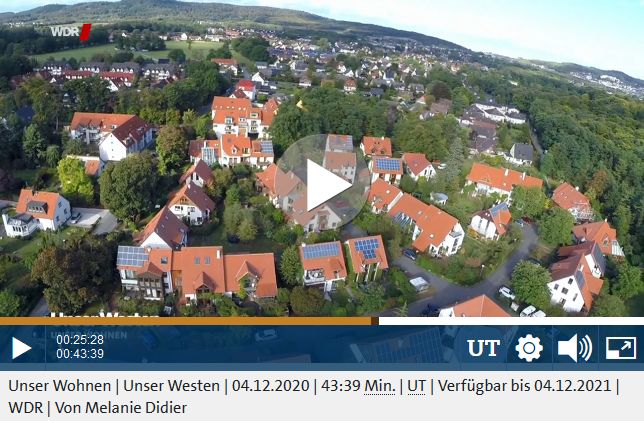
Our home. Our West. Broadcast from 7.2.2020
43:39 Min Available until 07.02.2021
WDR. By Melanie Didier
From minute 25 to 29:50 the ecological settlement Waldquelle in Bielefeld is shown. Ute Möller, one of the founders, leads a tour through the ecological settlement and reports on the experiences and developments in the now almost 25-year-old settlement with lots of wood, greenery and solar cells on the roof.
Link to the documentary: www1.wdr.de/...unser-wohnen-100.html
Info and photo gallery about the Waldquelle eco-settlement
http://sdg21.eu/db/bielefeld-waldquelle
Keywords:
Building Biology, Building materials / Construction, Greening / climate adaptation, DE-News, Movies, Media, News Blog NRW, PV, Participation, Settlements, eG
"The world's water resources are currently facing the greatest threat in the history of mankind," write aquatic ecologists in their recently published statement paper. More than one hundred professional societies of aquatic ecosystem research around the globe have signed the joint statement. In it, the researchers show the dramatic effects that climate change is having on aquatic ecosystems worldwide. They call for immediate concerted action by politics, business, science and society to halt the progress of climate change.
"Climate change is here - and it is leaving clear, partly irreversible traces in aquatic ecosystems," says Prof. Markus Weitere, President of the German Limnology Society (DGL) and Head of the Department of Stream Ecology at the Helmholtz Centre for Environmental Research (UFZ). (DGL) and head of the Department of Stream Ecology at the Helmholtz Centre for Environmental Research (UFZ). "We aquatic ecologists see the effects of climate change every day through our work. And the exchange with colleagues from all over the world shows: The problems reach around the globe - and they are massive." In a joint statement paper, professional societies from all over the world that study aquatic ecosystems have now compiled the effects of climate change on aquatic ecosystems and substantiated them with relevant studies. The paper was published on 14 September 2020. The DGL is one of the 110 signatory professional societies with more than 80,000 members.
"Freshwater ecosystems are among the most threatened ecosystems on earth." (quote statement paper)
Water is essential for the survival of all organisms. Aquatic ecosystems are therefore an indispensable basis for all life on earth. Due to climate change, however, water bodies are losing their ecological balance. "The extreme droughts we have experienced in Germany in recent years are signs of climate change and will become more severe," says Weitere. "The associated consequences for our water bodies are serious. For example, flowing waters carry less water, riparian areas and floodplain landscapes are falling dry. All this has a negative impact on the water ecosystem." The dwindling availability of water is also a problem for humans, as the groundwater level is sinking and drinking water reservoirs can no longer be sufficiently replenished.
Water quality is also suffering from the effects of climate change. "High temperatures and changes in water flow favour the eutrophication of water bodies, which leads to an increased development of algae as well as potentially toxic blue-green algae. "When this algal biomass is degraded, favoured by high temperatures, oxygen depletion occurs," explains Weitere. "This damages the organisms and can cause mass fish kills, as seen in the 2018 and 2019 droughts." In their statement, the professional societies further point to the risk of increased pollutant loads in water bodies. Rising temperatures can mobilise pollutants bound in permafrost soils and release them into water systems. "These and numerous other effects of climate change are leading to an increasing loss of biodiversity in water ecosystems," says Weitere. "This process is further exacerbated by immigrant species that benefit from changing conditions in water bodies and displace native species." Climate change is also leading to an increasing deterioration of water quality in the oceans. In their statement, the expert societies explain that shifts in species composition and abundance, for example, are already visible - with consequences for fishery yields and food security. "The global economic consequences of climate change should not be underestimated," says Weitere. "Failure to tackle climate change, loss of biodiversity and water crisis - these three issues have now been ranked for the first time among the top 5 risks of the coming decade by the World Economic Forum in its assessment of global risks."
"Governments, the public, industry, science and all other sectors of society need to prioritise and act in a concerted way to halt man-made climate change and prevent dire consequences."
(Quote statement paper)
What must be done now to slow down the progress of climate change and to keep the impacts as low as possible? In their statement paper, the aquatic ecologists call for a rapid, consistent and drastic reduction in the release of greenhouse gases. In addition, natural processes that sequester carbon must be promoted - e.g. by preserving, protecting and developing wetlands as natural carbon sinks. "Some consequences of climate change will be irreversible, however," says Weitere. "To best buffer the negative effects, we need to take regionally adequate measures." This includes promoting research and training in water ecology and ensuring capacities in water monitoring and management. The effects caused by climate change - eutrophication, oxygen depletion, pollutant mobilisation, immigration of alien species and loss of biodiversity - are not unknown in water ecology and can therefore still be managed in many cases. "Climate change is both a trigger and an accelerator. We can still make a difference - for that we have to take the scientific findings seriously and act boldly and decisively," says Weitere.
This statement is being released to coincide with the start of the American Fisheries Society (AFS) Virtual Annual Meeting on 14 September 2020 (afsannualmeeting.fisheries.org).
Statement (German translation): https://www.dgl-ev.de/cms/upload/dokumente/Stellungnahmen/200914_Statement_Wasse…
Prof. Markus More
Head of UFZ Department of Flowing Water Ecology / President of the DGL
markus.weitere@ufz.de
Original publication:
https://climate.fisheries.org/world-climate-statement/
Source: PM of the Helmholtz Centre for Environmental Research (UFZ) from 14.09.2020
Keywords:
Research, Climate emergency, Climate protection, News Blog Europe (without DE), Permaculture, Quarters, Settlements, City, Transition Town, UN (United Nations), Environmental policy, Water design, Ecology

There is a shortage of housing in Europe's conurbations; Germany alone lacks about 1.5 million residential units (WE). For this reason, the federal government has decided to build 400,000 WE annually. At the same time, the federal government's climate protection plan foresees a significant decrease in building emissions from 209 million to 67 million tonnes of CO2-equivalents by 2030, which would correspond to an emission reduction of 68 % since 1990. Other European countries have also committed to implementing far-reaching climate protection targets. Against this background, many of those involved in construction are increasingly relying on wood as a renewable building material, in addition to energy-efficient construction and the use of renewable energies.
The Construction cost study on large timber housing estates and quarters in Europe (short Wooden housing study), financed from funds of the funding programme FUTURE CONSTRUCTION of the Federal Ministry of Transport, Building and Urban Affairs (BMWSB) and based at the Rottenburg University of Applied Sciences (HFR), systematically researches and records those projects in timber and timber hybrid construction that have already been realised or are currently in planning. In the process, the construction costs of the buildings are analysed as well as the motives of the investors and clients to build with wood. Another goal is to show how timber construction methods can be further established in the segment of housing estates and urban districts in order to expand the range of large-volume housing projects with an environmentally and climate-friendly variant.
The first results of the study will be presented at the 15th Congress Efficient Building with Wood in Urban Areas on 19 October 2022 in Cologne presented. So far, 118 large-scale housing projects with more than 100 units have been identified across Europe by the HFR researchers, 47 of which are located in Germany. Final results will be presented at the beginning of December at the 26th International Timber Construction Forum in Innsbruck presented on 30 November 2022 and also published in a brochure by the Information service wood published.
Supported by funds from the "Zukunft Bau" funding programme

Keywords:
Construction and operating costs, Building materials / Construction, DE-News, Research, Wood construction, New books and studies, News Blog Europe (without DE), Quarters, Settlements, Housing, XXL settlements