 The German Sustainable Building Council (DGNB e.V.) has published a new report explaining how buildings can contribute to the United Nations' global sustainability goals. The publication compares the 17 Sustainable Development Goals (SDGs) with the potential influence of sustainable planning and construction. Architects and planners, as well as building owners and municipalities, are thus provided with orientation as to how they can meaningfully become active in terms of sustainable development. The report also offers a comparison of the SDGs with the criteria of various DGNB certification systems. This shows: Up to 15 of the 17 SDGs are addressed in the context of the DGNB certification of a building project.
The SDGs are part of the 2030 Agenda, which was adopted by all member states of the United Nations in September 2015. With the goals, the international community is committed to socially, economically and ecologically sustainable development. "In many countries, the SDGs are actively lived and used as a common basis for communication," says Dr. Christine Lemaitre, Executive Director of the DGNB. "In Germany, and in particular also in the construction and real estate industry, on the other hand, we still have a lot of catching up to do. And this is despite the fact that the sector plays a key role in achieving the goals."
Almost all SDGs are addressed in construction
With the new report, the DGNB wants to help increase awareness of the SDGs in the building sector and ensure that they are understood as orientation and added value in planning and communication. "We wanted to present the topic in such a way that the direct link between the SDGs and sustainable construction is conveyed in a way that is easy to understand," says Lemaitre.
 The publication introduces the reader to the topics of the 2030 Agenda, identifies specific areas of impact and provides impetus for how each individual can make a contribution to the SDGs. It also shows why the construction industry is of particular importance for achieving the goals and which 15 SDGs are specifically addressed. In addition, the report takes a closer look at the six SDGs that are particularly relevant for the building sector:
- Health and well-being (SDG 3)
- Affordable and clean energy (SDG 7)
- Sustainable Cities and Communities (SDG 11)
- Sustainable consumption and production (SDG 12)
- Climate protection measures (SDG 13)
- Partnerships to achieve the goals (SDG 17)
 DGNB certification as an instrument for implementing the SDGs
A special focus of the publication is on the interlinking of the SDGs with different variants of the DGNB system. For this purpose, the different criteria of the DGNB certification of new buildings, buildings in operation and quarters were reviewed for their linkage to the UN goals.
"The DGNB system translates the SDGs into building practice and closes the gap between the big, global goals and real implementation," explains Lemaitre. "With the new report, interested parties can now see at a glance which SDGs a certified project contributes to," says Lemaitre. "The certification is thus also suitable as a communication tool for all building owners and can be integrated into the sustainability reporting of companies and municipalities."
Publication available via the DGNB website
The new DGNB Report "Building for a Better World" is available in a digital version via www.dgnb.de/publikationen available free of charge. In the near future, it will also be possible to order the publication in printed form free of charge. An English version is also planned.
Keywords:
DE-News, DGNB, New books and studies, SDG 2030, Certification & Labels
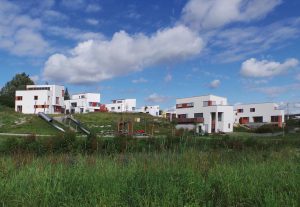 On siedlungen.eu there are now photos of the sustainable showcase quarter eQ in Pfaffenhofen for the first time.
 In the interview worth reading


