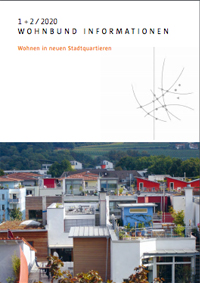
With a new law, Paris encourages its residents to garden the public space. Wherever possible, vertical and horizontal gardens are to be created, urban agriculture is promoted. There is even a starter kit with planting soil. Among other things, 100 hectares of living facades and roofs are to be created by 2020.
The 88th Conference of Environment Ministers has just passed a resolution in Bad Saarow on the "Promotion of Building with Wood", which was introduced by Rhineland-Palatinate. The document calls on the federal government to improve the framework conditions for timber construction. The German Timber Industry Council e. V. (DHWR) expressly welcomes this initiative.
According to the Rhineland-Palatinate Minister of the Environment, the positive climate protection properties of renewable raw materials are to be taken into account in building energy law, among other things.
This would be more than desirable, because the draft bill for the Building Energy Act (GEG) recently presented by the Federal Ministry for the Environment, Nature Conservation, Building and Nuclear Safety (BMUB) missed the opportunity to finally take the entire life cycle of buildings into account in the amendment.
In the manufacturing, recycling and disposal process of certain building materials, a large amount of CO2 is released - often more than is consumed in the entire use. In terms of climate policy, it is therefore incomprehensible that this is neither taken into account in the draft Building Energy Act, nor in the energy balance of the building according to the Thermal Insulation Ordinance, nor in the preparation of the energy certificate.
"The Federal Government and the Länder have an equal role to play in sustainable management and the future-oriented use of resources. We see the current resolution of the Conference of Environment Ministers as an important step in the right direction - this should serve as a signpost for both the current and the future federal government."
Read more:
Press release of the Ministry of Environment, Energy, Food and Forestry of Rhineland-Palatinate (May 5, 2017)
Kaiserslautern (energate) - The Energy Agency Rhineland-Palatinate and the consulting firm BET Aachen have published a study on the topic of "Attractive business models with PV systems".
Yesterday, the Agency for Renewable Energies awarded the Rhine-Hunsrück District as Energy Municipality of the Decade / Environment and Energy Minister Ulrike Höfken congratulates warmly on this award.
Yesterday, the Agency for Renewable Energies awarded the Rhine-Hunsrück district in Kassel as "Energy Municipality of the Decade". "Climate change is clearly noticeable in Rhineland-Palatinate, as currently shown by the dramatic damage to forests. With its commitment to the energy turnaround, the Rhine-Hunsrück district is making a significant contribution to climate protection and the preservation of our animal and plant species on a regional level. The fact that the Rhine-Hunsrück district has been chosen as the energy community of the decade among all the exciting and exemplary energy transition projects throughout Germany in the last ten years is an outstanding recognition. I would like to warmly congratulate all those who have contributed to this: The award is a great honour and motivation for all climate protection campaigners in the Rhine-Hunsrück district," said Environment and Energy Minister Ulrike Höfken today in Mainz.
The award is a nationwide recognition of what the district has successfully achieved in recent years. "The Rhine-Hunsrück district is one of the first zero-emissions districts in the inland, 300 percent electricity from renewable energies is generated here in relation to its own consumption, 16 local heating networks are in operation and save around 2.7 million liters of heating oil annually. These figures are also impressive in a nationwide comparison and are the result of an early, energetic and planned energy turnaround on site," explained the Minister. And this also has an impact on regional and economic development: A total of around 44 million euros per year in municipal added value is generated in the Rhine-Hunsrück district through renewable energies, Höfken cited. With these financial means of energy production from wind, sun and biomass, further meaningful projects for the continuation of the energy turnaround as well as for the development of rural areas will be implemented. Höfken concluded: "The Rhine-Hunsrück district impressively shows how energy transition and climate protection work on a municipal level."
Local heating supply from biomass and solar thermal energy in the bioenergy village of Mengsberg, source: Bioenergiegenossenschaft Mengsberg eG
With the portal https://energiewendedörfer.de the University of Kassel and the Georg-August-University Göttingen present first results from the joint project "Innovative concepts and business models for sustainable bioenergy villages - climate-friendly, democratic, close to the citizens". In particular, concepts for bioenergy or biogas plants are being developed that can enable continued economic operation following the previous 20-year EEG phase.
With recommendations for action in the areas of residual material use, alternative energy crops, optimisation of value creation through recycling management, future electricity marketing, efficient heating networks and sector coupling of bioenergy with other renewable energies, bioenergy villages and operators of energy plants are shown possible new business models. To this end, the researchers are working in so-called real laboratories with the bioenergy villages Krebeck/Wollbrandshausen and Altenmellrich/Anröchte in order to be able to examine the feasibility and economic viability of the new models under practical conditions.
The platform https://energiewendedörfer.de offers recommendations for action as well as information on biomass and residual material potentials and a GIS map that presents the bioenergy villages in Germany and their measures and technologies. Among other things, this enables a targeted search for the fuels or substrates used and the technologies applied. It is aimed at all interested parties who are committed to an energy and heat transition in their villages or communities.
The CO2-In addition, attractive funding programmes and the Building Energy Act support local authorities in switching to a renewable heat supply. Extensive information offers on energiewendedörfer.de as well as the guides, market overviews and other service offers of the Agency for Renewable Resources (Fachagentur Nachwachsende Rohstoffe e. V. - FNR) provide the necessary information. (FNR) provide the necessary support to advance the energy transition in municipalities.
The joint project "Innovative concepts and business models for sustainable bioenergy villages - climate-friendly, democratic, close to the people" is funded by the Federal Ministry of Food and Agriculture (BMEL) via the project management organisation FNR. Information on the project is available at https://energiewendedörfer.de and in the FNR project database at www.fnr.de under the funding codes "22405817" and "22405218" available.
We use cookies to optimize our website and services.
Functional
Always active
Technical storage or access is strictly necessary for the legitimate purpose of enabling the use of a particular service explicitly requested by the subscriber or user or for the sole purpose of carrying out the transmission of a communication over an electronic communications network.
Preferences
The technical storage or access is necessary for the legitimate purpose of storing preferences that have not been requested by the subscriber or user.
Statistics
The technical storage or access, which is solely for statistical purposes.Technical storage or access used solely for anonymous statistical purposes. Without a subpoena, voluntary consent from your Internet service provider, or additional records from third parties, information stored or accessed for this purpose cannot generally be used alone to identify you.
Marketing
Technical storage or access is necessary to create user profiles, to send advertising or to track the user on a website or across multiple websites for similar marketing purposes.