12/2013: Specialist advice on timber construction
The specialist timber construction advice service of the INFORMATIONSDIENST HOLZ provides individual and company-neutral assistance in planning and building with timber - from fundamental questions in building design to details in execution. These can be technical properties of building products, building law issues, design and structural issues or building physics contexts.
Architects and engineers, public and private building decision-makers, students and teachers as well as media representatives can obtain qualified and unbureaucratic information from experts whose knowledge is up to date.
Deutsche Umwelthilfe calls for immediate proposal for tax incentives for energy-efficient building refurbishment - Building sector makes decisive contribution to achieving climate protection targets - Increase refurbishment rate to 2 percent per year
Contrary to the agreements in the coalition agreement, the draft budget presented by the Federal Minister of Finance, Olaf Scholz, on 2 May 2018 does not include tax incentives for the energy-efficient refurbishment of buildings. Deutsche Umwelthilfe (DUH) considers this a worrying revelation. The environmental and consumer protection organisation calls on the federal government to immediately launch a programme for tax incentives for the energy-efficient refurbishment of buildings and to increase the refurbishment rate for existing buildings from the current 0.8 percent to at least 2 percent per year.
"If the Federal Minister of Finance does not anchor this measure, which was agreed in the coalition agreement and is central to climate protection, in his draft budget, then he shows that he has either forgotten or already abandoned the climate policy promises of the new government after only a few weeks in office.", says Sascha Müller-Kraenner, Federal Executive Director of DUH.
Energy-efficient building refurbishment is a central element of the energy transition and climate protection. However, climate protection in the building sector will only be successful if the renovation rate in the building stock increases from the current 0.8 percent to over 2 percent annually.
"The two previous governments already failed to set the course for tax incentives in time and thus make a decisive contribution to achieving the 2020 climate protection target"Müller-Kraenner continues. "The reservations of the Länder that tax incentives would create a budget gap for them have been known for a long time. It is time to bring acceptable counter-financing solutions to the table."
After all, tax incentives for refurbishment costs are an important incentive not only for large housing associations but also for private homeowners to invest their own funds. The starting signal for this must now be given urgently.
Researchers at DIW Berlin have developed the "Ampel-Monitor Energiewende" - monitor the extent to which the government's energy policy agenda is being implemented - immense efforts are needed to close the gap between the announced targets and the current status quo
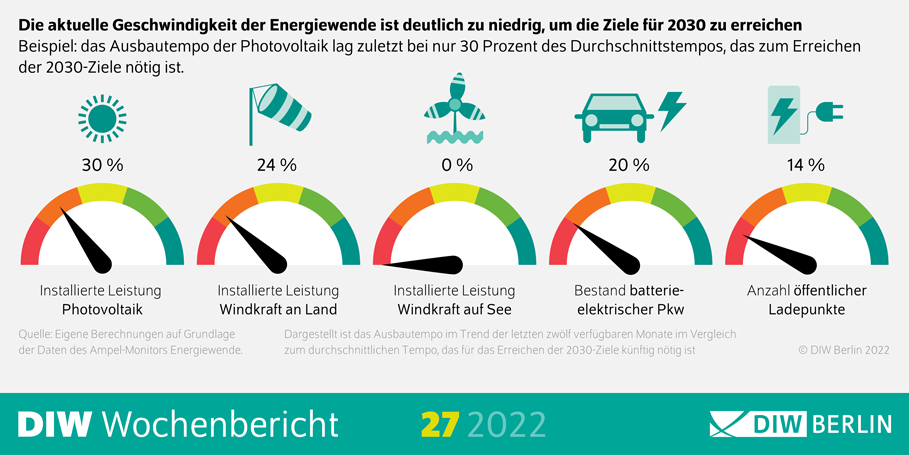
If the German government wants to achieve its energy policy goals, it must step up the pace. There are particularly large gaps between the current development and the targets for green hydrogen, electromobility and renewable heat, as the "Ampel-Monitor Energiewende" of the German Institute for Economic Research (DIW Berlin) shows. DIW researchers developed the monitor to track the progress of the energy transition towards climate neutrality using 15 indicators. The monitor, which is based on open data, accompanies progress on the government's goals with a focus on the period up to 2030. Selected results are now available on the DIW Berlin website (https://www.diw.de/ampel-monitor) are provided in the form of interactive graphics and short analyses and are updated regularly. All indicators and the underlying data can also be found open source on the Open Energy Tracker platform (https://openenergytracker.org).
"Our traffic light monitor makes it clear: the current pace of the energy transition is far too slow to achieve the 2030 targets," says DIW energy economist Wolf-Peter Schill, co-initiator of the monitor, which is presented in a study today. "If the government does not want to fall behind its target path, it must implement concrete and far-reaching steps promptly."
The pace of photovoltaic expansion must be tripled
The monitor shows: If the government wants to achieve its photovoltaic targets by 2030, it will have to triple the pace of expansion compared to the trend of the past twelve months, and even quadruple it for onshore wind power. At the current rate, the targets would clearly be missed. This would also make it impossible to achieve the coalition's goal of increasing the share of renewable energies in electricity consumption from the current 42 percent to 80 percent in 2030.
There is also a large gap in renewable heat, for which a share of renewable energies of 50 percent is envisaged in 2030. For this to happen, the share must grow by almost four percentage points per year - although it has not even increased by three percentage points since 2012.
"The Federal Government's to-do list is still long. The energy policy goals that have been set are not self-fulfilling; development must gain momentum in all areas." Alexander Roth
E-car fleet still growing very slowly - charging infrastructure inadequate
If the coalition's goal of increasing the e-car fleet to 15 million vehicles by 2030 is to be achieved, an average of around 130,000 vehicles must be registered in Germany every month. In addition to the existing purchase premiums, the EU ban on combustion engines, which is currently being voted on, could certainly contribute to more electromobility," explains study author Adeline Guéret.
According to the Monitor's data, the charging infrastructure must increase even more if the target is not to be missed. Instead of the current 1200 charging points per month, 8,700 would have to go into operation - around seven times as many.
From practically zero to ten gigawatts in green hydrogen
Most needs to happen with green hydrogen, as the traffic light monitor shows: The electrolysis capacity of around ten gigawatts in 2030 targeted in the coalition agreement still seems a long way off, given an electrical capacity of around 60 megawatts at the end of last year.
"With its open and constantly updated energy data, our traffic light monitor makes an important contribution to an informed and fact-based energy policy debate," concludes study author Alexander Roth. "It shows that the German government still has a long to-do list. The goals set are not self-fulfilling; development must gain momentum in all areas."
Even before the UN Summit on Sustainable Development, it is clear that the implementation of the 2030 Agenda is making slow progress. The global community now needs action instead of words to achieve the Sustainable Development Goals.
The international report on the status of SDG implementation shows that there are major gaps in implementation worldwide. The number of hungry people is increasing again worldwide. Social inequality continues to rise. The climate crisis and species extinction are advancing.
It is particularly dramatic that Germany is not a pioneer. In sustainability policy, the German government permanently acts according to the motto "too little, too late". Germany has a double responsibility: firstly, as an industrialised country, to demonstrate that it is taking the implementation of the Agenda seriously as a pioneer. And secondly, to contribute more than it has so far to financing the 2030 Agenda at the international level.
There is no coherent national legislation aligned with the SDGs. Still not all departments have prepared SDG action plans or provided additional funding. The climate cabinet's proposals are far from sufficient to achieve the climate sustainability goal and the Paris Climate Agreement. Biodiversity is declining, nitrate pollution for groundwater is not decreasing, environmentally harmful subsidies amounting to over 40 billion euros annually are not being eliminated.
We demand binding targets for SDG implementation for all ministries and ambitious measures where there are particularly large deficits in achieving the Sustainable Development Goals. In addition, the German government must develop more ambitious indicators to meet the requirements of the SDGs. There is also a need for a sustainability TÜV for new laws.
At the international level, sustainability summits need to be organised in a more goal-oriented and inclusive way. It is incomprehensible that the private sector is invited to the SDG Business Summit at the United Nations, while there is no comparable forum for civil society. This is a fatal sign at a time when civil society actors worldwide are increasingly suffering from restrictions. This approach runs counter to the "Leave no one behind" guiding principle of the 2030 Agenda.
Source: Press release of 24.9.2019 by Buendnis 90/The Greens in the Bundestag Uwe Kekeritz, Spokesperson for Development Policy, and Bettina Hoffmann, Spokesperson for Environmental Policy
In a second, somewhat more extensive update of the sdg21 web database, there were these innovations:
- the Home page was completely revised
- many new projects and Photo galleries
- the Europe projects reorganised
- FNB blog on the sdg21 website at blog.sdg21.eu moved
- Improved structuring and new plugins improve functionality
We use cookies to optimize our website and services.
Functional
Always active
Technical storage or access is strictly necessary for the legitimate purpose of enabling the use of a particular service explicitly requested by the subscriber or user or for the sole purpose of carrying out the transmission of a communication over an electronic communications network.
Preferences
The technical storage or access is necessary for the legitimate purpose of storing preferences that have not been requested by the subscriber or user.
Statistics
The technical storage or access, which is solely for statistical purposes.Technical storage or access used solely for anonymous statistical purposes. Without a subpoena, voluntary consent from your Internet service provider, or additional records from third parties, information stored or accessed for this purpose cannot generally be used alone to identify you.
Marketing
Technical storage or access is necessary to create user profiles, to send advertising or to track the user on a website or across multiple websites for similar marketing purposes.
 12/2013: Specialist advice on timber construction