Following China and the USA, India now also wants to approve the Paris Climate Agreement. Prime Minister Narendra Modi announced the date as 2 October. It is the birthday of Mahatma Gandhi. India is the world's third largest producer of greenhouse gases.
With a very large majority, the municipal council decided on 22.07.2021 to initiate the urban development measure (SEM) "Nördlich Hafner". The development statute provides the project with a binding legal framework for the city of Constance and the remaining property owners in the area. The decision is also the conclusion of the preparatory studies (VU) that have been running for about four years, in which not only various subject-related studies and the urban development framework plan were developed, but also a comprehensive timetable and a detailed cost and financing overview were drawn up. In total, the development of the approx. 106 ha large area (of which around 60 ha settlement area) including all technical and social infrastructures (e.g. day-care centres, primary school). In the end, income from the allocation of land will result in a largely balanced overall balance.
"With the results of the preparatory studies, valuable foundations have been laid for a speedy development of the area and thus for the creation of affordable housing and commercial space. Even though major tasks still await us in the coming years: Now the development of the Hafner can really take off. I am looking forward to the further joint process of developing the new district for and with the people of Constance," says Construction Mayor Karl Langensteiner-Schönborn.
The development of the first construction phase could begin from the end of 2025, and the completion of all development measures in the third and final construction phase is planned for 2038. Until then, there are still many planning steps to be taken: Further owner discussions and negotiations (with the aim of acquiring the plots or a binding participation of the owners), the further development of the framework plan, in-depth expert opinions, the preparation of development plans as well as the development of an allocation concept for plots are only some of the tasks. For all those involved and interested, there will also be many opportunities in the coming years to inform themselves about the further process and to participate.
In 2016, the municipal council decided that preparatory studies for an urban development measure should be carried out for the Hafner area. After these were completed in May 2021, the project now reaches an important milestone with the consultations on the resolution of a development statute in July 2021.
Over the past four years, the city administration, together with external experts, has investigated the prerequisites for implementing an urban development measure in the area: from a planning, temporal, economic and property rights perspective. The preparatory studies have come to the conclusion that the urban development framework plan for the area, which was adopted by the municipal council at the end of 2019, can be implemented. "The important foundation for a rapid development of affordable housing and commercial space in the Hafner area - over 3,000 residential units and 15 ha of commercial space - has thus been laid," says Mayor Karl Langensteiner-Schönborn.
In contrast to traditional models of building area development, the instrument of urban development measures offers the possibility to prevent land speculation, to involve the owners in the development and to handle and finance the social infrastructure needs in the area through the measure. The instrument distributes obligations and rights fairly between the owners and the common good: investment costs are not socialised and development profits are not privatised, but reinvested for development.
The resolution of a development statute now sets the corresponding legal framework for the development. It is also the starting signal for the next steps in the development process. At the end of 2021, the decision to draw up the development plan for the first construction phase is to follow, and from 2024, the allocation of plots to WOBAK, housing cooperatives, building associations and other developers is to begin via concept procedures. Development of the first construction phase is expected to begin at the end of 2025.
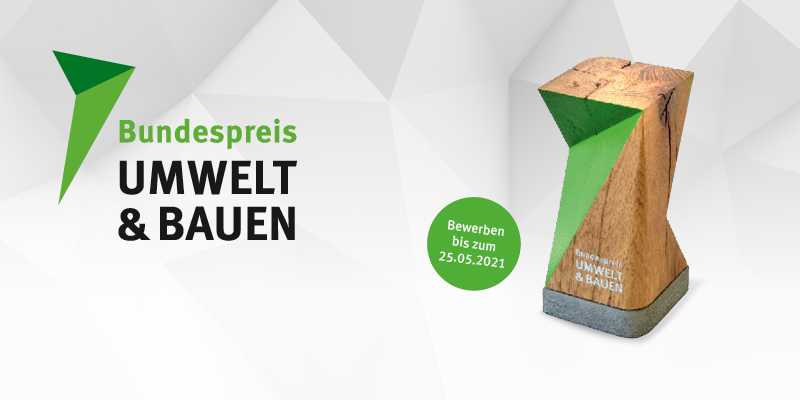
The Federal Award ENVIRONMENT & BUILDING initiated by the Federal Ministry for the Environment, Nature Conservation and Nuclear Safety (BMU) and the Federal Environment Agency (UBA) under the patronage of Federal Minister Svenja Schulze honors projects that already realize the idea of a new Bauhaus in the sense of holistically sustainable buildings. In 2021, the prize will be awarded for the second time, this time in four categories. All players in the building sector are eligible to apply. The closing date for entries is 25 May 2021.. The prize will be awarded on 7 September by Parliamentary State Secretary Florian Pronold and UBA President Dirk Messner.
The discussion about the climate, environmental and health impacts of buildings and their construction has long since reached the centre of society. Topics such as primary energy demand, grey energy or healthy building are no longer just the preserve of experts, but are also attracting the attention of more and more private and public building owners. And rightly so - because the building sector consumes enormous raw material and energy resources, and building products can be harmful to the environment and health. Sustainable solutions already exist today and are already being implemented. The Federal ENVIRONMENT & BUILDING Award therefore honours lighthouse projects in the field of sustainable building and helps to bring the EU Commission's vision of a "New European Bauhaus" to life.
About the Federal Award
This year, the Federal Award will again be presented in the categories "Residential Buildings", "Non-residential Buildings" and "Neighbourhoods". A fourth category, "Climate-friendly refurbishment", is new. In addition to these competition categories, the jury may award special prizes for particularly innovative approaches among the projects submitted.
Conditions of participation
Due to the thematic breadth, all actors in the building sector are invited to apply: from builders and developers to offices for architecture, building services engineering, urban or landscape planning to manufacturers or research institutions. The call for entries is aimed at buildings that have already been completed in Germany or neighbourhoods that are at an advanced stage of planning; multiple applications in different categories are possible (also applies to refurbishment projects!).
What awaits the winners
The award winners will receive public attention on several levels. The award ceremony will take place on 7 September 2021 at the Federal Ministry for the Environment, Nature Conservation and Nuclear Safety in Berlin, where the award-winning projects will be presented to experts and the media. The award-winning projects will also be featured on the websites of UBA and the Federal Environment Ministry. UBA is having films made on the award-winning sustainability examples, which the winners can then use for their own public relations work. Furthermore, all award-winning projects will be documented in a book.
Further
For more information on the conditions of participation in the Federal Environment & Building Award and last year's winners, please visit the Federal Award website: www.umweltbundesamt.de/bundespreis-umwelt-bauen.
More and more people are answering the question "How do we want to live?" with "Together instead of alone." Community living has become very popular in recent years, both among young and older people. The forms of new residential, house and housing communities are diverse: from self-sufficient eco-villages and multi-generational housing projects to so-called "beguine projects" for women.
The ARL - Academy for Spatial Research and Planning took up this topic in the 1/2016 issue of "ARL News" under the title "Housing projects - from niche to trend?". Micha Fedrowitz contributed an article on communal living in Germany.
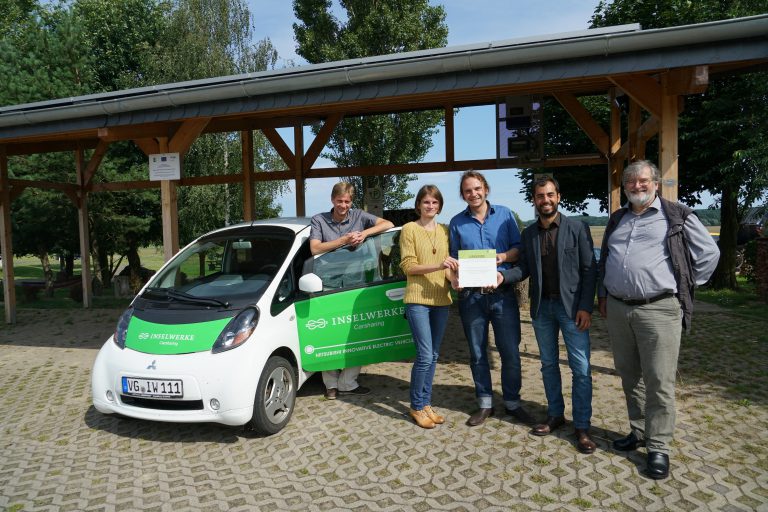
Inselwerke eG has been named Citizen Energy Project of the Year 2017. Photo: Matthias Gründling / Inselwerke eG
In future, three citizens' energy cooperatives will bear the award "Citizens' Energy Project 2017". A total of 17 projects nationwide took part in the competition for the title. The three winning projects received a particularly large number of votes during a two-month internet voting process, in which around a thousand interested people took part, and also prevailed in the evaluation of the jury consisting of committee representatives of the Bündnis Bürgerenergie (BBEn). The jury, consisting of five BBEn committee members, was impressed by the large number of applications to the competition, which was held for the first time, as well as the diversity of the applicant projects. According to the jury, the high level of the winning projects also shows how versatile the citizen energy companies in Germany currently are. This can be seen in the very different activities of the three winning cooperatives and the projects they submitted.
Development of a charging network According to the jury, the project of Inselwerke eG to set up an e-charging network on the Baltic Sea island of Usedom combines sustainable mobility and the expansion of the regional infrastructure so that "a strengthening of the important economic factor of tourism is achieved", as Thomas Banning, member of the jury and BBEn supervisory board member, emphasises. The professional concept of the cooperative convinced the jury and shows which business models are open to citizen energy companies. In particular, the possible duplicability of the charging network and the associated high reach of this approach are aspects that the jury considers worthy of an award. The Inselwerke eG developed a special Usedom model for a multi-stage expansion of the charging infrastructure for electric vehicles - not only on the Baltic Sea island, but also for the entire state of Mecklenburg-Vorpommern. Since April 2016, the cooperative has been able to set up 16 charging stations at 12 locations in cooperation with 11 partners, and more are currently being planned.
Noise barrier with integrated photovoltaic system The second winner, the EnergieGenossenschaft Inn-Salzach eG, is awarded for its noise barrier with integrated PV system. The energy cooperative in the Upper Bavarian region had erected a noise barrier together with the town of Neuötting. The 230-metre-long and almost five-metre-high structure along a busy road is also equipped with solar power panels. The modules together have a maximum output of 64 kilowatts, which can cover half of the electricity needs of a nearby school during the day. In addition, the wall also separates the school from traffic noise. In addition, the project flows into the lessons and thus ensures a tangible integration of the topic for the pupils.
According to the jury, this integrative concept reflects the current progress of the energy transition and uses dormant potential. Thomas Banning emphasises the recognisable double benefit of the solar noise barrier as follows: "The noise barrier combines the generation of clean energy with protection from the negative consequences of car traffic. The whole thing also has a high aesthetic value and is easy to communicate. That's how you move more!"
Innovative municipal energy concept The third winner, BürgerEnergiegenossenschaft Emmendingen eG, is awarded for its activities as a cooperative. According to Kai Hock, member of the jury and BBEn supervisory board member, it strives for a holistic energy transition from a technical point of view. It achieves a strong local impact with its activities, which can be seen, for example, in the number of 180 members. Thus, the cooperative has a high reach of the energy transition with its projects and achieves this with different forms of application and technologies, which is why a high innovative character can also be attributed to it.
For example, Emmendinger eG gave schools and residential buildings an all-round energy upgrade, consisting of heating systems, CHP systems and solar systems. It has also equipped buildings such as the adult education centre with photovoltaic systems on a lease model. In addition, a PV system on a goat shed with 250 kWp is currently being planned.
According to the jury, the three winners are particularly representative of the high level of activity of the many citizens' energy associations in Germany. They are therefore rightly awarded the title "Citizen Energy Project of the Year", on which the jury congratulates them warmly.
We use cookies to optimize our website and services.
Functional
Always active
Technical storage or access is strictly necessary for the legitimate purpose of enabling the use of a particular service explicitly requested by the subscriber or user or for the sole purpose of carrying out the transmission of a communication over an electronic communications network.
Preferences
The technical storage or access is necessary for the legitimate purpose of storing preferences that have not been requested by the subscriber or user.
Statistics
The technical storage or access, which is solely for statistical purposes.Technical storage or access used solely for anonymous statistical purposes. Without a subpoena, voluntary consent from your Internet service provider, or additional records from third parties, information stored or accessed for this purpose cannot generally be used alone to identify you.
Marketing
Technical storage or access is necessary to create user profiles, to send advertising or to track the user on a website or across multiple websites for similar marketing purposes.