Bonn/Berlin (26 Jan. 2019). The Coal Commission's decision sets the course for the coal phase-out by 2035, or 2038 at the latest. The environmental and development organisations welcome these decisions, but regret that this phase-out path is not yet ambitious enough to achieve the Paris climate goals.
In 2023, according to the compromise, the phase-out can be improved for the first time so that it fits in with the climate goals of Paris. Only then would the social contract be fulfilled that we owe to those already massively affected by the climate crisis and to future generations. Around 10,000 students pressed for this yesterday in front of the negotiation building. Thousands supported them in many cities nationwide.
Cornerstones of the compromise: - The phase-out of coal should be completed by 2038 at the latest and preferably by 2035. In 2032, it will be examined whether the phase-out is already possible in 2035 in terms of energy economics. The environmental associations state in a special vote that they assume 2035 in view of the climate policy and energy economic situation.
- By 2022, a total of 12.5 GW of coal are to be decommissioned or placed in reserve. This includes 3 GW of lignite in the west in addition to the closures already decided. This will save the Hambach Forest and probably also the villages in NRW.
- In 2023, the targets can be revised for the first time so that they fit in with the Paris climate goals.
- The large Jänschwalde power plant will be shut down by 2025. The name is not mentioned, but the announced reduction of 10 million tonnes of CO2 refers to this site.
- From 2025, a steady reduction path begins until 2030, leading to a maximum of 9 GW of lignite and 8 GW of hard coal. This steady path is specified in a special vote by the environmental associations.
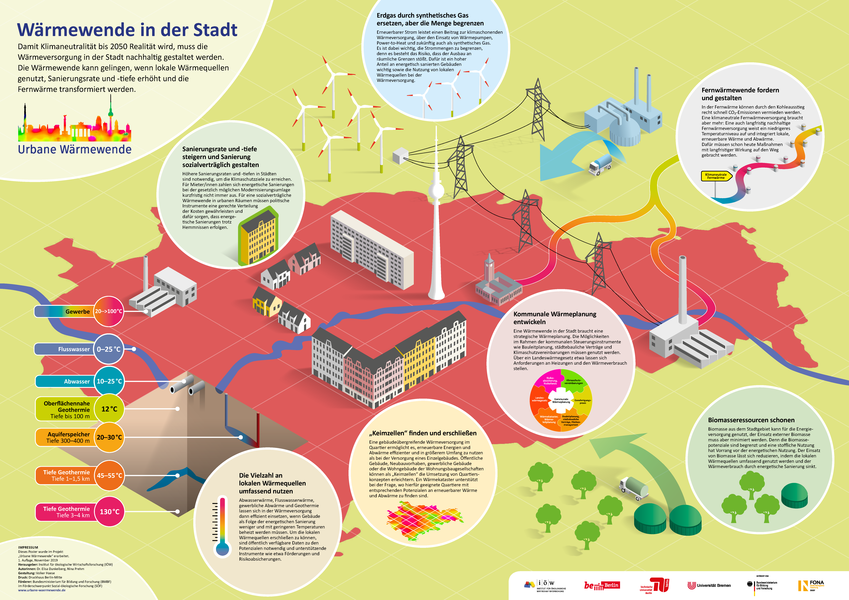
Berlin, 9 January 2020 - One of the Herculean tasks in achieving the climate targets is to radically reduce CO2 emissions from the heating supply. A research group led by the Institute for Ecological Economy Research (IÖW) is showing how cities can move away from coal, oil and gas in a socially responsible way. The "Urban Heat Transition" project analysed possible contributions from renewable energies and local heat sources in Berlin's urban districts. "Waste heat from businesses, heat from waste water or geothermal energy have hardly been utilised to date. The key to such environmentally friendly heat are neighbourhood concepts and heating networks," says project manager Bernd Hirschl from the IÖW. "An important prerequisite is a more efficient building stock. Only if the heat demand is significantly reduced can environmentally friendly heat sources be utilised efficiently."
In the three-year project, the project team from the IÖW, the University of Bremen and the Technical University of Berlin worked together with the Berlin Senate Department for the Environment, Transport and Climate Protection with funding from the Federal Ministry of Education and Research to develop local heating concepts for three Berlin neighbourhoods. At the end of 2019, they discussed their results with the heating industry in Berlin, and the documentation of the conference is now available online at www.urbane-waermewende.de.
Developing nuclei for the heat transition
"Previous neighbourhood concepts were often too complex, had too many different stakeholders and often ended up in a drawer. That's why we recommend a nucleus approach," says Elisa Dunkelberg from the IÖW. These could be public buildings, new construction projects, commercial buildings or housing associations and co-operatives.
The researchers show what a neighbourhood concept can look like for an old building district in Charlottenburg-Wilmersdorf: Firstly, the heat demand must be reduced through energy-efficient refurbishment. The heat can be generated using a wastewater heat pump, which is partly powered by solar electricity generated on site, in combination with combined heat and power generation. "Particularly in the case of public buildings, which have a pioneering role - enshrined in law in Berlin - it should always be checked in the case of refurbishment and new buildings whether they are suitable as a nucleus for a neighbourhood concept and the co-supply of surrounding buildings," emphasises Dunkelberg.
Climate-neutral district heating: utilising waste heat and renewables
District heating plays a major role in urban areas. "To become climate-neutral, it is important to integrate more local heat sources from wastewater, river water and geothermal energy as well as waste heat into district heating," says Hirschl, adding that attention must also be paid to the resilience of the heat generation system. A joint case study with the Neukölln district heating plant shows that it is possible to utilise local heat sources. But it needs to be tested technically and requires supporting financial measures. The next steps should now be test drilling for deep geothermal energy, for example, as well as pilot plants that use large heat pumps to provide wastewater or river water heat for district heating. Strategies for funding and risk protection are needed for investment in these technologies, some of which are untested and highly expensive.
Heat transition requires municipal strategic heat planning - and social compatibility
"Municipal heat planning, which has long been standard practice in pioneering countries such as Denmark and in other federal states and municipalities for some time, helps to tap into the identified potential," emphasises Hirschl. The basis for this is a heat register that visualises heat sources such as waste water and commercial waste heat. This can also be used to identify neighbourhoods for cross-building concepts. With sector coupling, it is also important that local authorities and cities plan across infrastructures. Instruments such as urban land-use planning and urban development contracts must be geared towards climate neutrality.
Low refurbishment rates in recent years show that purely incentive-based measures are not enough to ensure energy modernisation. The researchers therefore recommend implementing the regulations more strongly and developing a step-by-step plan to guide the building stock towards climate neutrality. At the same time, subsidies must be increased and conditions for passing on rent must be made more socially acceptable. A step-by-step plan under the conditions of a rent cap must be designed in such a way that energy modernisation is economically reasonable for both landlords and tenants.
Federal Ministry of Education and Research funds "Urban Heat Transition" project for another two years
The Federal Ministry of Education and Research is funding the project in a new partner constellation for a further two years in order to test solution strategies for the central obstacles to implementation and to anchor the research results in municipal heat planning. In addition to the IÖW, the partners are Berliner Wasserbetriebe and the law firm Becker Büttner Held.
Offensive for green electricity: Installation of 1,000 new photovoltaic systems and 2,000 charging points in Deutsche Wohnen neighbourhoods
"The building sector is responsible for around one third of all CO2-emissions in Germany. To achieve a climate-neutral building stock by 2050, the energy refurbishment of existing buildings alone is not enough," explains Michael Zahn, CEO of Deutsche Wohnen SE. "We also need to exploit the technological possibilities for CO2-Reduction to the fullest and open up the opportunity for our tenants to live sustainably."
Together with GETEC, Deutsche Wohnen will in future jointly develop offers for green tenant electricity and electric mobility for its tenants. As an important contribution to the energy transition in the big city, the companies want to promote decentralised power supply by means of photovoltaic (PV) systems in the neighbourhoods. Around 1,000 PV systems will be installed on the roofs of Deutsche Wohnen's properties - the first 20 will go into operation this year. The electricity generated by these systems will be directly available to the tenants in the buildings as green tenant electricity, without first being fed through the grid. This conserves resources and relieves the strain on electricity grids. Even small solar systems with a peak output of 38 kilowattsPeak (kWP) save around 14 tonnes of CO2 in. In Deutsche Wohnen's portfolios, the savings potential thus amounts to a total of around 14,000 tonnes of CO2 annually.
"Deutsche Wohnen has been investing in improving the carbon footprint of its properties for years. The expansion of photovoltaics is the next logical step towards climate-neutral living and working. We will invest around 50 million euros in this over the next ten years," says Michael Zahn.
In the future, the decentrally generated electricity will also be used to charge e-vehicles in the respective residential complexes, among other things. Together with GETEC, Deutsche Wohnen intends to set up more than 2,000 charging points across Germany. Planning for the first joint charging infrastructure projects has already begun. The investment volume amounts to approximately 25 million euros.
"Together with Deutsche Wohnen, we are creating needs-based electric charging infrastructure in neighbourhoods across Germany, sending a clear signal for the mobility turnaround," says Dr Karl Gerhold, managing partner of GETEC Energie Holding GmbH, underlining the aims of the collaboration.
Deutsche Wohnen and GETEC will establish the joint company SYNVIA mobility GmbH for the construction and operation of electric charging stations. The electricity generated in the districts will be marketed by the new joint company SYNVIA energy GmbH.
Source: Deutsche Wohnen PM dated 29 September 2020
On Saturday 14.4.2018, around 13,000 to 15,000 people took to the streets in Berlin under the slogan "Resistance - together against displacement and rent madness". 254 initiatives and organizations (see mietenwahnsinn.info/initiativen) called for the protest march. Many Berliners fear for their existence due to high housing costs.
Article "Large demonstration in Berlin - thousands against rent madness" in the taz: http://taz.de/Grossdemonstration-in-Berlin/!5498560/
3 min. video (Länderspiegel ZDF):
www.zdf.de/...grossdemonstration-in-berlin-rund-13-000-gegen-mietenwahnsinn-100.html
Statement by Klara Geywitz on the 2022 budget and the key figures of the financial planning until 2026
The draft budget for 2022 and the key figures of the financial planning until 2026 provide a total of 14.5 billion euros in programme funds for social housing. With this, we will support the construction of 100,000 social housing units annually. This is more than three times the original financial planning, which had provided four billion euros until 2025. The 2022 budget lays the groundwork with two billion euros. The federal and state governments want to create affordable and climate-friendly housing. Housing is one of the most important social issues of our time and must remain affordable. This is precisely where noticeable relief must be provided.
Construction does not happen overnight, which is why long-term planning security is crucial. The construction industry and the Länder receive my guarantee: we want to build and we will build. That's what the 14.5 billion euros are for.
In total, the budget of the BMWSB provides for expenditures of almost 4.9 billion euros for 2022, including 3.61 billion euros in investments that will strengthen the economy in Germany. The programme funds for urban development funding could be stabilised and secured at 790 million euros per year. The 14.5 billion for social housing construction is distributed as follows over the years: 2022 2 billion euros, 2023 2.5 billion euros, 2024 3 billion euros, 2025 3.5 billion euros and 2026 3.5 billion euros.
We use cookies to optimize our website and services.
Functional
Always active
Technical storage or access is strictly necessary for the legitimate purpose of enabling the use of a particular service explicitly requested by the subscriber or user or for the sole purpose of carrying out the transmission of a communication over an electronic communications network.
Preferences
The technical storage or access is necessary for the legitimate purpose of storing preferences that have not been requested by the subscriber or user.
Statistics
The technical storage or access, which is solely for statistical purposes.Technical storage or access used solely for anonymous statistical purposes. Without a subpoena, voluntary consent from your Internet service provider, or additional records from third parties, information stored or accessed for this purpose cannot generally be used alone to identify you.
Marketing
Technical storage or access is necessary to create user profiles, to send advertising or to track the user on a website or across multiple websites for similar marketing purposes.