Short film: 9 storeys in modular timber construction
Published
Hotel Jakarta in Amsterdam
Together with Ursem Modulaire Bouwsystemen, the DERIX Group is building a hotel made of wooden modules - 9 storeys high, in the middle of Amsterdam. Here, 2,100 m³ of wood will be used, 550 m³ of which is silver fir, with which the visible surfaces of the modules will be finished. The hotel is currently being assembled from 176 wooden modules, which are transported to the construction site completely prefabricated. 12 modules are assembled per day, and the hotel will open at the end of 2017.
Hotel Jakarta is the first energy-neutral hotel in Amsterdam and will feature 200 luxurious hotel rooms and suites, in addition to a wellness centre with swimming pool and gym, a skybar, various restaurants, an espresso bar, underground parking and a tropical garden.
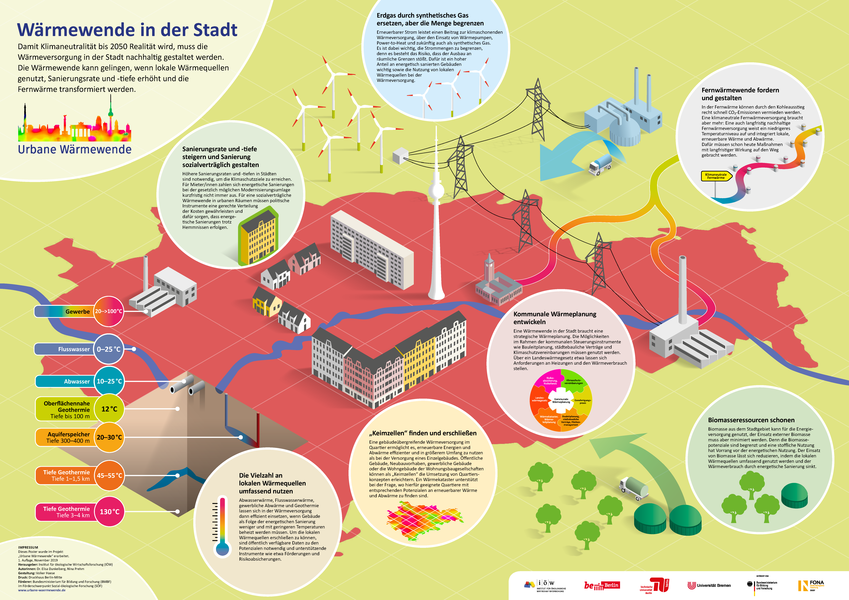
Berlin, 9 January 2020 - One of the Herculean tasks in achieving the climate targets is to radically reduce CO2 emissions from the heating supply. A research group led by the Institute for Ecological Economy Research (IÖW) is showing how cities can move away from coal, oil and gas in a socially responsible way. The "Urban Heat Transition" project analysed possible contributions from renewable energies and local heat sources in Berlin's urban districts. "Waste heat from businesses, heat from waste water or geothermal energy have hardly been utilised to date. The key to such environmentally friendly heat are neighbourhood concepts and heating networks," says project manager Bernd Hirschl from the IÖW. "An important prerequisite is a more efficient building stock. Only if the heat demand is significantly reduced can environmentally friendly heat sources be utilised efficiently."
In the three-year project, the project team from the IÖW, the University of Bremen and the Technical University of Berlin worked together with the Berlin Senate Department for the Environment, Transport and Climate Protection with funding from the Federal Ministry of Education and Research to develop local heating concepts for three Berlin neighbourhoods. At the end of 2019, they discussed their results with the heating industry in Berlin, and the documentation of the conference is now available online at www.urbane-waermewende.de.
Developing nuclei for the heat transition
"Previous neighbourhood concepts were often too complex, had too many different stakeholders and often ended up in a drawer. That's why we recommend a nucleus approach," says Elisa Dunkelberg from the IÖW. These could be public buildings, new construction projects, commercial buildings or housing associations and co-operatives.
The researchers show what a neighbourhood concept can look like for an old building district in Charlottenburg-Wilmersdorf: Firstly, the heat demand must be reduced through energy-efficient refurbishment. The heat can be generated using a wastewater heat pump, which is partly powered by solar electricity generated on site, in combination with combined heat and power generation. "Particularly in the case of public buildings, which have a pioneering role - enshrined in law in Berlin - it should always be checked in the case of refurbishment and new buildings whether they are suitable as a nucleus for a neighbourhood concept and the co-supply of surrounding buildings," emphasises Dunkelberg.
Climate-neutral district heating: utilising waste heat and renewables
District heating plays a major role in urban areas. "To become climate-neutral, it is important to integrate more local heat sources from wastewater, river water and geothermal energy as well as waste heat into district heating," says Hirschl, adding that attention must also be paid to the resilience of the heat generation system. A joint case study with the Neukölln district heating plant shows that it is possible to utilise local heat sources. But it needs to be tested technically and requires supporting financial measures. The next steps should now be test drilling for deep geothermal energy, for example, as well as pilot plants that use large heat pumps to provide wastewater or river water heat for district heating. Strategies for funding and risk protection are needed for investment in these technologies, some of which are untested and highly expensive.
Heat transition requires municipal strategic heat planning - and social compatibility
"Municipal heat planning, which has long been standard practice in pioneering countries such as Denmark and in other federal states and municipalities for some time, helps to tap into the identified potential," emphasises Hirschl. The basis for this is a heat register that visualises heat sources such as waste water and commercial waste heat. This can also be used to identify neighbourhoods for cross-building concepts. With sector coupling, it is also important that local authorities and cities plan across infrastructures. Instruments such as urban land-use planning and urban development contracts must be geared towards climate neutrality.
Low refurbishment rates in recent years show that purely incentive-based measures are not enough to ensure energy modernisation. The researchers therefore recommend implementing the regulations more strongly and developing a step-by-step plan to guide the building stock towards climate neutrality. At the same time, subsidies must be increased and conditions for passing on rent must be made more socially acceptable. A step-by-step plan under the conditions of a rent cap must be designed in such a way that energy modernisation is economically reasonable for both landlords and tenants.
Federal Ministry of Education and Research funds "Urban Heat Transition" project for another two years
The Federal Ministry of Education and Research is funding the project in a new partner constellation for a further two years in order to test solution strategies for the central obstacles to implementation and to anchor the research results in municipal heat planning. In addition to the IÖW, the partners are Berliner Wasserbetriebe and the law firm Becker Büttner Held.
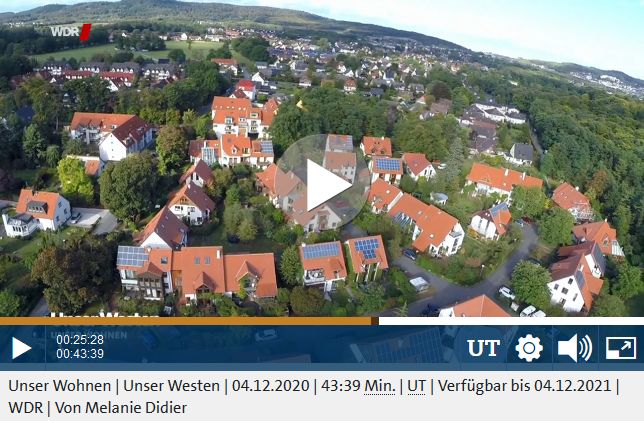
Our home. Our West. Broadcast from 7.2.2020
43:39 Min Available until 07.02.2021
WDR. By Melanie Didier
From minute 25 to 29:50 the ecological settlement Waldquelle in Bielefeld is shown. Ute Möller, one of the founders, leads a tour through the ecological settlement and reports on the experiences and developments in the now almost 25-year-old settlement with lots of wood, greenery and solar cells on the roof.
Heating village heating networks with sun and wood is becoming a model for success. In Germany, five such heat supply systems are being launched this year.
While the heating sector is the problem child of the energy transition throughout Germany, numerous villages are showing how the conversion to renewable energies can be mastered in one fell swoop. More and more often, village communities are relying on a combination of sun and wood, with a large solar thermal system taking over the entire heat supply in the summer. While one such network was launched in each of the past two years, the number of German solar bioenergy villages will grow by five to a total of eight by the end of 2018.
Thomas Pauschinger, a member of the management team at the Steinbeis Research Institute Solites in Stuttgart, where he is in charge of the Solnet 4.0 project for the promotion of solar heating networks, sees a clear trend towards solar heating in Germany's villages: "It is obvious that solar thermal energy is becoming a reliable and economical heat generator in more and more energy villages, because such systems are a future-proof investment and enjoy a high level of acceptance among the residents. With current technology, even more is possible than the 20-percent share that is common in Germany's solar villages today, says Pauschinger: "We expect that in the future solar thermal will not only cover the summer demand of such heating networks, but will also achieve higher solar shares through larger storage tanks."
New to the club are:
Solar energy village Liggeringen, district of the town of Radolfzell, Baden-Württemberg Operator: Stadtwerke Radolfzell GmbH
Commissioning: 2018
House connections: 90 (first construction phase)
Network length: 5 km
Collector area: 1,100 m² (first construction phase)
Collector type: High-temperature flat-plate collectors
Expected annual yield: 470 MWh/a
Solar coverage: 20 %
Solar energy village Randegg, district of the municipality of Gottmadingen, Baden-Württemberg Operator: Solarcomplex AG
Commissioning of heating network: 2009
Commissioning solar thermal: 2018
House connections:150
Network length: 6.6 km
Collector area: 2,400 m2
Collector type: CPC vacuum tube collectors
Expected annual yield: 1100 MWh/a
Solar coverage: 20 %
Solar energy village Mengsberg, district of the town of Neustadt, Hesse Operator: Bioenergiegenossenschaft Mengsberg BEGM eG
Commissioning: 2018
House connections: 150
Network length: 9 km
Collector area: 3,000 m2 Collector type: High-temperature flat-plate collectors Expected annual yield: 900 MWh/a
Solar coverage: 17 %
Solar Energy Village Breklum, Schleswig-HolsteinOperator: BürgerGemeindeWerke Breklum e.G.
Commissioning: 2018
House connections: 42 (first construction phase)
Network length: 3.8 km
Collector area: 652 m2 (first expansion stage)
Collector type: CPC vacuum tube collectors
Expected annual yield: 289 MWh/a (first construction phase)
Solar coverage: 8 %
Solar energy village Ellern, district of the municipality of Rheinböllen, Rhineland-Palatinate Commissioning: 2018
House connections: 105
Network length: 5.3 km
Collector area: 1,245 m2
Collector type: CPC vacuum tube collectors
Expected annual yield: 555 MWh/a
Solar coverage: 15 %
Further information on the use of large solar thermal systems in villages, neighbourhoods and cities can be found on the website www.solare-waermenetze.de. The Steinbeis Research Institute Solites offers initial consultations for interested municipalities.
The Solnet 4.0 project is funded by the Federal Ministry for Economic Affairs and Energy and companies in the solar thermal industry. Project partners are the AGFW - Effizienzverband für Wärme, Kälte, KWK, the Steinbeis Research Institute Solites, Bröer & Witt GbR and the Hamburg Institute.
We use cookies to optimize our website and services.
Functional
Always active
Technical storage or access is strictly necessary for the legitimate purpose of enabling the use of a particular service explicitly requested by the subscriber or user or for the sole purpose of carrying out the transmission of a communication over an electronic communications network.
Preferences
The technical storage or access is necessary for the legitimate purpose of storing preferences that have not been requested by the subscriber or user.
Statistics
The technical storage or access, which is solely for statistical purposes.Technical storage or access used solely for anonymous statistical purposes. Without a subpoena, voluntary consent from your Internet service provider, or additional records from third parties, information stored or accessed for this purpose cannot generally be used alone to identify you.
Marketing
Technical storage or access is necessary to create user profiles, to send advertising or to track the user on a website or across multiple websites for similar marketing purposes.