Market incentive programme for solar thermal energy
Published
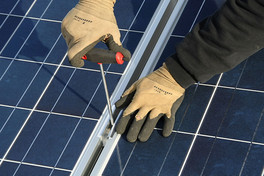
According to the DGS (Deutsche Gesellschaft für Sonnenenergie e.V. - German Solar Energy Society), the general conditions for solar thermal systems are more attractive than ever before, which is related to the market incentive programme (MAP) for solar thermal subsidies that was overhauled last year. After years of dwindling sales, the latest collector sales statistics from the German Solar Industry Association (BSW) and the German Heating Industry Association (BDH) show around 7 percent growth from November 2015 to March 2016. Certainly, the level is no longer very high due to the lean years, but there is once again an application backlog at BAFA for a long time. In addition to the financial incentives, the many programme components of the MAP are particularly interesting. Thanks to innovation funding, additional funding for process heat and solar houses, it has become much more attractive.
According to Ministerial Councillor Dr. Frank Heidrich in his introductory lecture at the 26th DGS Thermal Solar Energy Symposium in April 2016, the programme is being promoted by the BMWi in a "communication activation campaign". The DGS considers a merger with the Renewable Energies Heat Act in the course of the EnEV amendment to be a more suitable funding approach for solar thermal energy.
In the study "What does the energy turnaround cost?" by Fraunhofer ISEwhich deals with the ways to transform the German energy system by 2050, Prof. Dr Hans-Martin Henning concludes that economically good solutions are only possible with solar thermal energy.
Climate protection targets can only be achieved by investing in green technologies of the future and sustainable investment strategies / Energy Agency to support municipalities with divestment strategies in future.
"To be climate neutral by 2050, we not only need to make additional investments in green and innovative technologies of the future. Above all, we also need a shift from existing investments in 'brown' raw materials such as coal, oil and gas to 'green' climate-friendly technologies. The phase-out of fossil fuels must be global and rapid, in line with the goals of the World Climate Conference. Only in this way can we realistically achieve the climate protection goals. Churches, municipalities and also companies are setting new standards here and demonstrating the feasibility of the changeover in both ecological and economic terms," said Environment Minister Ulrike Höfken today at the event "Divestment and Sustainable Finance", which took place during the Climate Protection Weeks in Rhineland-Palatinate.
Höfken discussed new sustainable financing approaches together with Saori Dubourg, member of the Board of Executive Directors of BASF SE and member of the Council for Sustainable Development, Oberkirchenrat Heinz Thomas Striegler, Head of Church Administration of the Protestant Church in Hesse and Nassau and Chairman of the Working Group of Church Investors of the Protestant Church in Germany, as well as Christoph Bals, Political Director at Germanwatch e.V. and member of the Sustainable Finance Advisory Council of the German Federal Government.
According to the Potsdam Institute for Climate Impact Research, the financial sector in particular has one of the greatest levers of influence in the short term to encourage other sectors of the economy to do more to protect the climate. The central tool here is divestment, a withdrawal of capital from markets and products that violate sustainability criteria, such as fossil-intensive industries, Höfken continued. "Rhineland-Palatinate is one of seven German states that has already passed a divestment resolution: The special assets of the state and the funds of state foundations are invested according to sustainable criteria," the minister explained. The Energy Agency Rhineland-Palatinate will support municipalities in the state in establishing divestment approaches in the future, Höfken announced. Here, the discussion is still in its infancy and further development in terms of content is necessary.
Whether municipalities, churches or companies: All players are called upon to examine their investment strategies and invest in a sustainable future. The City of Bonn is one of the pioneer cities with its path to sustainable financial investment. Carsten Buschmann, Head of Department at the City of Bonn, said: "The City of Bonn is pursuing a holistic approach that will be further expanded. Our experience in Bonn has shown that sustainable investing and returns are not mutually exclusive."
Climate Protection Weeks Rhineland-Palatinate:
During the Climate Protection Weeks Rhineland-Palatinate from 12 November to 11 December 2020, experts will discuss concrete instruments and measures against the climate crisis. From climate-efficient construction to climate funds and sustainable management, the events will highlight numerous approaches to achieving climate protection goals. In addition to top-class experts such as Prof. Hans Joachim Schellnhuber, Prof. Claudia Kemfert or Christoph Bals, renowned companies and organisations such as BASF, Boehringer Ingelheim and the European Investment Bank, numerous national and international politicians from Germany, Luxembourg, Rwanda, Canada and the EU will be represented.
Detailed information on the climate protection weeks can be found at here
Great joy in Aachen: One of the central urban development projects is awarded special federal funding.
Mayor Sibylle Keupen: "This is a super message for our city!"
The Büchel old town quarter is one of 24 projects nationwide that are now being supported with a total of 75 million euros.
98 cities and municipalities had applied.
A most welcome piece of news reached the city of Aachen this morning (17 March 2021): Federal Minister Horst Seehofer has announced this year's selection of the "National Projects of Urban Development" and announced that the development of the Büchel old town quarter will receive up to 5.5 million euros in funding. Aachen is thus one of four municipalities in NRW to have been awarded the contract. With the amount of funding, the city is in third place nationwide.
Great news from Berlin: The federal government wants to support the development of the Büchel in Aachen's city centre with up to 5.5 million euros. Photo: City of Aachen / Andreas Herrmann
OBin Keupen: "We feel the spirit of optimism!"
"This is a great message for our city," says Mayor Sibylle Keupen in her first reaction. "We have long felt the spirit of optimism around the Büchel in Aachen. The demolition of the multi-storey car park is imminent, the planning workshop was a great success, many groundbreaking political decisions have been made, and more are on the horizon. Above all, many city makers are on board and want to be involved in a very concrete way. They want to participate, to shape, to plan, to build. The fact that this high level of commitment of all those involved here on site has now also triggered such a response at federal level encourages us to continue on the path of 'making a city at Büchel'."
City Planning Director Burgdorff: "Aachen can play in the Bundesliga!"
The municipal councillor for urban development, construction and mobility, Frauke Burgdorff, adds: "I am extremely pleased that Aachen, if it sticks together, can also play in the Bundesliga! Aachen's politicians have united behind the project and have given their backing to the state and federal governments. Thank you for that! But I would also like to express my sincere thanks to those who have done the substantive work here on site, to the municipal project manager Nils Jansen as well as to Christoph Guth and Antje Eickhoff, who have done an excellent job on the part of the municipal development company SEGA."
Making town at the Büchel
A special piece of the city at eye level is to be created at Büchel. It is being developed together with many committed people and institutions. With this approach, it has also precisely met the requirements of the call for proposals. The Federal Ministry's project overview states: "Knowledge, living, meadow" are the keywords under which a mixed-use, urban quarter is to be created in the heart of Aachen's old town in a cooperative and exemplary development process that is wanted and supported by the urban community.
The basis for the development is the exploratory procedure "Stadt machen am Büchel" (Making a city at Büchel), which the city of Aachen launched in spring 2020. City Planning Director Burgdorff sums up: "A multi-storey car park has been blocking the development of the old town for decades. We are tearing it down and building a new urban quarter. The urban community itself is developing the programme, urban design and investment strategy. This project offers a unique opportunity to find answers to the question of how a major wound in the old city can be healed with contemporary building-cultural responses."
The next steps
Following today's basic commitment by the federal government to fund the project, the detailed applications for funding will be drawn up in phase 2. In this ongoing process - and on the basis of upcoming landmark decisions of Aachen's municipal politics - it will now be worked out how the Büchel of the future will take shape with the funding millions.
National urban development projects
National urban development projects are nationally and internationally visible, larger-scale urban development projects with clear impulses for the respective municipality or city, the region and urban development policy in Germany as a whole. They are characterised by a special quality standard with regard to the urban development approach, the building culture aspects and the participation processes, contribute to the realisation of the federal government's building policy objectives and have innovation potential. National urban development projects are projects that generally solve tasks and problems of considerable financial dimension. The focus is on the major challenges currently facing cities and municipalities in Germany (e.g. preservation of existing buildings, conversions, sustainable neighbourhood development).
A total of 24 projects for forward-looking urban development are being funded by the federal government with a total of around 75 million euros. 98 cities and municipalities from all over Germany applied for the funding.
More info Interesting facts about the Büchel can be found on the Internet at www.buechel-aachen.de
From Aprill 2021 the Demolition work on the Büchel multi-storey car park. All the info on this has been presented as part of an online event. The stream is still available on the YouTube channel of the city of Aachen: https://youtu.be/KQqFq6v_edA.
Within the framework of a cooperative planning workshop, three teams of experts developed three exciting designs for the Büchel, each with a focus on the major themes of "knowledge, living, meadow". The final presentation of the planning workshop, which took place digitally in January 2021, is also still available as a stream: https://youtu.be/AWSb5Gx3gKA.
According to the head of the EIB (European Investment Bank), Werner Hoyer, it is realistic to invest one trillion euros for climate protection within 10 years. In an interview with Der Spiegel, Hoyer said: "If we want to achieve our climate protection goals, we're no longer talking about billions, but trillions of euros" and "We can handle that." EU Commission President Ursula von der Leyen had named the climate protection target when she took office. Hoyer assumes that 1 trillion euro EU climate protection measures will trigger investments totalling 4 trillion euro.
Hoyer wants to mobilise additional money on the capital markets. "If we want to finance climate projects worth an average of 100 billion euros per year and the leverage that our investments trigger is around three, then the EIB would have to raise 30 to 35 billion euros per year," the bank boss told Der Spiegel. Already today, 28 per cent of the EIB's loans flow into projects that serve climate protection: "I want it to become 50 per cent in the future".
The EU target of investing 100 billion per year in climate protection was announced by the new head of the EU Commission Ursula von der Leyen at the 25th Climate Conference COP25 in Madrid. The EU is to become climate neutral by 2050. The EU's first climate protection law will be presented in March 2020.
We use cookies to optimize our website and services.
Functional
Always active
Technical storage or access is strictly necessary for the legitimate purpose of enabling the use of a particular service explicitly requested by the subscriber or user or for the sole purpose of carrying out the transmission of a communication over an electronic communications network.
Preferences
The technical storage or access is necessary for the legitimate purpose of storing preferences that have not been requested by the subscriber or user.
Statistics
The technical storage or access, which is solely for statistical purposes.Technical storage or access used solely for anonymous statistical purposes. Without a subpoena, voluntary consent from your Internet service provider, or additional records from third parties, information stored or accessed for this purpose cannot generally be used alone to identify you.
Marketing
Technical storage or access is necessary to create user profiles, to send advertising or to track the user on a website or across multiple websites for similar marketing purposes.