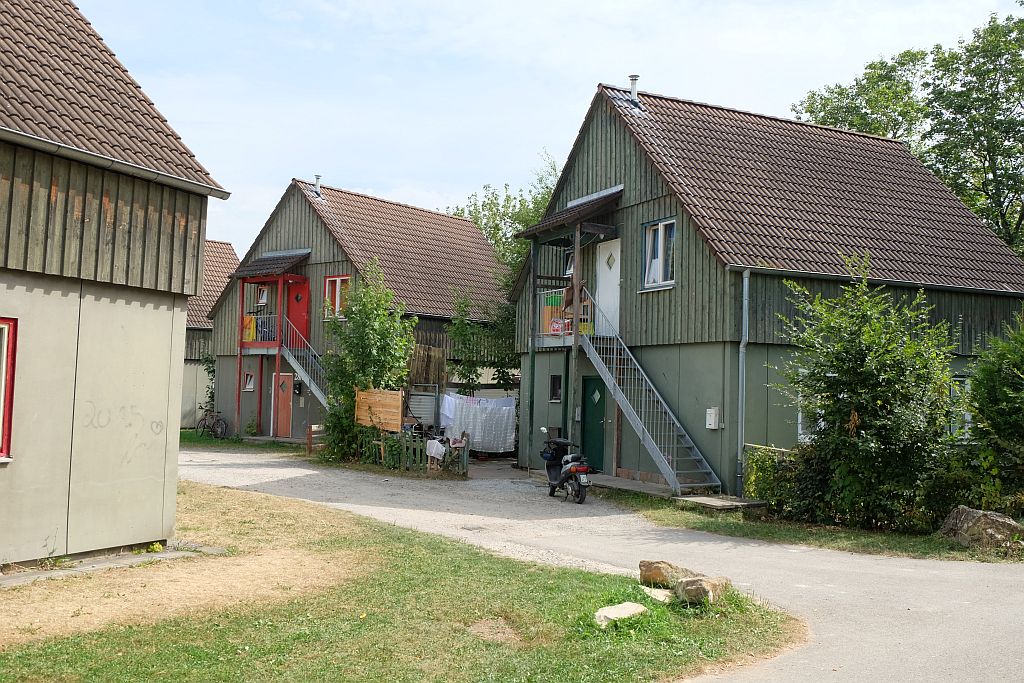
A big thank you to Mr Pohlmeyer for the current photos of the small "Cube settlement".
To the Photo gallery 9/2016
Keywords: Wood construction, News Blog Baden-Württemberg, Settlements, Residential, sdg21 news

A big thank you to Mr Pohlmeyer for the current photos of the small "Cube settlement".
To the Photo gallery 9/2016
The bioeconomy can be a central building block for the transformation of our largely coal, oil and gas-based economy. However, renewable raw materials and synthetic carbon compounds are scarce and expensive. They should be used in areas such as the chemical industry - not as energy sources. For the shift from a fossil-based economy to a bioeconomy to succeed, fossil carbon must also become more expensive. The ifeu now presents the results of four trend-setting studies.
"Carbon compounds will continue to be needed in the chemical industry and, in the medium term, in parts of the transport sector. Here we can use biomass and other renewable carbon sources for chemicals, bio-based products or fuels, replacing fossil carbon in the form of oil and gas," says ifeu project manager Dr Heiko Keller. "Bioeconomy provides much more than fuels from agricultural biomass," adds Nils Rettenmaier, also project manager and expert on
Biomass and Bioeconomy at ifeu. However, the resources of the bioeconomy are a scarce commodity. Cultivation areas for renewable raw materials are limited by food production and the protection of biodiversity.
Such cultivated biomass can no more cover the long-term demand for carbon than can biogenic residues. Defossilisation of the economy needs framework conditions. In order to build a stable market, the bioeconomy would need fair competitive conditions in which its advantages over products made from
fossil CO2 sources are taken into account, according to the experts. Thus, in the long term, products from biogenic raw materials can prevail over the hitherto cheaper fossil raw materials through a higher CO2 tax. In addition, sufficient green electricity and hydrogen must be available in the medium term.
"If the right course is set, the bioeconomy can make a significant contribution to defossilisation," says Rettenmaier. "It is an important piece of the puzzle in the transformation towards a climate-friendly society.
For large parts of the economy, ways to say goodbye to fossil fuels are now foreseeable - for example with electric cars and heat pumps instead of combustion engines and gas heating. But a complete decarbonisation of the economic system is neither possible nor sensible. Therefore, ifeu is researching technologies that make sustainable renewable carbon available. The reports from four recently completed large-scale projects provide valuable new insights.
(Re)activating arable land that is hardly usable for other purposes
In the EU, there is a lot of unused arable land and some special sites such as post-mining areas. With the cultivation of frugal biomass on these so-called marginal areas, the increasing competition for land use can be mitigated. In the MAGIC project, ifeu has identified boundary conditions that must be met for sustainable implementation:
- Care must be taken not to endanger biodiversity, which can be high on parts of these areas, through use.
- Imposing conditions on subsidies that are necessary anyway can be a solution to this conflict of goals.
Detailed recommendations can be found in the report on MAGIC at
https://www.ifeu.de/projekt/magic
Converting biomass residues into products needed in the long term
Many residual materials such as straw or green waste from landscape conservation (so-called lignocellulosic residues) are not used to a large extent. Others, such as forest residues, are currently burned primarily for energy use. However, heat can and should be generated in the medium term, for example via heat pumps using green electricity. The scarce renewable carbon is too precious for these decarbonisable applications. New technologies are now being developed so that these residues can be efficiently converted into products such as chemicals or aviation fuel in the future.
The UNRAVEL project investigated how new processes and value chains for chemicals and building materials (insulating foam boards, bitumen sealing membranes, etc.) can be established. From a sustainability point of view, decisive progress was made:
- The process can now flexibly use different residual materials at constant product quality - depending on sustainable availability.
- The energy efficiency of the main process (organosolv) was significantly increased.
- A technical bottleneck has been identified that has so far been responsible for the fact that residual materials that are currently hardly used in particular can be converted less efficiently.
Concrete further steps on how the process could be further developed in a future-proof manner, both from a raw material and product perspective, are listed in the reports (link: https://www.ifeu.de/projekt/unravel).
Lignocellulosic residues can also serve as a feedstock for bio-oil by means of pyrolysis. A process developed in the BioMates project uses green hydrogen to prepare the bio-oil for easy feed into petroleum refineries. Partial replacement of petroleum in refineries with bio-oil can reduce greenhouse gas emissions in the relatively short term. This is urgently needed from a sustainability perspective. In the long term, the share of refinery products for chemicals, aviation and marine fuels in particular could be expanded. The sustainability assessment is available at https://www.ifeu.de/projekt/biomates available.
Synthetic hydrocarbons
In the eForFuel project, it was not biomass that was investigated as a carbon source, but the synthesis of hydrocarbons from CO2 from industrial point sources (here: blast furnace gas) as well as the air. This can be converted to formic acid in an electro-biorefinery using renewable electricity and water and fermented in a bioreactor with the help of microorganisms. The end products are synthetic fuels such as propane and isooctane. Main findings from this project:
- Renewable carbon can be obtained in far greater quantities if it comes from CO2 instead of plant biomass. However, even in this case, efficient use is crucial, because harnessing it requires a great deal of energy.
- Many improvement options could be identified. However, some development work is still needed before it is ready for the market.
Details and reports are available at https://www.ifeu.de/projekt/eforfuel available.
Source: ifeu-PM of 15.2.2023
Keywords:
Building materials / Construction, DE-News, Research, Wood construction, NaWaRohs, Sustainable management, New books and studies, Resource efficiency, Environmental policy, Life cycle assessment
Anne Katrin Bohle has been State Secretary for Construction at the Federal Ministry of the Interior, Building and Housing since March 2019.
Until the German EU-The "Leipzig Charter" is to be further developed into the "Leipzig Charter 2.0" for the EU Council Presidency in 2020. The "Leipzig Charter", which is little known even among experts, invokes the values of "citizens' co-determination and self-determination, calls for social integration, the creation and use of public space, a strengthening of city centres and a mix of uses". And the "idea of the "European City" explicitly opposes one-sided and monotonous urban development. Against exclusion and isolation of individual city districts, against the ruthless enforcement of individual interests."
In an interview with Bauwelt, the Secretary of State for Construction explains the goals and approach:
www.bauwelt.de/rubriken/interview/Die-Charta-muss-mehr-als-nur-aktualisiert-werden-3430440.html
The German Chamber of Architects also reported:
www.dabonline.de/...leipzig-charta-kommentar-stadtentwicklung/
On 5 and 6 December 2019, the Bauwelt Congress will be held for this purpose:
https://siedlungen.eu/…bauwelt-kongress-2019-die-ganze-stadt
Keywords:
DE-News, News Blog Europe (without DE), Mix of uses, Quarters, SDG 2030, City, Environmental policy, Urban production, Housing policy
6:22 min, 14 April 2014, Ed: The Guardian
Oliver Wainwright visits the International Building Exhibition (IBA), a six-year experiment to build a zero-carbon extension to Hamburg in northern Germany. The project is home to all kinds of Passivhaus buildings, solid timber construction, the recycling of greywater, and even a building with a bubbling bio-reactive algae facade. Wainwright meets some of the key representatives of the project to examine a variety of different examples of eco architecture
Click here for full Guardian article:
www.theguardian.com/lifeandsty...
Project Info: http://sdg21.eu/db/iba-wilhelmsburg
Keywords:
DE-News, Renewable, Movies, Movies 4 to 10 Min, Wood construction, Climate protection, News Blog Hamburg, PV, Solar thermal, Housing
From January 2017, the state capital Munich will also pay up to 2,000 euros in purchase premiums for privately used eCargobikes.
On 1 April 2016, the Munich-based Electromobility funding guideline into force. It introduced purchase premiums for commercial e-vehicles from pedelecs to e-cars. Since then, there has been a subsidy of 25 percent of the purchase price up to a maximum of 1000 euros for commercially used eCargobikes. In the first five months 86 applications approved. In addition, there is a 1000 euro scrapping premium if a car with an internal combustion engine is demonstrably permanently withdrawn from circulation.
Read the whole article at: http://cargobike.jetzt
Keywords:
Bike-/Velo-City, Funding, Communities, Mobility, News Blog Bavaria, Environmental policy, eMobility