According to a new study, the world is still a long way from achieving the United Nations' Sustainable Development Goals. Sweden is in the best position, according to the report published by the Bertelsmann Stiftung and others. The study compared 149 countries. Sweden is closest to the goals, followed by Denmark and Norway. Germany came in sixth place. The UN Sustainable Development Goals are intended to help combat extreme poverty, climate change and discrimination by 2030.
The study was produced in collaboration with the renowned economist and UN special advisor Jeffrey Sachs and the United Nations Sustainable Development Solutions Network (SDSN). It was presented at a United Nations sustainability conference in New York on 20 July and handed over to UN Secretary-General Ban Ki-moon.
"I am certain that the SDG Index from SDSN and the Bertelsmann Stiftung will make a valuable contribution to making the world a more peaceful, just and sustainable place."
Timber construction can be cheaper than standard construction - At the same time significantly better CO2 balance
MNP Architects Munich, School Wangen
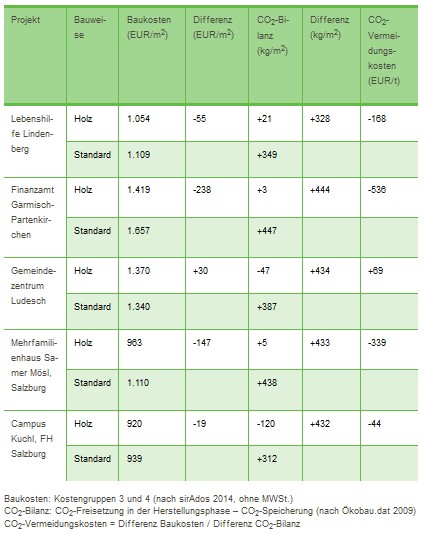
Current comparative calculations based on realized new buildings in timber construction show: Building with wood does not have to be more expensive than the standard construction method. This result is surprising, as it contradicts the common perception that timber construction is more expensive. At the same time, the CO2 balance of timber construction is significantly better; as a result, its CO2 avoidance costs are very favourable, in some cases even negative. An expansion of timber construction would therefore be climate protection at comparatively low cost.
The architect and developer of the Legep construction software, Holger König, has balanced the construction costs and CO2 emissions for the production of five public and private timber buildings and compared them with the results that would have been produced for the same buildings if they had been built in the conventional way. Legep can be used to calculate the manufacturing and life-cycle costs, energy requirements and environmental impact of buildings. In this case, König only looked at manufacturing. For the prices, he used current sirAdos data, which represent the market very realistically. He then went to the trouble that many architects, civil engineers and building owners shy away from: He modeled the buildings with the same area and cubature and the same energy standard, but replaced the wooden components with conventional materials - depending on the building project, solid masonry in brick, sand-lime brick or aerated concrete, or a column-beam supporting structure made of reinforced concrete. He used reinforced concrete for the floor slab, cellar, ceilings and flat roofs, mineral wool or polystyrene for the insulation, and plastic or aluminum frames for the windows. König explains the fact that four out of five buildings in timber construction cost less or the same as in standard construction with the industrial-technical development that many timber construction companies have undergone in recent years. Two of the timber buildings even achieved a negative CO2 balance in the manufacturing phase due to the large amount of renewable raw materials used, which act as carbon stores. In the other three buildings, a slightly higher proportion of non-wooden components, which every timber building also contains, caused the slightly positive CO2 balance.
If one relates the difference in CO2 savings to the difference in construction costs, one obtains the CO2 avoidance costs of timber construction. Negative abatement costs here mean that the builder has saved costs with timber construction compared to standard construction and at the same time protected the climate.
By increasing the proportion of timber construction, more climate protection can be achieved at low or even negative costs, while at the same time strengthening rural areas. The green-red state government in Baden-Württemberg has recognised this and created more favourable framework conditions for the building material in its state building code, which was amended on 1 March (information here). In contrast, some state building codes still contain legal obstacles to building with wood.
The city of Munich also wants to convince more builders to use timber construction: as part of its "Munich Energy Saving Promotion Programme", it has been granting a CO2 bonus for the use of timber and other renewable raw materials in building construction of 30 cents/kg since 2013 (information here).
A high insulation standard with insulating materials made from renewable raw materials is also a contribution to climate protection. The plant raw materials from which the insulating materials were obtained have bound CO2 from the atmosphere, which is now stored in the building material for long periods of time. And finally, heating based on renewable energies also reduces CO2 emissions.
The Agency of Renewable Resources (Fachagentur Nachwachsende Rohstoffe e.V.). (FNR) funded the determination of LCA baseline data for the Legep programme with funds from the Federal Ministry of Food and Agriculture (BMEL) between 2004 and 2006.
On the one hand, more and more old office buildings and office parks are losing their function. On the other hand, there is a great demand for living space in cities and agglomerations. This publication shows the opportunities, but also the difficulties, associated with the conversion of this particular building typology.
The conversion of office properties certainly represents only a very small and special segment of our urban development. But it deserves more attention, both in terms of the history behind this inconspicuous building task and in terms of the future potential that we are far from having exhausted. The conversion of this particular building stock is a serious alternative to demolition and new construction.
Seven practical examples show how diverse and varied office building conversion projects are. From historic individual properties to modern office districts, the framework conditions are often very different. However, it is precisely by dealing with the existing buildings that they can develop new qualities for their surroundings (Lyoner Viertel, Frankfurt; Büropark Seestern, Düsseldorf; O-Werk, Bochum; Goltsteinforum, Cologne; Beginenhof, Essen; Gerling Hochhaus, Cologne; Hochhaus an der Baierbrunner Straße, Munich).
The study commissioned by StadtBauKultur NRW was prepared in cooperation with the ILS - Institute for Regional and Urban Development Research.
We use cookies to optimize our website and services.
Functional
Always active
Technical storage or access is strictly necessary for the legitimate purpose of enabling the use of a particular service explicitly requested by the subscriber or user or for the sole purpose of carrying out the transmission of a communication over an electronic communications network.
Preferences
The technical storage or access is necessary for the legitimate purpose of storing preferences that have not been requested by the subscriber or user.
Statistics
The technical storage or access, which is solely for statistical purposes.Technical storage or access used solely for anonymous statistical purposes. Without a subpoena, voluntary consent from your Internet service provider, or additional records from third parties, information stored or accessed for this purpose cannot generally be used alone to identify you.
Marketing
Technical storage or access is necessary to create user profiles, to send advertising or to track the user on a website or across multiple websites for similar marketing purposes.
 According to a new study, the world is still a long way from achieving the United Nations' Sustainable Development Goals. Sweden is in the best position, according to the report published by the Bertelsmann Stiftung and others. The study compared 149 countries. Sweden is closest to the goals, followed by Denmark and Norway. Germany came in sixth place. The UN Sustainable Development Goals are intended to help combat extreme poverty, climate change and discrimination by 2030.