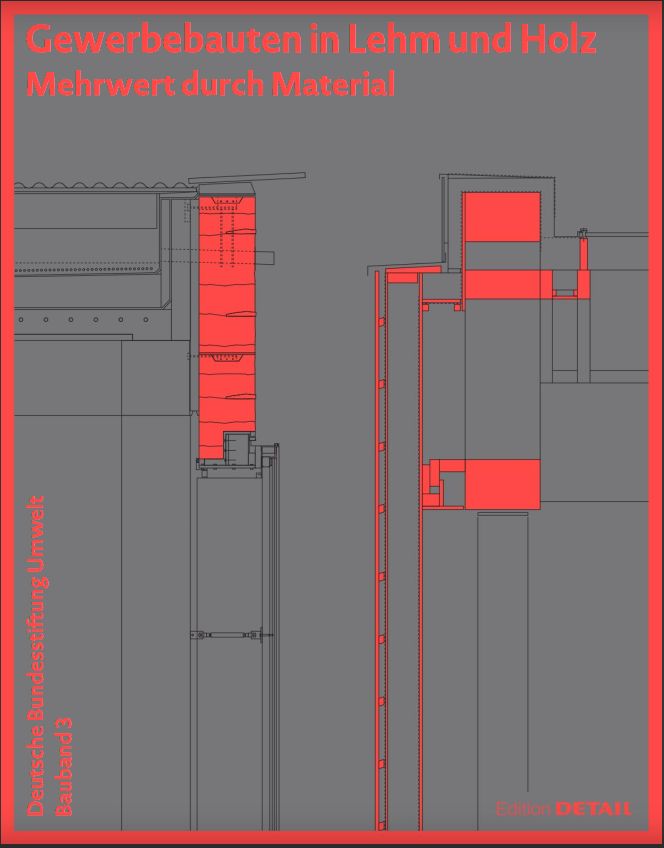
Publisher: German Federal Foundation for the Environment / Sabine Djahanschah
 Author of the book review: Roman Schaurhofer, Vienna
The construction volume "Commercial Buildings in Clay and Wood - Added Value through Material" was published in 2020 by Sabine Djahanschah of the Deutsche Bundesstiftung Umwelt (German Federal Foundation for the Environment) at Verlag Detail. The publication, which appeared in book form, deals with the use of the building materials wood and clay in the construction of commercially used buildings. To this end, six buildings with commercial use were analysed in terms of their architectural construction and technical quality features and evaluated with the help of measurements, surveys and life cycle assessments.
By way of introduction, the different techniques, construction and production methods as well as the advantages of wood and clay are discussed. After this presentation of the understanding of the different building materials as well as fossil and renewable raw materials, the authors go into more detail on the life cycle assessment or life cycle analysis. They explain the components of a life cycle assessment for buildings. Furthermore, the calculation steps and methods for the life cycle phases, the period under consideration and the final energy demand are defined. This is followed by a naming of the balances created and evaluations.
The concept, the design and the constructive aspects are examined in more detail for each of the objects examined (two office buildings, two warehouses and two workshops). In addition, the acoustics, the energy concept, the fire protection and the added value of the building are evaluated. Monitoring values for temperature, CO2-concentration or air humidity underpin the results. Finally, the life cycle assessment, the material balance, the life cycle phase comparison and the DGNB rating are explained.
Ultimately, the researchers make a case for the use of wood and clay in commercial buildings with their results and conclusions from their detailed investigations, as well as their presentation of the effects on quality of stay, indoor climate, changeability and expression.
The building examples studied also convince with impressive results when the materials are applied well. Due to the interdisciplinary approach and the wide-ranging investigations by the researchers, technically sound results and arguments that can be discussed were achieved.
At the same time, however, it must be noted that due to the different building use and material selection, the selected example projects can hardly be compared with each other. In addition, other aspects relevant to construction, such as economic possibilities or monetary aspects, are not taken into account.
They are to be understood as pilot projects, but serve as exemplary examples for increased use in commercial construction.
Nevertheless, the investigations of the buildings show the relevance of sustainable building materials in the construction of buildings.
In any case, the authors provide sound evidence why wood and/or clay should be increasingly used in the construction of buildings for commercial use and make a professionally relevant contribution to the promotion of sustainability.
First edition: 2020
Format: 167 pages, German, 21 x 27 cm, Swiss brochure
Publisher: Detail Business Information GmbH, Munich
Reading sample and ordering option:
https://shop.detail.de/de_de/dbu-bauband-3-gewerbebauten-in-lehm-und-holz
Keywords:
Building Biology, Building materials / Construction, DE-News, Business, Wood construction, Earth Building, NaWaRohs, Sustainable management, New books and studies, Resource efficiency, Urban production, Life cycle assessment

 Since 2012, the DGNB certification system has been a tool for municipalities that helps them to optimise neighbourhoods in terms of sustainability and to document this through an award. For this system, the DGNB has now specifically further developed the criteria catalogue and significantly reduced the scope through adjustments. According to the DGNB in its press release, this would reduce the effort and costs for building owners "without compromising on quality". New in the updated system version are topics such as light pollution, smart infrastructure, governance, resilience and adaptability.