Since September 2014, Wagner Solar, a solar pioneer from Cölbe, has been a subsidiary of Sanderink Holding under the leadership of Dutch entrepreneur Gerard Sanderink. The business operations are continued under the name Wagner Solar GmbH. The managing director is Brigitte van Egten, a lawyer with experience in the industry.
With 65 employees at the two sites in Cölbe and Kirchhain, our solar heating, solar power, electricity storage and TRIC mounting systems divisions as well as sustainable energy technology products will continue to operate under the proven "Wagner Solar" brand.
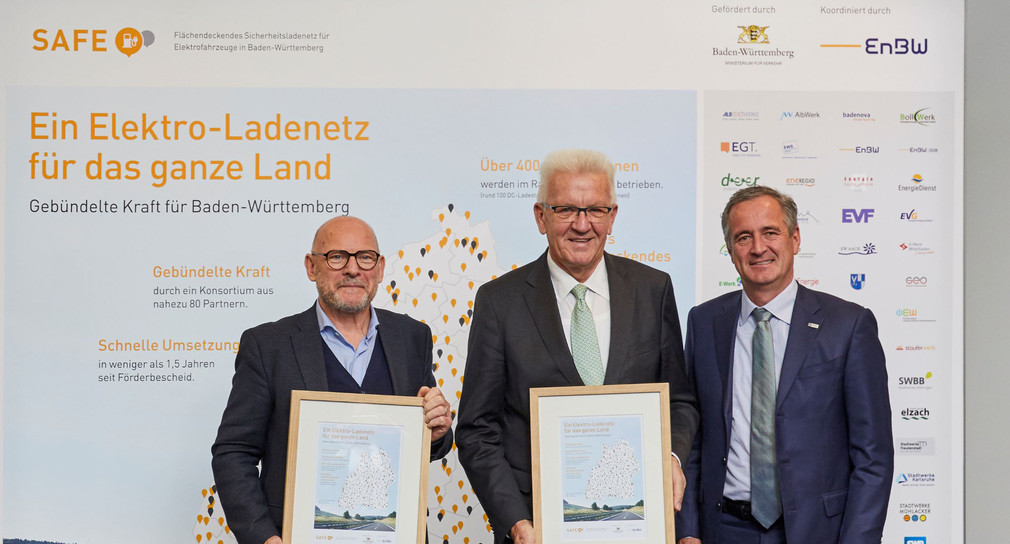
With the successful implementation of the state program "Area-wide Safety Charging Network for Electric Vehicles" (SAFE), Baden-Württemberg is the first state to have an area-wide charging network for electric cars in a 10-kilometer grid. The SAFE charging network consists of more than 450 charging stations.
While the construction of public charging infrastructure for electric cars is still being discussed elsewhere, Baden-Württemberg has built up a comprehensive charging network in recent months. A reliable charging infrastructure with more than 450 charging points now covers the entire state in a 10-kilometre grid. A consortium of 77 municipal utilities and suppliers as well as three municipalities had joined forces under the leadership of EnBW and successfully implemented the state programme "Area-wide Safety Charging Network for Electric Vehicles" (SAFE). The final event was held today (04.11.2019) in Stuttgart to take stock.
Electromobility is not only suitable for the big city!
"I am extremely pleased that we have taken electric mobility in Baden-Württemberg an important step forward with the SAFE project. Because with the nationwide expansion of the charging infrastructure, we are showing: Electromobility is not only suitable for the big city! I was able to see this for myself during my charging stop in Bad Urach today. SAFE, which was realised within the framework of Baden-Württemberg's strategy dialogue on the automotive industry, thus illustrates that electric mobility in the state is not only a clean and efficient, but also a reliable form of mobility," said Minister President Kretschmann. A consortium led by EnBW had been awarded the contract for the project in May 2018. "The parties involved have managed to set up a nationwide network of charging stations in one and a half years. I would like to thank EnBW as the project leader and its many project partners for this remarkable achievement. Together we are showing that we are pushing ahead: We are stepping on the gas and advancing electromobility in Baden-Württemberg step by step," Kretschmann continued.
Transport Minister Winfried Hermann explained: "E-charging must be as safe as it is simple. Above all, the charging points must work. With the nationwide SAFE charging network, we are creating the basis for the electrification of passenger car traffic in cities and rural areas. In this way, we are facilitating the switch to climate-friendly e-mobility."
81 Partner on behalf of the State of Baden-Württemberg
The SAFE charging network consists of more than 450 charging stations and will be operated by the project partners for at least six years. More than 250 already existing normal charging stations and more than 60 fast charging stations could be included in the network. But the consortium also built around 40 new fast charging stations and 88 normal charging stations. In addition, twelve existing charging stations were upgraded.
"This is how the mobility revolution must be managed," says EnBW CEO Dr. Frank Mastiaux, summing up the cooperation in the project. "With clout and teamwork, 81 partners have built up a powerful and reliable charging network within just 18 months. Complex infrastructure projects not only need a reliable framework, but also a planned and coordinated interaction between different players. SAFE is an example of how this can be achieved: through a high level of prioritisation by each project partner on site, as well as with the state of Baden-Württemberg as the key driver and funding provider."
The central requirement of the SAFE programme was: In a grid of ten by ten kilometres, there is at least one charging station with 22 kilowatts of power. In a second grid of 20 by 20 kilometres, there is also at least one fast charging station with 50 kilowatts of power. SAFE thus provides an area-wide charging network for drivers of electric cars: On average, there is a charging station every ten kilometres throughout the province - even in rural areas. All e-car drivers have easy access to the SAFE charging stations via the connected electromobility providers.
Starting signal for the further expansion of the charging infrastructure
SAFE has laid another foundation stone for the expansion of the charging infrastructure in Baden-Württemberg. In order to drive this forward, the Charging Infrastructure Network BW will bundle the exchange in the state even more strongly. Current challenges will be discussed and solutions developed via this open platform. The state agency for new mobility solutions and automotive Baden-Württemberg e-mobil BW GmbH is coordinating the new network, in which the experiences and findings of SAFE will be taken up and continued. In addition to its own commitment to the rapid expansion of charging infrastructure, EnBW will also remain closely associated with the new network as a partner. The state of Baden-Württemberg is thus directly taking the next step to prepare the charging infrastructure in the southwest of the republic for the ramp-up of e-cars. To this end, it had also launched the Charge@BW funding programme for non-public charging points launched.
On the SAFE website you will also find a Map overview of all SAFE charging stations between Wertheim in the north and Constance in the south, and Kehl in the west and Giengen an der Brenz in the east of Baden-Württemberg.
Stuttgart. The Baden-Württemberg Association of Cities is in favour of a CO 2 -pricing. At the most recent board meeting, the committee spoke unanimously in favour and called on the state government to develop a concept together with the municipalities.
"Cities and municipalities have been working hard on the topic of climate protection in recent years - and yet we are finding that it has not been enough in terms of results ", said the President of the Association of Cities and Towns, Dr Peter Kurz, Lord Mayor of Mannheim, citing examples: "Energy saving, renewable energies, energy refurbishment and environmentally friendly mobility have long been on the energy policy agenda of cities," Kurz said, "and there are several networks on climate impact adaptation at both European and international level in which many cities and municipalities in Baden-Württemberg are also involved, such as the EU Covenant of Mayors."
"Proven instruments of municipal climate protection policy are independent and ambitious climate protection concepts in our larger member municipalities and the proven instruments of the European Energy Award," added Gudrun Heute-Bluhm, executive board member of the Association of Cities. The heating plans that will be required in future by the state for the larger municipalities are also available in four places and offer great potential for climate protection with municipal funds.
In order to reduce CO2 -emissions, other incentives are needed than those currently in place, according to the Executive Committee of the Association of German Cities. Following on from the resolution of the German Association of Cities, the board therefore advocates a CO2 This would allow costs to be shifted in favour of climate-friendly energy sources. In any case, the desired restructuring of the state tax and levy system must be socially balanced. "Climate-damaging behaviour must have a price, so we should also examine with the state how we can implement this in the municipal levy system. This is in the interest of the municipalities, which want to actively participate in the achievement of national and international climate protection goals," says the board.
"No one can achieve climate protection alone - neither the federal government, nor the state, nor the municipalities. We can only do it hand in hand, which is why the climate targets can only be achieved if the federal and state governments live up to their responsibility by creating suitable framework conditions and taking action themselves," stressed Mayor Kurz. The state government should therefore come to an agreement with the municipalities on a concept that takes into account the municipal options for action. Climate protection-relevant support programmes should be examined for their effect and adapted if necessary.
President Kurz: "We see climate protection as the challenge of the future and it is a matter for the bosses in our cities - 'mayors for future', so to speak!"
In this tutorial, Anne Albrecht, building consultant at Faktor X Agentur, shows you in detail how to enter an example house in massive construction into the climate and resource protection tool (KuRT) from start to finish.
We use cookies to optimize our website and services.
Functional
Always active
Technical storage or access is strictly necessary for the legitimate purpose of enabling the use of a particular service explicitly requested by the subscriber or user or for the sole purpose of carrying out the transmission of a communication over an electronic communications network.
Preferences
The technical storage or access is necessary for the legitimate purpose of storing preferences that have not been requested by the subscriber or user.
Statistics
The technical storage or access, which is solely for statistical purposes.Technical storage or access used solely for anonymous statistical purposes. Without a subpoena, voluntary consent from your Internet service provider, or additional records from third parties, information stored or accessed for this purpose cannot generally be used alone to identify you.
Marketing
Technical storage or access is necessary to create user profiles, to send advertising or to track the user on a website or across multiple websites for similar marketing purposes.