Production in the city is not a new phenomenon. Urban production - in its various forms and development paths - is one of the constitutive features of a city. The concept of the Productive City opens up the possibility of using a strategic approach to link the central aspects of the changing socio-economic basis of cities (development of new forms of production and work) with the goals of a compact and functionally mixed city.
In a research project of the iaw, the conceptual foundations of urban production and the productive city were prepared with a view to the situation in Bremen and analysed in their impact structure. The study makes proposals for describing and recording urban production that is compatible with the city and embedding it in an urban development policy model of a productive city. On the basis of seven reference cities (Vienna, Zurich, Stuttgart, Hamburg, Frankfurt am Main, Wuppertal, Bochum), corresponding activities were filtered out and their transferability to the city of Bremen was examined. In the city of Bremen, eight locations and neighbourhoods (including the Tabakquartier and Kellogg-Areal) were examined with regard to their potential for implementing a productive city.
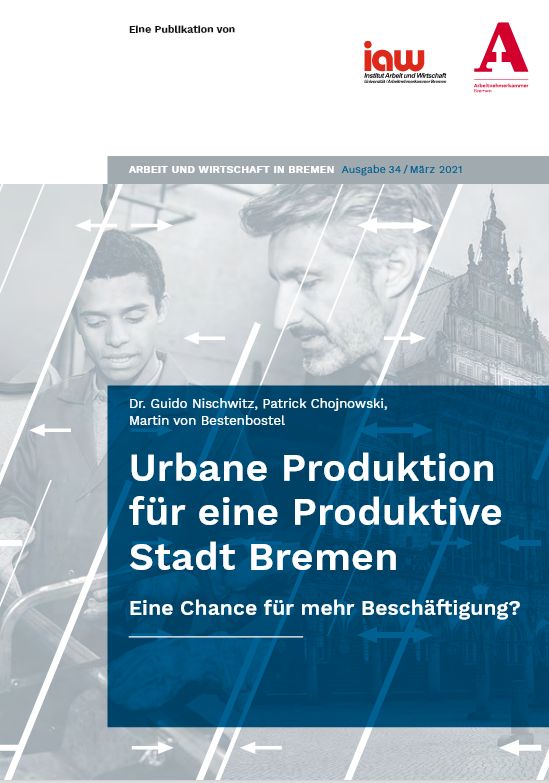
Arbeitnehmerkammer Bremen (ed.), authors: Nischwitz, Guido; Chojnowski, Patrick; von Bestenbostel, Martin (2021): "Urbane Produktion für eine Produktive Stadt Bremen. An opportunity for more employment?" Series Work and Economy in Bremen 34/2021, Bremen. 202 pp.
Already in December, the state parliament, with the votes of the red-red-green coalition, had a decision The state has adopted a resolution on how it intends to implement the 2030 Agenda for Global Sustainable Development and the United Nations Framework Convention on Climate Change on the ground.
For the first time ever in a federal state, the state parliament in Erfurt is thus also setting up a "Parliamentary Advisory Council on Sustainable Development". Some federal states have their own sustainability councils or scientific advisory bodies, and many have also formulated their own sustainability strategy. However, there is no advisory council at parliamentary level anywhere.
Read the full article from the 26.01.2017: www.nachhaltigkeitsrat.de/...
WIESBADEN: In 2014, companies in Germany achieved a turnover of 3.7 billion euros with goods and services from the solar industry. Compared to 2011, the last economically strong year, this corresponds to an overall decline in turnover of 74.2% or 10.6 billion euros. The crisis in the solar industry in Germany was already apparent in previous years: turnover totalled 9.5 billion in 2012 and 5.1 billion in 2013. The declining economic importance of the solar industry in Germany is primarily due to negative developments in the photovoltaic industry. Between 2011 and 2014, sales of photovoltaic systems and components fell by 75.5 % from 13.3 to 3.3 billion euros. Turnover also fell sharply in the solar thermal sector - from 1.0 billion euros in 2011 to 0.4 billion euros in 2014. Detailed results can be found in the specialist series "Turnover in environmental protection goods and services, 2014". Further information on the survey can be found in the environmental economics section.
The German Solar Energy Society DGS has commented on the developments in a pointed manner: www.dgs.de/index.php?id=3364&type=0#13585 (5th article in the newsletter of 22 July 2016)
Source: Press release destatis.de
Strengthen energy refurbishment of buildings and demand responsibility from landlords.
Housing policy must create supportive framework conditions and thus contribute to the reduction of living space.
"For a necessary energy turnaround in the housing industry, conditions must be created that demonstrate noticeable incentives for owners and users to consume less energy in the future," says DAI President Dipl.-Ing. Architekt Arnold Ernst. On the occasion of the Federation Day of the German Associations of Architects and Engineers (DAI), a declaration on current topics of building and planning culture is published in annual succession. For previous DAI statements, see below.
In Germany, CO2 emissions from buildings are equivalent to the pollution caused by traffic. The intensity of the public discussion does not reflect this. This is all the more reason why architects and engineers are called upon to show responsibility in their field and to demonstrate ways in which they intend to make their contribution to sustainable climate protection.
The technical solutions are available, and we need to develop better methods, especially for the sustainable retrofitting of existing buildings. However, there is a lack of incentives for owners and users to implement and tolerate energy-efficient refurbishment. It is easier to demand climate protection than to pay for it. The environmental impact of CO2 emissions is (still) free, but avoiding it costs money, a lot of money in existing buildings. The landlord shies away from the investment because only a small part can be passed on to the rents. The tenant has an understandable insistence on not changing the size and location of his flat, especially as long as the parties keep deciding on new socially undifferentiated benefits in the competition for the cheapest rents. Both landlords and tenants must make their economic contribution in order to finance the comprehensive energy-efficient refurbishment of the housing stock.
The benchmark for all participants must be the Polluter pays principle be. Those who contribute to the release of CO2 must have an economic advantage if they actively participate in the reduction; those who refuse to participate must have an economic disadvantage as a result.
The DAI demands:
A CO2 levy for each sqm of heated floor space according to the information in the energy performance certificate from level B. This levy is covered by the Owner to pay.
A CO2 levy on the energy used according to consumption and specific CO2 emissions. This levy is determined by the Tenant to pay.
Both levies make it more expensive to live in buildings that are not optimised in terms of energy efficiency. Weighing up the direct financial burden on those affected and the long-term burden of climate change, the DAI considers the additional costs incurred to be justified. Support for economically weak households in line with the social market economy must ensure that the entitlement to adequate housing is met.
As appropriate in the sense of social indigence 30 sqm per person + 20 sqm for each additional person in a dwelling are considered. Appropriate transitional periods should on the one hand avoid social hardship and on the other hand continuously stimulate stronger incentives for the adaptation of housing conditions to economic performance. In order to also stimulate the corresponding adjustment processes above the level of social need, the regulation of the rent level should be waived, but in the case of existing tenancies with an appropriate limitation of the annual increase, also in order to facilitate the adjustment to economic performance.
DAI Presidium
Note sdg21: the statement presented here does not reflect the opinion of the sdg21 editorial team.
The boom in the bicycle trade, which has been ongoing for years, continued in 2018. As reported by the Federal Statistical Office (Destatis) on the occasion of World Health Day on 7 April, the retail trade in bicycles, parts and accessories recorded an increase in sales of 11.9 % in real terms in 2018 compared to the previous year.
880,000 electric bikes imported into Germany
The trend towards electric bicycles with a rated continuous power of up to 250 watts is reflected in foreign trade: 880,000 electric bicycles with a total value of 789.6 million euros were imported to Germany in 2018. This corresponded to an increase in volume of 32.3 % compared to 2017. With a share of 23 % of the total imports of electric bicycles to Germany, Hungary was the most important importing country. Other important supplier countries were Vietnam with a share of 17.2 % and the Netherlands with 10.2 %.
Prices for conventional bikes are rising faster than prices for electric bikes
Consumers had to spend more money on pedelecs and e-bikes in 2018 than three years previously: between 2015 and 2018, prices in this market segment rose by 1.8 %. However, prices rose less sharply than consumer prices overall in this period (+3.8 %). In comparison, prices for bicycles without an electric motor rose by an above-average 4.5 % between 2015 and 2018.
Opportunity for bargains outside of the cycling season
Whether with or without an electric motor: consumer prices for bicycles fluctuate slightly depending on the time of year. Bicycles are cheaper around the turn of the year than in summer. If you are looking for good value for money, you can buy cheaper on average outside the cycling season.
Source: Press release of the Federal Statistical Office from 3 April 2019
We use cookies to optimize our website and services.
Functional
Always active
Technical storage or access is strictly necessary for the legitimate purpose of enabling the use of a particular service explicitly requested by the subscriber or user or for the sole purpose of carrying out the transmission of a communication over an electronic communications network.
Preferences
The technical storage or access is necessary for the legitimate purpose of storing preferences that have not been requested by the subscriber or user.
Statistics
The technical storage or access, which is solely for statistical purposes.Technical storage or access used solely for anonymous statistical purposes. Without a subpoena, voluntary consent from your Internet service provider, or additional records from third parties, information stored or accessed for this purpose cannot generally be used alone to identify you.
Marketing
Technical storage or access is necessary to create user profiles, to send advertising or to track the user on a website or across multiple websites for similar marketing purposes.

 Production in the city is not a new phenomenon. Urban production - in its various forms and development paths - is one of the constitutive features of a city. The concept of the Productive City opens up the possibility of using a strategic approach to link the central aspects of the changing socio-economic basis of cities (development of new forms of production and work) with the goals of a compact and functionally mixed city.