Event by IBA Hamburg / Arch +
Min. 14
Keywords: Movies, Movies 11 to 45 Min, Wood construction, IBA, News Blog Berlin, Quarters
Event by IBA Hamburg / Arch +
Min. 14
The aim is to redesign a 100% CO2-neutral neighbourhood.
To this end, a first building complex with approx. 25 buildings (113 residential units) and approx. 10 commercial units is to be converted in a climate-neutral manner between 2016 and 2018 and a first representative microgrid is to be developed in the quarter. In addition to office units, there will also be restaurants, workshops and a municipal gymnasium. So to speak "normal life", as one finds in most building complexes of this kind. In addition to the approx. 250 residents, approx. 80 employees as well as employers and house owners must be involved in the transformation process.
In addition to the energy supply, we want to develop new sustainable mobility options for people. The aim is to achieve more flexible, cost-effective and environmentally friendly mobility through the increased use of shared infrastructure in conjunction with sharing systems and the additional use of electric vehicles as temporary energy storage units.
The aim is to make this pilot ready for swarming after realisation in 2018 and a further year of test operation and to transfer it to the entire district in the years 2020 to 2030, thus creating the blueprint for a transformation in Wuppertal.
Project website:
www.aufbruch-am-arrenberg.de/site/home/klimaquartier/news/
Keywords:
Stock, CO2-neutral, Movies, Movies < 4 Min, News Blog NRW, PV, Quarters, urban gardening
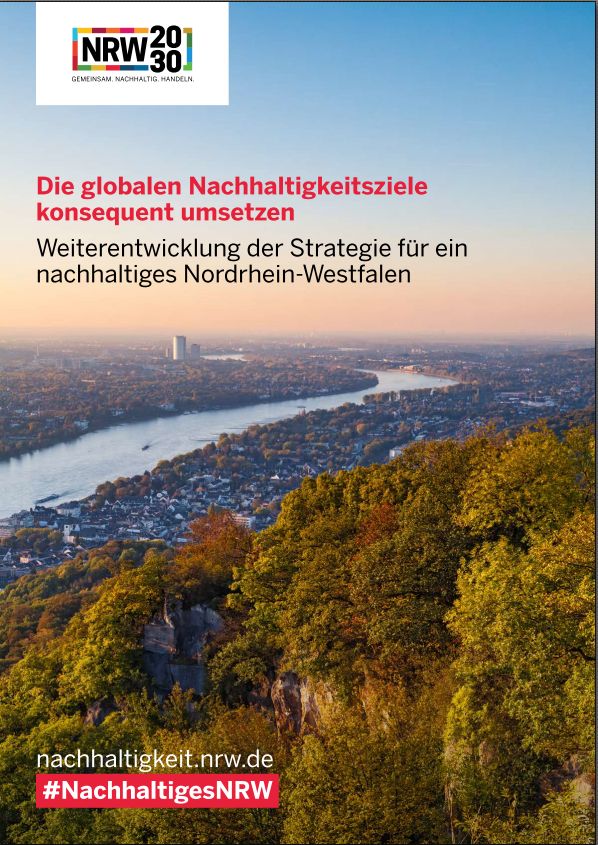 North Rhine-Westphalia is the world's largest public issuer of sustainability bonds / Minister President Laschet: North Rhine-Westphalia is committed to a future in which ecology and economy are responsibly compatible
The state government of North Rhine-Westphalia has adopted an updated sustainability strategy that has been supplemented with important topics for the future. With a wide range of goals and measures, the strategy shows the way to sustainable living and economic activity in the most populous federal state. The strategy was developed in cooperation with all ministries of the state government under the leadership of the Ministry of the Environment. The state government will appoint a sustainability advisory board to accompany the implementation, evaluation and further development of the sustainability strategy.
Minister President Armin Laschet: "With the newly presented sustainability strategy based on the 17 UN goals, North Rhine-Westphalia is making concrete contributions to the integrity of creation and to sustainable economic activity. North Rhine-Westphalia is a pioneering state: we show how sustainability can succeed here in a highly developed and densely populated industrial state in the heart of Europe. In this way, we can set an example worldwide. North Rhine-Westphalia is committed to a future in which ecology and economy are responsibly compatible."
"By positioning ourselves sustainably as a society and economy, we are shaping the future and future markets. Each and every individual can make a contribution to this in this decade of sustainability," says Environment Minister Ursula Heinen-Esser: "At the same time, the new strategy is also a central guard rail for the way out of the corona pandemic. This must be linked to tangible steps towards sustainability so that the economy can not only recover, but North Rhine-Westphalia can emerge from the crisis more climate-friendly, resource-efficient and sustainable."
The core of the new sustainability strategy is a set of 67 concrete goals and indicators. These are closely interlinked with the goals at federal level and are based on the global sustainability goals adopted by the United Nations on 25 September 2015 with the worldwide Agenda 2030. Ecology, economy and social coexistence are given equal consideration.
World's largest public issuer of sustainability bonds
Among other things, North Rhine-Westphalia plays a pioneering role in the issuance of sustainability bonds. In recent years, North Rhine-Westphalia has placed six sustainability bonds with a total volume of almost eleven billion euros on the financial markets. This makes North Rhine-Westphalia the largest public issuer of sustainability bonds worldwide and the first and so far only German state to issue bonds in this area. The multiple awards with industry prizes confirm the success of the state's sustainability bonds.
"The sustainability principle is particularly important to us - economically and politically," affirms Lutz Lienenkämper, Minister of Finance. "We achieve high demand on the market and at the same time enable important investments for the future of our country."
Wide range of targets and indicators
The spectrum of goals and indicators ranges from an increase in organic farming to 20 percent of agricultural land, to strengthening the environmental economy as an important future segment, to a minimum investment of 3.5 percent of GDP in innovations and solutions for the future. Other indicators describe the expansion of all-day care at primary school age and the increase in raw material productivity by 2030. In addition, the strategy includes important future topics such as digitalisation, the circular economy and electromobility.
Further information on the sustainability bonds
With the sustainability bond, the country is addressing investors who value a financial investment that supports social and ecological concepts. The investors' money flows into sustainable projects of the state from a total of seven project categories. These include, for example, exemption from contributions for the last year of kindergarten and the expansion of cycle paths and broadband infrastructure. The pension fund of the state of North Rhine-Westphalia is also managed 100 percent sustainably. The state pursues the goals of security, profitability and sustainability in its investment decisions.
The requirements for sustainable capital investments include both general ESG criteria (Environment, Social, Governance - ESG) and targeted criteria for the exclusion of ethically or ecologically particularly problematic business practices. This is how sustainable management with improved environmental standards succeeds in the industrial and energy state of North Rhine-Westphalia. The state invests exclusively in companies that are among the best rated in the areas of ecology, social affairs and corporate governance on the basis of numerous key figures. In particular, international norms and standards for the protection of the environment as well as ethical and social criteria formulated by the UN apply.
Keywords:
News Blog NRW, SDG 2030, Environmental policy
Contrary to the agreements in the coalition agreement, the draft budget presented by the Federal Minister of Finance, Olaf Scholz, on 2 May 2018 does not include tax incentives for the energy-efficient refurbishment of buildings. Deutsche Umwelthilfe (DUH) considers this a worrying revelation. The environmental and consumer protection organisation calls on the federal government to immediately launch a programme for tax incentives for the energy-efficient refurbishment of buildings and to increase the refurbishment rate for existing buildings from the current 0.8 percent to at least 2 percent per year.
"If the Federal Minister of Finance does not anchor this measure, which was agreed in the coalition agreement and is central to climate protection, in his draft budget, then he shows that he has either forgotten or already abandoned the climate policy promises of the new government after only a few weeks in office.", says Sascha Müller-Kraenner, Federal Executive Director of DUH.
Energy-efficient building refurbishment is a central element of the energy transition and climate protection. However, climate protection in the building sector will only be successful if the renovation rate in the building stock increases from the current 0.8 percent to over 2 percent annually.
"The two previous governments already failed to set the course for tax incentives in time and thus make a decisive contribution to achieving the 2020 climate protection target"Müller-Kraenner continues. "The reservations of the Länder that tax incentives would create a budget gap for them have been known for a long time. It is time to bring acceptable counter-financing solutions to the table."
After all, tax incentives for refurbishment costs are an important incentive not only for large housing associations but also for private homeowners to invest their own funds. The starting signal for this must now be given urgently.
Source: DUH PM of 07.05.2018
Keywords:
Stakeholders, Stock, DE-News, Funding, Climate protection, Environmental policy, Housing policy, Thermal insulation