Traffic clubs demand purchase premium of up to 4000 Euro for e-bikes
Published
Electric cars are subsidised by the state, e-bikes are not. The bicycle lobby thinks this is unfair, as does the Federal Council - they argue that an opportunity for a transport revolution is being wasted. The government disagrees.
Federal Ministry for Climate Protection announces comprehensive emergency programme
Introduction
After a significant decline in the previous year, greenhouse gas emissions in Germany are on the rise again. Thus, around 762 million tonnes of greenhouse gases were released in 2021 - a good 33 million tonnes or 4.5 percent more than in 2020. Overall, emissions in Germany have thus fallen by 38.7 percent since 1990. The increase in the last year is particularly noticeable in the energy sector: This shows an increase of 27 million tonnes CO2-equivalents, as increased demand for electricity, lower electricity generation from renewable energies and the higher gas price led to increased use of coal for electricity generation. Electricity generation from renewables fell by seven per cent, mainly due to poor wind conditions. In the transport and building sectors, emissions were above the annual ceilings set by the Federal Climate Protection Act. This is shown by the latest calculations of the Federal Environment Agency (UBA), which are based on the specifications of the Federal Climate Protection Act and the EU-Renewable Energy Directive (RED) were presented today.
Climate State Secretary Patrick GraichenThe increase in greenhouse gas emissions has unfortunately become apparent. The Federal Government will now quickly counteract this with an immediate climate protection programme. The key is a much faster pace in the expansion of renewable energies. We must manage to install three times as much capacity as before in order to increase the share of renewables in electricity generation to 80% by 2030. There must be no more of the kind of stalemate we have seen in recent years. The Russian war of aggression on Ukraine has also made it dramatically clear to us how closely security and energy supply are linked. We can no longer afford to ignore this. That is why we must now quickly remove every stumbling block on the path to more wind and solar power. The faster shift away from fossil energies must encompass all sectors - from industrial production and buildings to mobility and agriculture. It is crucial to maintain the social balance in the process."
UBA-President Dirk Messner: "Almost half of the 2020 reduction in greenhouse gas emissions has already been lost. Our figures clearly show that the federal government's targets must be addressed as quickly as possible. We need to build more solar and wind power plants quickly. We must convert our buildings to heat pumps and stop installing oil and gas heating systems as soon as possible. We can also achieve a lot with our houses by saving energy, especially by making them more energy-efficient. This will also help to reduce our energy dependence on Russia. Each and every one of us can do something here that also helps the climate: heat a little less, leave the car parked more often or, if it is necessary, drive more slowly."
Current emission data in detail
Since 1990, emissions in Germany have fallen by 38.7 percent. The target for 2030 is a reduction of 65 percent. In 2021, there were increases in emissions compared to the previous year in almost all sectors. The available data show that since 2010, the energy transition in particular has contributed to the reduction of emissions. All other significant sectors have more or less stagnated since 2010.
In the sector Energy industry are with around 27 m. tonnes - this corresponds to 12.4 per cent more than in 2020. With around 247 tonnes, the m. Tons CO2-equivalents, however, emissions were still a good 11 m. There is no annual emission quantity for 2021 in the Federal Climate Protection Act for the energy sector. Emissions from hard coal and lignite-fired power generation increased particularly significantly due to the increased use of coal. The use of lower-emission natural gas, on the other hand, decreased in the second half of the year due to the significant increase in gas prices. The main reason for the increased use of fossil energy sources for electricity generation is the 17.5 TWh Significantly reduced electricity generation from renewable energies, in particular the lower wind power generation, and a 13.5 TWh increased gross electricity consumption.
At Traffic in 2021, around 148 m. Tons CO2-equivalents are emitted. This means that greenhouse gas emissions from this sector are both 1.2 per cent above the 2020 value and around 3 m. tonnes above the annual emission quantity of 145 tonnes permitted in the Federal Climate Protection Act for 2021. m. Tons CO2-equivalents. One reason for this is road freight traffic, which has risen again on the motorways to a level slightly above that of 2019. The CAR-In contrast, the level of traffic is still lower than before the Corona pandemic (2019), which is reflected in fuel sales figures and data from counting stations on motorways and trunk roads.
In the sector Industry emissions rose by a good 9 % compared to the previous year. m. Tons CO2-equivalents increased (plus 5.5 per cent). With around 181 m. Tons CO2-equivalents, they were almost at the 2019 level again, but just below the annual emission quantity of 182 m. Tons CO2- equivalents. Catching-up economic effects in the wake of the Corona crisis and increased use of fossil fuels play an important role here. The most significant percentage increase was in the steel industry, where crude steel production rose by around 12 percent. In the manufacturing industry (energy-related share), emissions increased by around seven m. Tons CO2-equivalents respectively 6.4 per cent.
At Buildings In 2021, there was an emission reduction of just under 4 m. Tons CO2-equivalents (minus 3.3 per cent) to around 115 m. Tons CO2-equivalents. Despite this reduction in emissions, the building sector, as in the previous year, exceeds the permitted annual emission quantity according to the Federal Climate Protection Act, which is 113 m. Tons CO2-equivalents. The reduction in emissions is mainly due to a special effect of significantly reduced heating oil purchases. Heating oil stocks were already increased extensively in 2019 and 2020 due to the favourable prices and in anticipation of the Fuel Emissions Trading Act. Natural gas consumption, on the other hand, increased due to the weather.
In the sector Agriculture Greenhouse gas emissions decreased by a good 1.2 m. Tons CO2-equivalents (minus 2.0 per cent) to 61 m. Tons CO2-equivalents. The sector thus remains significantly below the annual emission level of 68 m. Tons CO2-equivalents. The decline in animal numbers continues. Cattle numbers fell by 2.3 percent, pig numbers by 9.2 percent. As a result, there was less manure, which is why the emissions associated with fertilisation also fell (-4.0 percent compared to 2020). However, the significant undercutting of the set annual emission quantity is mainly due to methodological improvements in the calculation of emissions.
The emissions of the Waste sector fell by around 4.3 per cent compared to the previous year to a good eight per cent. m. Tons CO2-equivalents. This means that the waste sector once again remains below the annual emission level of nine m. Tons CO2-equivalents. The trend is essentially determined by the decreasing emissions from landfilling as a result of the ban on landfilling organic waste.
Further procedure under the Federal Climate Protection Act
The emission data for the year 2021 will now be reviewed by the Expert Council on Climate Issues, as provided for in the law. The expert council submits an assessment of the data within one month. After that, according to the law, the respective responsible ministries have three months to submit an emergency programme containing proposals for measures to bring the building sector and transport sector onto the intended target path in the coming years. However, the federal government is already working on an emergency climate protection programme that is intended to meet these requirements as far as possible.
Dirk Messner: "In order to achieve the German government's goals by 2030, six percent of emissions must now be reduced per year. Since 2010, the average has not even been two percent. To achieve this, Germany now needs a joint energy effort. Together, we must put all our energy into making ourselves independent of Russian energy and protecting our climate.
Current data on renewable energies
As early as 2020, the project, which was launched as part of the EU-Renewable Energies Directive (Renewable Energy DirectiveRED), Germany's binding target of 18 percent of gross final energy consumption was exceeded with 19.3 %. In 2021, the gross final energy consumption from renewable energies in the electricity, heating and transport sectors rose according to the calculation specifications of the RED further slightly to 483 Billion kWh an. This corresponded to a share of 19.7 per cent of total gross final energy consumption.
The main reason was that more renewable energies were used for heating and cooling due to the cold winter. For this reason - and because heating oil sales, which are decisive for the calculation of the share, also declined due to high inventories and rising oil prices - the share of renewable heat increased significantly from 15.3 to 16.5 percent in 2021. The heating and cooling sector accounts for more than half of Germany's total gross final energy consumption.
Electricity generation from renewable energies declined by seven percent in 2021 due to a comparatively poor wind year. At the same time, the expansion of onshore wind energy plants stagnated in recent years. The renewable share of gross electricity consumption fell accordingly from 45.2 percent in 2020 to 41.1 percent. Electricity consumption represents about a quarter of Germany's total gross final energy consumption. For the European monitoring according to RED the real decline in renewable electricity generation is, however, mitigated by a normalisation rule for compensating for weather effects over several years.
In the transport sector, the share of renewable energies in total final energy consumption fell from 7.6 percent in the previous year to 6.8 percent in 2021. This decline can be explained by special carry-over arrangements from earlier years under the greenhouse gas reduction quota and a higher crediting of upstream emission reductions. Transport is responsible for a good quarter of total energy consumption.
These and many other up-to-date and quality-assured data have been published in the background paper "Renewable Energies in Germany - Data on Development in 2021" by the Working Group on Renewable Energies Statistics (AGEE-Stat), which appeared today. The first available data on the use of renewable energies in the electricity, heat and transport sectors are supplemented by calculations on the associated avoided emissions and economic effects.
Further information: The accuracy of the data
The present emission data for the year 2021 represent the best possible calculation at present. They are associated with corresponding uncertainties, in particular due to the limited statistical calculation basis available at this time. The calculations are derived from a system of model calculations and trend updates of the detailed inventories of greenhouse gas emissions for 2020 published in January 2022.
The complete, official and detailed inventory data on greenhouse gas emissions in Germany for the year 2021 is published by the UBA in January 2023 with the transmission to the European Commission.
Berlin: On 4 May 2018, BUND presented a shutdown plan for nuclear power plants (NPPs) and coal-fired power plants. This analysis shows that the decommissioning of the most climate-damaging coal-fired power plants by 2020 and a significant acceleration of the nuclear phase-out in Germany are possible without jeopardising security of supply. "The shutdown plan is a call to action for the political actors to finally take action," explains BUND Chair Hubert Weiger at the presentation of the shutdown plan in Berlin.
In the shutdown plan, BUND has drawn up a concrete performance balance and names power plants as well as annual figures for the shutdown. The focus is on the years 2020 and 2023. This period is considered to be a particular challenge for supply security, since on the one hand it is the legal date for the phase-out of nuclear power. On the other hand, a good half of the coal-fired power plants must be taken off the grid in order to achieve the German climate target for 2020.
The BUND shutdown plan shows that this is possible and that significantly more coal-fired power plants can be taken off the grid in the short term than has been discussed so far, and that this can also be combined with a significant acceleration of the nuclear phase-out. As a result, the power surplus in Germany is declining, but the supply remains guaranteed even in hours without sun and with little wind. "In the first quarter of 2018, Germany exported on average the electricity production of five large power plants. Against this background alone, it is surprising that the new federal government has not agreed on the short-term decommissioning of the most climate-damaging coal-fired power plants," says the BUND chairman. "We want to show with our analysis that much more is possible if the political will is there."
The BUND shutdown plan shows that security of supply can be ensured if politicians do not continue to wait, but actively promote the energy transition in parallel to the shutdowns. The calculations of the power balance are mainly based on values from, for example, the Federal Network Agency or the transmission system operators. Deviations and other assumptions are justified. "With our analysis, we want to provide an important impetus for a transparent debate within the framework of the amendment to the Atomic Energy Act and the coal phase-out commission that is being constituted," explains Weiger.
In a shutdown list for coal-fired power plants, BUND proposes the units that would have to be taken off the grid first in order to achieve the 2020 climate target. It concerns all larger coal-fired power plants that were connected to the grid before 1990, in order to reduce the coal capacity on the electricity market to 20 gigawatts. As a new measure to enable a socially acceptable coal phase-out and to safeguard security of supply in extreme situations, the environmental association proposes the introduction of an additional coal phase-out reserve of six to eight gigawatts.
"The Paris Climate Agreement requires the phase-out of coal before 2030. The federal government is responsible for achieving the climate targets, it must enshrine the phase-out in law and ensure a just structural change. To achieve the 2020 climate target, it must now launch an immediate programme. Waiting any longer is irresponsible," continued the BUND chair. Due to the inactivity of climate policy in recent years, the German "climate problem" has become increasingly acute. According to the latest emission forecasts, the German climate protection target for 2020 will be missed by ten percentage points.
At the same time as the coal phase-out, the nuclear power plants can also be taken off the grid more quickly than required by law. The seven nuclear power plants that are currently still connected to the grid represent a constant safety risk for the population and must be decommissioned as soon as possible. So far, however, the federal government does not want to use the amendment to the Atomic Energy Act to really accelerate the nuclear phase-out. "BUND demands an immediate nuclear phase-out. At the very least, the current revision of the Atomic Energy Act must be used to legally prohibit further transfers of electricity volumes," says Weiger. Without this transfer, the nuclear power plants would run for a total of ten years less and the production of 300 tonnes of highly radioactive nuclear waste would be avoided.
Getting out of nuclear power and coal and still securing the energy supply - this is possible if the energy transition is driven forward. "It is a matter of further expanding renewable energies with commitment and creating the energy-economic framework conditions for an energy turnaround that is essentially based on wind energy and photovoltaics," says Weiger. This means an expansion of flexible decentralised CHP power plants, a reduction in electricity consumption, optimised utilisation of the electricity grids and a significant increase in the possibilities for load reduction.
Timber construction can be cheaper than standard construction - At the same time significantly better CO2 balance
MNP Architects Munich, School Wangen
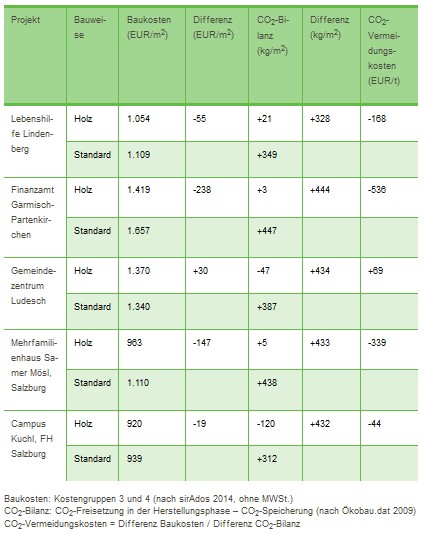
Current comparative calculations based on realized new buildings in timber construction show: Building with wood does not have to be more expensive than the standard construction method. This result is surprising, as it contradicts the common perception that timber construction is more expensive. At the same time, the CO2 balance of timber construction is significantly better; as a result, its CO2 avoidance costs are very favourable, in some cases even negative. An expansion of timber construction would therefore be climate protection at comparatively low cost.
The architect and developer of the Legep construction software, Holger König, has balanced the construction costs and CO2 emissions for the production of five public and private timber buildings and compared them with the results that would have been produced for the same buildings if they had been built in the conventional way. Legep can be used to calculate the manufacturing and life-cycle costs, energy requirements and environmental impact of buildings. In this case, König only looked at manufacturing. For the prices, he used current sirAdos data, which represent the market very realistically. He then went to the trouble that many architects, civil engineers and building owners shy away from: He modeled the buildings with the same area and cubature and the same energy standard, but replaced the wooden components with conventional materials - depending on the building project, solid masonry in brick, sand-lime brick or aerated concrete, or a column-beam supporting structure made of reinforced concrete. He used reinforced concrete for the floor slab, cellar, ceilings and flat roofs, mineral wool or polystyrene for the insulation, and plastic or aluminum frames for the windows. König explains the fact that four out of five buildings in timber construction cost less or the same as in standard construction with the industrial-technical development that many timber construction companies have undergone in recent years. Two of the timber buildings even achieved a negative CO2 balance in the manufacturing phase due to the large amount of renewable raw materials used, which act as carbon stores. In the other three buildings, a slightly higher proportion of non-wooden components, which every timber building also contains, caused the slightly positive CO2 balance.
If one relates the difference in CO2 savings to the difference in construction costs, one obtains the CO2 avoidance costs of timber construction. Negative abatement costs here mean that the builder has saved costs with timber construction compared to standard construction and at the same time protected the climate.
By increasing the proportion of timber construction, more climate protection can be achieved at low or even negative costs, while at the same time strengthening rural areas. The green-red state government in Baden-Württemberg has recognised this and created more favourable framework conditions for the building material in its state building code, which was amended on 1 March (information here). In contrast, some state building codes still contain legal obstacles to building with wood.
The city of Munich also wants to convince more builders to use timber construction: as part of its "Munich Energy Saving Promotion Programme", it has been granting a CO2 bonus for the use of timber and other renewable raw materials in building construction of 30 cents/kg since 2013 (information here).
A high insulation standard with insulating materials made from renewable raw materials is also a contribution to climate protection. The plant raw materials from which the insulating materials were obtained have bound CO2 from the atmosphere, which is now stored in the building material for long periods of time. And finally, heating based on renewable energies also reduces CO2 emissions.
The Agency of Renewable Resources (Fachagentur Nachwachsende Rohstoffe e.V.). (FNR) funded the determination of LCA baseline data for the Legep programme with funds from the Federal Ministry of Food and Agriculture (BMEL) between 2004 and 2006.
We use cookies to optimize our website and services.
Functional
Always active
Technical storage or access is strictly necessary for the legitimate purpose of enabling the use of a particular service explicitly requested by the subscriber or user or for the sole purpose of carrying out the transmission of a communication over an electronic communications network.
Preferences
The technical storage or access is necessary for the legitimate purpose of storing preferences that have not been requested by the subscriber or user.
Statistics
The technical storage or access, which is solely for statistical purposes.Technical storage or access used solely for anonymous statistical purposes. Without a subpoena, voluntary consent from your Internet service provider, or additional records from third parties, information stored or accessed for this purpose cannot generally be used alone to identify you.
Marketing
Technical storage or access is necessary to create user profiles, to send advertising or to track the user on a website or across multiple websites for similar marketing purposes.