17:10 min, talk by Andrew Waugh in March 2020.
Keywords: Movies, Movies 11 to 45 Min, Wood construction, Climate protection, News Blog Great Britain, Resource efficiency, Transition Town, Life cycle assessment

17:10 min, talk by Andrew Waugh in March 2020.
 Half of the city of Berlin belongs to multimillionaires. This is the conclusion of the Rosa Luxemburg Foundation's current study entitled "Who owns the city? Analysis of owner groups and their business practices on the Berlin real estate market".
This is the first systematic evaluation of property ownership in Berlin and the various business models behind it. It opens the black box of large private property owners, about whom little has been known until now. The study describes hitherto unknown owners with more than 3,000 apartments as well as those who are below this threshold and about whom little is known so far.
"The study dispels the myth of the nice little private landlord as the main player in the real estate market, as well as the myth that selling condominiums to owner-occupants under current conditions contributes to social security and affordable housing," says study author Christoph Trautvetter, head of the Rosa Luxemburg Foundation's "Who owns the city?" project.
The uninterrupted price increases on the housing market bring the owners immense unearned returns of sometimes more than 20 percent a year. The study also compares business figures and practices of listed housing companies with their state-owned and cooperative counterparts.
"The sell-out of the city continues, although politically, especially by the Red-Red-Green Party, it is being resisted: for example, through the municipal right of first refusal, but also through the scandalisation of share deals and initiatives for more transparency. In the real estate market, both financial resources and access to information are very unevenly distributed. With its study on the disclosure of the ownership of real estate in Berlin, the Rosa-Luxemburg-Stiftung is doing important political education work and is thus providing actors with the tools they need to inform themselves and defend themselves against the sell-off of their city," says Daniela Trochowski, executive director of the Rosa-Luxemburg-Stiftung.
The trial will be held on November 10, 2020 at 6:00 p.m. via Livestream will be presented. Participants: Christoph Trautvetter (author of the study, project leader "RLS-Cities - Who owns the city?"), Daniela Trochowski (executive director of the Rosa Luxemburg Foundation), Carsten Schatz (co-chair of the parliamentary group DIE LINKE in the Berlin House of Representatives), Rouzbeh Taheri (representative of the IniForum Berlin and spokesperson for "Expropriating Deutsche Wohnen and Co"). Stefan Thimmel (Housing and Urban Policy Officer at the Rosa Luxemburg Foundation) will moderate.
Tenants can also contact www.wemgehoertdiestadt.de can dive into the data of the research with just a few clicks. The website contains further data on the owners presented in the study and on more than two hundred other players in the Berlin real estate market. It thus makes it easier for tenants to search for further clues about the homeowners on the basis of their address or the company they know.
Source: Rosa Luxemburg Foundation PM of 10.11.2020
Keywords:
Stock, DE-News, Research, New books and studies, News Blog Berlin, Affordable housing, City, Housing, Housing policy
Adjusted for inflation, construction volume will decline in 2022 - Price development and rising interest rates will continue to have a severe impact on the construction industry in the years to come - New residential construction will slump more than the overall construction volume - Policymakers will have to change their strategy in order to achieve their goals for the creation of new housing and energy-efficient building renovation in the medium term
Inflation and supply bottlenecks have stopped the construction boom in Germany: In 2022, real construction volume declined for the first time in many years, by around two percent. Similar declines are expected this year as well. Only in 2024 will the construction volume, adjusted for inflation, be back in the black. Residential construction in particular is disproportionately affected by the decline. This is the result of the current calculations of the construction volume, which are prepared annually by the German Institute for Economic Research (DIW Berlin).

© DIW Berlin
Although the construction volume rose by a record-breaking 13.6 percent last year in nominal terms, i.e. in current prices, the increase is solely due to the rapid rise in construction prices. Although this gave the construction companies good sales, adjusted for inflation, construction activity fell by two percent. The urgently needed new housing construction was and is particularly affected, which was even down 4.5 per cent in real terms. "For many years, residential construction has always grown faster than the overall construction volume. Now there are signs of a trend reversal, especially in new construction, which policymakers must take into account," says study author Laura Pagenhardt.
The federal government's goal of building 400,000 new flats per year is thus becoming a distant prospect. Already in the last two years, no more than 300,000 flats have been built. This year and next, the study authors expect that worsening financing conditions and political uncertainty will make investors even more cautious. However, construction prices are likely to rise less sharply due to the easing of supply chains and declining capacity utilisation. "Adjusted for inflation, the construction volume will probably still be negative this year and will only be positive again from 2024, but even then residential construction, especially new construction, is likely to lag behind the overall development," expects study author Martin Gornig.
"What is needed is a master plan that not only supports demand with long-term funding programmes, but also counteracts the bottlenecks in supply" Martin Gornig
He therefore calls for a change in strategy. Although the federal government has already decided on measures to promote housing construction through taxation, it must focus more on redensification of existing buildings in order to create affordable new housing, especially in urban areas. At the same time, there is a danger that a large part of the subsidies, especially for energy-efficient building renovation, will evaporate into rising prices if the supply side is not strengthened in addition to the demand side. According to Gornig, what is needed is a master plan that not only supports demand with long-term subsidy programmes. In addition, it must increasingly promote the expansion of planning, production and installation capacities in order to counteract bottlenecks in supply and thus price increases.
Keywords:
DE-News, Quarters, Settlements, Housing, Housing policy
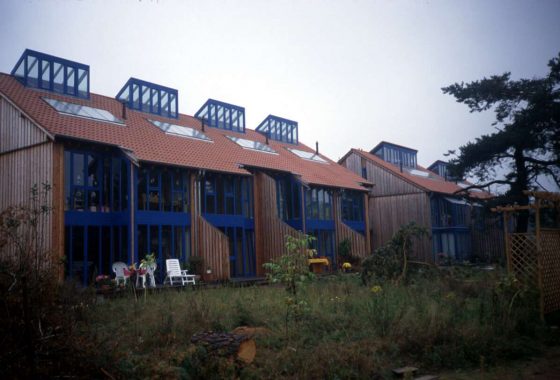
5:18 min, First broadcast: 11/19/2020, Available until 11/20/2021.
Wir im Saarland - The Magazine ∙ SR Television
"A quarter of a century ago, Bernd Janes looked for like-minded comrades-in-arms and founded an ecologically oriented housing estate on the outskirts of Kohlhof. At first, the new neighbors were eyed critically by the surrounding community. No wonder, because the houses were built in wood, four families shared one house and the gardens were not separated from each other by fences, but merged seamlessly into each other."
Link to post:
www.ardmediathek.de/...pioniere-die-erste-oekosiedlung-im-saarland-19-11-2020/...
Project Info: http://sdg21.eu/db/holzbausiedlung-kleiner-hirschberg
Keywords:
Building Biology, DE-News, Movies, Movies 4 to 10 Min, Wood construction, News Blog Saarland, Settlements
In Norderstedt, there is a housing project where you can only live if you have a special electric car with a rechargeable car charging box. Small catch: this doesn't even exist yet.
Hier gehts zum Clip extra 3 vom 1.2.2017 (Achtung Satire! 🙂
www.ndr.de/...Solardorf...
Keywords:
Movies, Movies < 4 Min, News Blog Schleswig-Holstein, eMobility