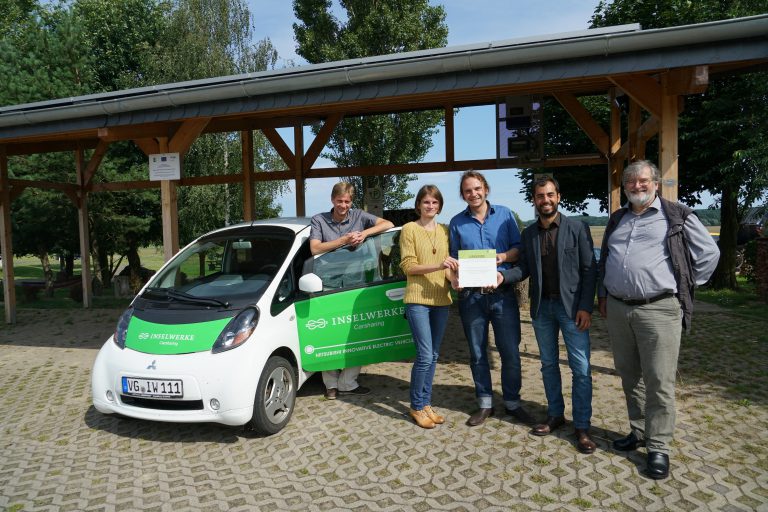
3 min, from April 2018 Energy-saving student dorm architecture (ESA dorm).
Project Info: http://sdg21.eu/db/esa-studierendenwohnheim-kaiserslautern
Keywords: Movies, Movies < 4 Min, News Blog RLP, Build it yourself, Student housing, Housing projects
3 min, from April 2018 Energy-saving student dorm architecture (ESA dorm).
Project Info: http://sdg21.eu/db/esa-studierendenwohnheim-kaiserslautern
Brussels, 30 January 2018. In 2017, for the first time, more electricity was produced from wind, solar and biomass in the European Union than from hard coal and lignite combined. Electricity generation from these renewables grew by 12 percent compared to the previous year. Since 2010, the share of electricity from wind, solar and biomass - the "new" renewables introduced since 2000 - has more than doubled in the EU. However, as hydropower production declined sharply in 2017, the share of all renewables in electricity generation grew only slightly from the previous year, rising from 29.8 to 30.0 percent. This is shown in a joint analysis by two think tanks - Agora Energiewende from Germany and Sandbag from the UK. The authors of the study compiled and evaluated public data from numerous sources.
However, the share of renewable energies is developing very differently from country to country. The United Kingdom and Germany, for example, have contributed more than half of the expansion of renewable energies in the past three years - wind energy in particular plays a major role here. In Germany, 30 percent of electricity was generated from wind, solar and biomass last year, compared with 28 percent in the UK. The strongest percentage growth was recorded in Denmark: In 2017, 74 percent of the electricity generated there came from wind, solar and biomass, an increase of seven percentage points within one year. The strong growth in these countries contrasts with very low growth in many other EU countries: Slovenia, Bulgaria, France, Slovakia, the Czech Republic and Hungary have all seen very low growth since 2010. Other countries still recorded significant growth at the beginning of the decade, but only stagnation in the past three years. These include Spain, Italy, Portugal, Belgium and Greece. The exceptions are Croatia and Romania, where the share of electricity from wind, solar and biomass has increased from low single digits to 18 (Croatia) and 16 percent (Romania) since 2011. Six countries produced less than ten percent of their electricity from wind, solar and biomass in 2017: Slovenia (4%), Bulgaria (7%), France (8%), Slovakia (8%), Czech Republic (8%) and Hungary (10%).
Fossil energy also showed an uneven development. Electricity generation from hard coal declined by 7 percent due to higher wind power production. This development will continue in the Netherlands, Italy and Portugal due to political decisions. However, electricity generation from lignite increased slightly across the EU in 2017, and there is no sign yet of a shift away from lignite-fired generation.
Despite the increase in wind and solar energy, CO2-emissions from the European power sector did not fall in 2017, remaining at 1,019 million tonnes. A combination of three factors led to this: First, electricity generation from hydropower fell to a Europe-wide low, mainly due to low precipitation and snowfall, which largely eroded gains in other renewables. Second, nuclear power plants in France and Germany supplied less electricity than in previous years. And third, electricity consumption in the European Union rose for the third year in a row, by 0.7 percent in 2017. Since CO2-emissions outside the power sector increased, emissions within the EU Emissions Trading Scheme (ETS) are expected to rise again for the first time since 2010, the authors of the study forecast. They assume that in 2017, within the ETS, 1,756 million tonnes of CO2 were emitted, six million metric tons more than in the previous year. Emissions from the use of oil and gas outside the ETS also grew. Sandbag and Agora Energiewende therefore assume an increase in total greenhouse gas emissions in the EU of around 1 percent.
"In recent years, the development of renewable energies in Europe has been strongly influenced by the success story of wind energy in the UK and Germany. However, only if all countries in Europe commit themselves equally will it be possible to achieve a 35 percent share of renewable energies in energy consumption by 2030. Photovoltaics can make a much greater contribution to this than has been the case to date. Measured against its potential and its now very low costs, it plays far too small a role," says Matthias Buck, Head of European Energy Policy at Agora Energiewende.
"With electricity consumption rising for the third year in a row, countries need to step up their energy efficiency efforts," adds Sandbag analyst Dave Jones. "To make a difference on emissions, European Union countries can't avoid closing coal-fired power plants. According to our calculations, 258 coal-fired power plants in the EU accounted for 38 percent of all emissions in the ETS last year. This is equivalent to 15 percent of total greenhouse gas emissions." In 2017, the Netherlands, Italy and Portugal announced plans to phase out coal-fired power generation in the coming years. "This is great. But we need a fast and complete coal phase-out in Europe. It would be absurd to still be charging electric cars with electricity from coal in the 2030s," Jones says.
To reach the EU's 2030 renewables target, the EU will have to make much greater efforts in the coming years than in the past. "Especially in Southern and Central Europe, but also in Spain and Greece, renewable energies can play a much greater role. Because the climatic conditions there are very favourable for renewables," says Buck. Agora Energiewende has therefore recently proposed a guarantee programme to significantly reduce the financing costs for renewable energy projects in these countries.
The analysis "The European Power Sector in 2017" was presented today in Brussels. It is available in English on the website www.agora-energiewende.de available for download free of charge. A comprehensive data set with all figures used in the publication is available as an Excel file.
Keywords:
Stakeholders, DE-News, Renewable, Climate protection, Media, New books and studies, News Blog Europe (without DE), Environmental policy, Ecology
The property developer WvM Immobilien + Projektentwicklung GmbH and the eco-energy supplier NATURSTROM AG found the joint company Green Estate. With the fusion of energy and real estate know-how, the partners are taking a new path to enable people to live sustainably.
The aim of the cooperation is to include decentralised, clean energy generation in future WvM building projects from the very beginning - and thus to optimally exploit the possibilities of a networked electricity, heating and e-mobility infrastructure. The Green Estate acts as an operating company through which WvM and NATURSTROM jointly invest in the building energy systems in the WvM properties. NATURSTROM will then take over the technical operation of the systems and the billing of energy consumption to the customers. "We have the vision of providing people with a sustainable supply of electricity and heat exclusively from renewable sources on site," explains NATURSTROM CEO Dr Tim Meyer. "With WvM, we have found a partner who pursues the same goals."
With the founding of Green Estate, NATURSTROM and WvM Immobilien are entering into the first cooperation of this kind. Such a far-reaching cooperation is absolutely exemplary, because in the course of a decentralised energy turnaround, more and more overlaps are emerging between the energy and real estate industries. The ecological capabilities of cities and urban centres are crucial for the future of the planet.
For each building project, the companies develop an individual energy concept in order to make the best possible use of the on-site generation potential and to align it with the respective demand. "Behind NATURSTROM are thoroughbred enthusiasts who live and breathe climate protection and with whom we are happy to cooperate for this reason, among others," says Raphael Hüffelmann, Head of Construction Project Management at WvM, explaining the cooperation.
The planning for the first two construction projects in Cologne and Berlin has already been completed, and further projects are in the planning stage - including the residential quarter in Subbelrather Straße in Cologne-Ehrenfeld, for which WvM and NATURSTROM are currently developing an innovative climate-friendly energy concept for sustainable living.
Picture material for download: Visualisation project Subbelrather Straße Cologne. © WvM Real Estate
About WvM Real Estate
WvM Immobilien + Projektentwicklung was founded in 1992 by Wolfgang von Moers and is Cologne's largest owner-managed property developer for residential real estate. We currently employ more than 120 people; in addition to civil engineers and architects, we also have real estate agents, marketing and sales specialists. The range of services covers the entire value chain from purchasing to development/realisation to the sale and management of the properties. Since June 2017, we have been represented with a location in Berlin-Charlottenburg.
Keywords:
DE-News, Renewable, Climate protection, Cologne, Tenant electricity, News Blog Berlin, News Blog NRW, Quarters, Settlements, Housing
Sustainable development is hardly conceivable without a consistent circular economy. Turning away from a predominantly linear economy requires a change of course. UBA has drawn up guiding principles for politics, business and society which systematically set out the objectives, scope for action, standards of action, requirements and success factors of a circular economy.
The pressure of strain is increasing
The world's population has doubled in the past five decades, and global raw material extraction has tripled. By 2060, the demand for raw materials threatens to increase dramatically from the current level of around 90 billion tonnes to as much as 190 billion tonnes. The competition is no longer just for raw materials, but for access to natural resources as a whole: such as soil, land, clean drinking water and intact ecosystems. According to the International Resource Panel, about 50 % of climate-damaging greenhouse gas emissions and 90 % of biodiversity loss and water stress are due to the extraction, preparation and processing of raw materials. The negative impacts on the natural environment from the extractive industries as a whole, and the resulting waste and emissions, continue to increase. Meanwhile, only just under 9 % of raw material demand worldwide is met by resource-conserving secondary raw materials.
No "business as usual" with the linear economy
A rethink is slowly taking place to meet these challenges. For example, the European Green Deal, which sets out the EU's key development goals for 2030, makes a carbon-neutral circular economy a key pillar of sustainable development. The European Commission's new "Action Plan for the Circular Economy - Towards a Cleaner and More Competitive Europe" aims at a more circular economy, which is about preserving the value of products, materials and resources within the economy for as long as possible and precisely not consuming them, as well as generating as little waste as possible. The stated aim of the action plan is to reduce the footprint in terms of resource consumption in absolute terms and, to this end, to double the proportion of materials used in a circular way over the next ten years.
Circular economy, but the right way
This requires a systemic approach; across entire value chains and product life cycles, with a systemic change of the economic system that focuses on more sustainable production patterns and product policies. This transformation to a circular economy and its political design goes far beyond what can be regulated with the help of the German Closed Substance Cycle Waste Management Act in the production and management of waste. In the sense of a sustainable circular economy, other ministries, economic and legal areas are included. The broader focus is already partly reflected in the amendment of the Closed Substance Cycle Waste Management Act (2020) to take account of the revised EU Waste Framework Directive (2018). However, in the next few years, the systemic approach of the circular economy must be developed and concretised so that the overarching goals such as the conservation of natural resources, the protection of human health and a more sustainable supply of raw materials are also achieved.
Guiding principles provide orientation
The Federal Environment Agency has therefore drawn up nine guiding principles which are intended to create a common understanding of the circular economy, its central terms, principles, objectives, benchmarks and the most important approaches to action. Waste and secondary raw materials management is embedded in these principles as an essential functional area for a circular economy. In addition, there is also a place for overarching approaches such as avoidance, design and the consideration of how to deal with pollutants. The guiding principles are explained in detail in each case, and terms and starting points are systematically explained. In addition, standards are set on the basis of the objectives of the circular economy, assessments are made and the links between the guiding principles are shown. The guiding principles are intended to create an order for the circular economy and provide reliable orientation for its successful development.
You can find more information HERE>
Source: UBA
Keywords:
DE-News, Resource efficiency, Environmental policy
Mainz, March 12, 2019 Air pollution is clearly underestimated as a health hazard, even though there is currently a heated discussion about nitrogen oxides, particulate matter and diesel driving bans. A team of scientists led by Jos Lelieveld, Director at the Max Planck Institute for Chemistry, and Thomas Münzel, Professor at the University Medical Center Mainz, has now determined that air pollution reduces the average life expectancy of Europeans by around 2 years. Worldwide, about 120 people per 100,000 inhabitants die prematurely each year as a result of polluted air, according to the study, and in Europe as many as 133, which is higher than the global average. In at least half of the cases, cardiovascular diseases are the cause of death.
Bad air, especially air polluted with particulate matter, leads to respiratory and cardiovascular diseases and apparently poses a greater health risk than previously assumed. With their study, which is published in the current issue of the European Heart Journal, the Mainz researchers updated recent calculations of the Global Burden of Disease (GBD), a worldwide health study, and also results of their own earlier investigations: Until recently, they assumed a global mortality rate due to air pollution of around 4.5 million people per year. The newly calculated figure is 8.8 million per year. In Europe alone, almost 800,000 people die prematurely each year as a result of air pollution.
The update of the calculations became necessary because a recently published study puts the disease-specific hazard rates significantly higher than the values of the GBD. "Since the GBD study takes into account 41 comprehensive case group studies from 16 countries, including China, it provides the best data basis currently available," says Jos Lelieveld, Director at the Max Planck Institute for Chemistry.
Polluted outdoor air claims more victims than smoking
According to the recalculation by the Mainz researchers, bad air thus joins the list of the most significant health risks such as high blood pressure, diabetes, obesity and smoking. By way of comparison, the World Health Organization (WHO) estimates the mortality rate from tobacco smoke at 7.2 million people per year - including passive smoking. Thus, polluted outdoor air is a similarly large risk factor. However, smoking is individually preventable, whereas air pollution is not.
The researchers emphasize that fine dust particles smaller than 2.5 micrometers in diameter (PM2.5) are the main cause of respiratory and cardiovascular diseases, which explains the high mortality rates attributed to bad air. "Our results show that the European limit value for particulate matter, which is 25 micrograms per cubic meter of air for the annual average, is far too high," said Thomas Münzel, director of the Center for Cardiology at the University Medical Center Mainz. The value is far above the WHO guideline of 10 micrograms per cubic meter.
For their calculations, the scientists from Mainz first determined the regional exposure to pollutants such as particulate matter and ozone using an established, data-based atmospheric chemistry model. They linked these exposure values with disease-specific hazard rates from epidemiological data, as well as population density and causes of death in individual countries.
Fine dust pollution should be reduced
"Our results show a much higher disease burden from air pollution than previously thought," says Münzel, who is also the initiator of the Mainz Heart Foundation. "Air pollution must be recognized as an important cardiovascular risk factor, as it causes additional damage in the body through diabetes, high blood pressure and high levels of cholersterol . Now it has become even more urgent to further reduce exposure to particulate matter and to adjust limit values. In addition, particulate matter needs to be given greater prominence in the European Society of Cardiology guidelines as a causative factor in cardiovascular disease."
Replacing fossil fuels with clean energy sources can cut mortality rates by more than half
Since much of the particulate matter and other air pollutants come from burning fossil fuels, the scientists advocate replacing fossil fuels for energy production. "If we use clean, renewable energy, we not only meet the agreements made in Paris to mitigate the effects of climate change," says Jos Lelieveld, who is also a professor at Johannes Gutenberg University in Mainz and the Cyprus Institute in Nicosia. "We can also use it to reduce the mortality rate in Europe caused by air pollution by up to 55 percent."
1 Age-dependent health risk from ambient air pollution: a modelling study of childhood mortality in middle and low-income countries
Jos Lelieveld, Andy Haines, Andrea Pozzer; The Lancet Planetary Health, 2 July 2018; pre-publication 29 June 2018.
2 Global estimates of mortality associated with long-term exposure to outdoor fine particulate matter
Burnett et al: Proceedings of the National Academy U S A. 115(38):9592-9597, doi: 10.1073/pnas.1803222115, 2018
3 Effects of gaseous and solid constituents of air pollution on endothelial function.
Munzel T, Gori T, Al-Kindi S, Deanfield J, Lelieveld J, Daiber A, Rajagopalan S. Eur Heart J 2018;39(38):3543-3550.
Original publication
Cardiovascular disease burden from ambient air pollution in Europe reassessed using novel hazard ratio functions.
J. Lelieveld, K. Klingmüller, A. Pozzer, U. Pöschl, M. Fnais, A. Daiber and T. Münzel
European Heart Journal (2019), 00, 1-7
DOI: 10.1093/eurheartj/ehz135
Keywords:
Stakeholders, Mobility, News Blog Europe (without DE), Environmental policy