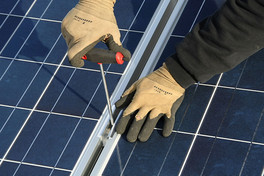
The Climate Action Programme 2030 presented by the Climate Cabinet on 20 September 2019 also includes new rules for the heating supply of buildings. One measure is the replacement premium for old oil and gas heating systems. According to the information programme sponsored by the Baden-Württemberg Ministry of the Environment, this is the state's way of The future of old buildings will cover up to 40 % of the costs if a more climate-friendly system with a proportion of renewable energy is used when a boiler is replaced. The installation of oil-only heating systems is to be completely banned from 2026.
Climate protection targets can only be achieved by investing in green technologies of the future and sustainable investment strategies / Energy Agency to support municipalities with divestment strategies in future.
"To be climate neutral by 2050, we not only need to make additional investments in green and innovative technologies of the future. Above all, we also need a shift from existing investments in 'brown' raw materials such as coal, oil and gas to 'green' climate-friendly technologies. The phase-out of fossil fuels must be global and rapid, in line with the goals of the World Climate Conference. Only in this way can we realistically achieve the climate protection goals. Churches, municipalities and also companies are setting new standards here and demonstrating the feasibility of the changeover in both ecological and economic terms," said Environment Minister Ulrike Höfken today at the event "Divestment and Sustainable Finance", which took place during the Climate Protection Weeks in Rhineland-Palatinate.
Höfken discussed new sustainable financing approaches together with Saori Dubourg, member of the Board of Executive Directors of BASF SE and member of the Council for Sustainable Development, Oberkirchenrat Heinz Thomas Striegler, Head of Church Administration of the Protestant Church in Hesse and Nassau and Chairman of the Working Group of Church Investors of the Protestant Church in Germany, as well as Christoph Bals, Political Director at Germanwatch e.V. and member of the Sustainable Finance Advisory Council of the German Federal Government.
According to the Potsdam Institute for Climate Impact Research, the financial sector in particular has one of the greatest levers of influence in the short term to encourage other sectors of the economy to do more to protect the climate. The central tool here is divestment, a withdrawal of capital from markets and products that violate sustainability criteria, such as fossil-intensive industries, Höfken continued. "Rhineland-Palatinate is one of seven German states that has already passed a divestment resolution: The special assets of the state and the funds of state foundations are invested according to sustainable criteria," the minister explained. The Energy Agency Rhineland-Palatinate will support municipalities in the state in establishing divestment approaches in the future, Höfken announced. Here, the discussion is still in its infancy and further development in terms of content is necessary.
Whether municipalities, churches or companies: All players are called upon to examine their investment strategies and invest in a sustainable future. The City of Bonn is one of the pioneer cities with its path to sustainable financial investment. Carsten Buschmann, Head of Department at the City of Bonn, said: "The City of Bonn is pursuing a holistic approach that will be further expanded. Our experience in Bonn has shown that sustainable investing and returns are not mutually exclusive."
Climate Protection Weeks Rhineland-Palatinate:
During the Climate Protection Weeks Rhineland-Palatinate from 12 November to 11 December 2020, experts will discuss concrete instruments and measures against the climate crisis. From climate-efficient construction to climate funds and sustainable management, the events will highlight numerous approaches to achieving climate protection goals. In addition to top-class experts such as Prof. Hans Joachim Schellnhuber, Prof. Claudia Kemfert or Christoph Bals, renowned companies and organisations such as BASF, Boehringer Ingelheim and the European Investment Bank, numerous national and international politicians from Germany, Luxembourg, Rwanda, Canada and the EU will be represented.
Detailed information on the climate protection weeks can be found at here
"Our struggle for global sustainability will be lost or won in cities." With these words Ban Ki-moon, Secretary-General of the United Nations, opened the High-Level Delegation of Mayors and Regional Authorities in New York City on 23 April 2012.
A little more than three years later, at the United Nations (UN) Summit in 2015, the 2030 Agenda for Sustainable Development was adopted. In the Agenda, 17 Sustainable Development Goals (SDGs) define the key areas and mechanisms for a future global development partnership. One of these goals (SDG 11: "Make cities and human settlements inclusive, safe, resilient and sustainable") distinctly alludes to urban development. The urban community has widely celebrated the adoption of this "stand-alone urban goal". The step is perceived as reflecting an increased awareness of the important role of cities for global development pathways.
On the insulation market, so-called "natural" insulation materials such as wood wool, hemp, cork, granulates and co. are still niche products. However, they are on the rise throughout Europe, at least from the architects' point of view: According to a survey of 1,600 European planners, the use of natural insulation materials is likely to increase in seven out of eight countries. The future prospects for mineral wool, the market leader, are also favourable in this country. According to the architects' forecast, other insulation materials will have a much harder time.
Natural insulation materials are expected to grow strongly in Germany and most countries - which is certainly related to the trend towards sustainable building, which was also highlighted as a strong development by architects in the same study. Mineral wool is also seen as an insulating material with a future in Germany and most countries - this is certainly also related to the market position of the large mineral wool manufacturers in Europe. PUR/PIR systems, on the other hand, are somewhat weaker - in Germany, planners even expect a slight decline in demand.
In most countries, the architects surveyed do not believe that insulation with EPS/XPs currently has strong growth potential - despite the relatively long service life of polystyrene-based core insulation, which has made these insulating materials so economical and popular. The image problems of the materials, which have come under fire because of fire hazards and also do not seem to fit in well with the current trend towards sustainable building with their somewhat anachronistic "Styrofoam" image, are too high.
Exceptions here, however, are Poland and the Netherlands, where plastic-based insulation is still popular. The EPS industry has also managed to gain ground there in terms of sustainability: It is certainly no coincidence that the first large European recycling plants for EPS insulation materials were launched in the Netherlands.
"The raw material wood is precious. It is therefore important to use it responsibly and in a way that conserves resources," warns Peter Aicher, Chairman of Holzbau Deutschland. Even if wood is affected by environmental influences or the bark beetle, it does not represent an inferior raw material, but has almost identical properties to conventional construction timber. "If the so-called 'calamity wood' has the same structural quality in terms of load-bearing capacity as conventional sawn timber, it can be used without restrictions," explains Aicher. In addition, the wood retains its important function as a CO2 sink, regardless of external impairments.
"If the wood is used as a building material, the carbon bound in the wood remains stored there in the long term, thereby significantly reducing the burden on the environment."
The goal must be an economically and ecologically sensible and efficient use of the domestic resource. In the interests of sustainability and climate protection, regional wood resources should therefore be used optimally.
Calamity wood is of high quality and can be used without restrictions
In most cases, bark beetle infestation is irrelevant for the use of the wood as a building material. The bark beetle lays its burrows in the bast, i.e. the area between the bark (bark) and the trunk, but not in the load-bearing wood itself. In addition, the sawn timber is technically dried during further processing. During this process at the latest, any remaining populations of insect pests are reliably killed off, so that beetle-free timber processed into sawn timber is guaranteed to be beetle-free. Every piece of sawn timber - regardless of its origin - must meet the criteria of DIN standard 4074 in order to be used as load-bearing timber in a building. In some cases, the wood turns a slightly bluish colour after a bark beetle infestation. It can then be used in the non-visible area.
Environmental factors and the effects of climate change have further facilitated the mass spread of the bark beetle in the past year. In most cases, rapid felling of the affected trees is the only alternative to stop the further spread of the pest. The logs are immediately removed from the forest and stored. This results in an oversupply of so-called 'beetle wood'. The prompt further processing of the calamity wood into sawn timber is an active contribution to climate protection.
Holzbau Deutschland appeals to the public sector as well as to architects and builders to make greater use of regional calamity wood and to specify this in tenders. The use of domestic calamity wood not only supports regional value creation, but is also a sign of solidarity with regional forest owners.
We use cookies to optimize our website and services.
Functional
Always active
Technical storage or access is strictly necessary for the legitimate purpose of enabling the use of a particular service explicitly requested by the subscriber or user or for the sole purpose of carrying out the transmission of a communication over an electronic communications network.
Preferences
The technical storage or access is necessary for the legitimate purpose of storing preferences that have not been requested by the subscriber or user.
Statistics
The technical storage or access, which is solely for statistical purposes.Technical storage or access used solely for anonymous statistical purposes. Without a subpoena, voluntary consent from your Internet service provider, or additional records from third parties, information stored or accessed for this purpose cannot generally be used alone to identify you.
Marketing
Technical storage or access is necessary to create user profiles, to send advertising or to track the user on a website or across multiple websites for similar marketing purposes.