Bavaria: Building with wood is put on an equal footing with other building materials
Published
The new version of the Bavarian Building Code will make it easier to build with wood in the future. In future, it can be used in all building classes. Schreyer: "With this, we are making wood significantly more attractive as a building material and thus making construction more sustainable." The Council of Ministers passed the amendment in its session today. Now it is the turn of the state parliament.
It will also be more favorable for developers. The new Bavarian building code, for example, allows local authorities to regulate parking space requirements more flexibly because they can, for example, take alternative mobility concepts into account.
The amendment to the building regulations goes back to the housing summit of 11 September 2019, and takes into account key results of an extensive survey among housing associations, the construction industry and municipal umbrella organisations, as well as an expert hearing held by the Bavarian State Parliament on 22 October 2019.
On 5 November 1977 27 people, including lawyers from the anti-nuclear movement, members of various environmental movements and critical natural scientists, but also economists and representatives of the Protestant Church, founded the Öko-Institut in Freiburg. The aim was to provide the public with independent scientific advice and well-founded expert opinions.
Today, more than 165 employees at the Freiburg, Darmstadt and Berlin sites work across disciplines in the fields of energy and climate protection; immission and radiation protection; agriculture and biodiversity; sustainability in consumption, mobility, resource management and companies; nuclear technology and plant safety, chemicals management and technology assessment as well as law, policy and governance.
2017 marks the 40th anniversary of the Öko-Institut. The independent scientific institute, which works extensively on sustainability issues and plays an active role in shaping environmental policy, is celebrating its anniversary under the motto "We wish for something!"
The Rosenstein urban planning competition recently ended with the decision on the winning design. First place went to the Stuttgart-based asp Architekten/Koeber Landschaftsarchitektur consortium. Detlef Kron, Head of the Office for Urban Planning and Housing, opened the exhibition on the Rosenstein competition in the Church of St. Maria at Tübinger Straße 36 in Stuttgart on Friday, 27 September, at 5 pm.
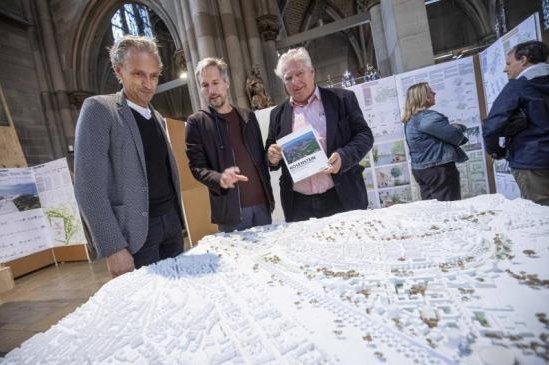
Dr. Detlef Kron (right), Head of the Office for Urban Planning and Housing, opened the exhibition on the urban planning competition. Also present were Cem Arat from the winning Stuttgart consortium asp Architekten/Koeber Landschaftsarchitektur (centre) and Domenik Schleicher, lay chairman of the St. Maria parish council. Photo: Thomas Wagner/City of Stuttgart
At the opening event, Kron said: "The Rosenstein urban planning competition was a complete success: with over 50 submissions from international planning offices, the city of Stuttgart has received a wide range of design ideas for the future Rosenstein quarter. So that the people of Stuttgart can now also get a picture of them, we will be exhibiting the results in the Church of St. Maria over the next four weeks."
The Office of Urban Planning and Housing is displaying all the submitted works from the competition in the exhibition. In addition to plans, drawings, and information about each submitted proposal, revised first and second place models will also be on display. The exhibition will be open for viewing daily (except October 3) between 10am and 6pm until October 25, 2019. Admission to the exhibition is free of charge.
Since 2017, the parish of St. Maria in the south of Stuttgart has made its church available for events other than church services. Whether theatre, café, gallery or marketplace - for two years now, the church of St. Maria has been tested as a space for togetherness with the implementation of various event formats.
Urban planning competition 2018 and public participation
In summer 2018, the city of Stuttgart announced the "international open urban planning competition Rosenstein - Ideas for the new district". The aim of the planning competition was to obtain an urban and open space planning design as a model for the future development of the Rosenstein district. A total of 54 international planning offices took part. Beforehand, citizens were able to contribute their own wishes and ideas for the Rosenstein Quarter at various information events and workshops held by the City of Stuttgart. These were incorporated into the competition.
The Rosenstein development area is currently considered the largest construction project to be realized in Stuttgart in the near future. It stretches between the main railway station, Nordbahnhofviertel, Rosensteinpark and Schlossgarten and offers 85 hectares of space for future-oriented living and working in the heart of the city. The Rosenstein Quarter is to be developed into an urban and mixed district with a high diversity of uses, attractive public spaces and internationally renowned cultural offerings. In addition, the quarter is to be developed under climate-friendly aspects. In addition to the expansion of the parks, the guiding principle of the energy-plus quarter plays a major role: the future buildings should generate more energy than they consume.
Exhibition in the Glass Office
Currently, the designs of the winning office asp Architekten/Koeber Landschaftsarchitektur are also on display at the Info-Laden Rosenstein auf der Prag e.V.. The exhibition in the Gläsernes Büro at Nordbahnhofstraße 81 can be seen until October 12, always on Mondays and Wednesdays between 5 and 7 p.m., Saturdays from 10 a.m. to 12 p.m. and by appointment.
The six 72-square-meter apartments of the GBB Plusenergiehaus on Südring are intended for tenants who have a certificate of eligibility for housing. Demand was high. Even before completion, all of the apartments, which were ready for occupancy from May 2015, were already occupied.
The fact that tenants in social housing can now also benefit from the PlusEnergy level and thus from low energy costs is another important step.
Project participants: Gesellschaft für Bauen und Wohnen Bottrop mbH (GBB); architectural firm Strelzig und Klump, energy concept by engineering firm Jung
We use cookies to optimize our website and services.
Functional
Always active
Technical storage or access is strictly necessary for the legitimate purpose of enabling the use of a particular service explicitly requested by the subscriber or user or for the sole purpose of carrying out the transmission of a communication over an electronic communications network.
Preferences
The technical storage or access is necessary for the legitimate purpose of storing preferences that have not been requested by the subscriber or user.
Statistics
The technical storage or access, which is solely for statistical purposes.Technical storage or access used solely for anonymous statistical purposes. Without a subpoena, voluntary consent from your Internet service provider, or additional records from third parties, information stored or accessed for this purpose cannot generally be used alone to identify you.
Marketing
Technical storage or access is necessary to create user profiles, to send advertising or to track the user on a website or across multiple websites for similar marketing purposes.