8:08 min., 12.07.2010, image video
Project Info: http://sdg21.eu/db/muenchen-riem
Keywords: DE-News, Movies, Movies 4 to 10 Min, News Blog Bavaria
8:08 min., 12.07.2010, image video
Project Info: http://sdg21.eu/db/muenchen-riem
A broad alliance of chambers, the housing industry, trade unions, environmental and nature conservation organisations as well as consumer and social associations came together in June 2016 to form the "NRW Building Alliance for Climate Protection". The aim of the alliance is to promote climate protection in the areas of housing and construction and to introduce jointly developed priorities into the political arena.
Energy-efficient refurbishment is an important and indispensable contribution to achieving climate protection targets. In addition to energy-efficient refurbishment as a central element in achieving the climate protection targets in NRW, energy-efficient new residential construction and the decentralised generation of renewable energy in residential and urban districts are also of great importance." (p.1 Joint declaration of the NRW Building Alliance for Climate Protection - 7 July 2016)"Almost every building is part of a neighbourhood, a settlement or a city district, in whose context of residential environment and infrastructure it is embedded. Refurbishment concepts should therefore not only be considered on a building-by-building basis, but should also take into account the social, socio-cultural development and natural compatibility of the surrounding neighbourhood, its supply structure and residents." (p.3 ibid.)
Members of the NRW Building Alliance for Climate Protection:

More info:
www.klimadiskurs-nrw.de
Keywords:
Stakeholders, Stock, Renewable, Climate protection, News Blog NRW, PlusEnergy house/settlement
 Housing construction has great potential to contribute to resource conservation. For this reason, NRW.BANK supports developers with a new additional loan under the state's housing promotion programme.
Wood as a building material already contributes to climate protection during the construction of a building. This is why the Ministry of Home Affairs, Municipal Affairs, Building and Equality has introduced a new additional loan for construction projects with a high wood content in the context of its housing promotion programme. Regardless of whether the project involves the construction of a new building or the modernisation of existing properties, NRW.BANK offers attractive development loans under the state's housing promotion programme to create affordable and modern housing.
Attractive low interest rates with high redemption discounts of 15 to 25 percent, and partial crediting against equity, as well as a long fixed interest rate.
"Housing developers and investors who opt for a 30-year commitment period are now rewarded by the development bank for North Rhine-Westphalia with an even higher redemption discount of an additional 5 percentage points. For special aspects - such as building with wood - the repayment discount is even 50 percent. In addition, the initial interest rate on the development loans is now uniformly 0.0 percent in NRW for a period of 15 years. In modernisation promotion, building owners can now benefit from a repayment discount of up to 30 percent (regularly 20 percent) if they use certified ecological insulation materials or achieve an above-average energy standard."
FAQ and general information about it:
www.bauen-mit-holz.nrw/...neues-zusatzdarlehen-fuer-bauen-mit-holz/
Further information
www.nrwbank.de/de/pulsar/2020_April_WRF_Bauen_mit_Holz.html
Keywords:
Funding, Wood construction, News Blog NRW
Annual DIW Heat Monitor based on data from energy service provider ista Deutschland GmbH: Heating energy demand in residential buildings declines again for the first time since 2015 - Rising prices, however, cause heating expenditure to increase by 2.4 percent - CO2emissions have fallen by 21 percent overall since 2010, but by only 2.6 percent when adjusted for temperature - Energy-efficient renovation in residential buildings almost stagnant
Last year - for the first time since 2015 - tenants in Germany used slightly less heating (minus 3.2 per cent). However, at an annual average of 130 kWh per square metre of heated living space, the heating energy requirement in apartment buildings is now only back at the 2010 level. CO2-emissions have not fallen nearly as much as they would have to in order to achieve the 2030 climate targets: adjusted for temperature, they have only fallen by 2.6 per cent since 2010. These are the key findings of this year's heating monitor calculated by the German Institute for Economic Research (DIW Berlin) on the basis of data from energy service provider ista Deutschland GmbH. They are based on the heating bills of 300,000 multi-party houses in Germany and are adjusted for climate and weather conditions.
"If we only look at the absolute reduction in CO2 emissions, appearances are deceptive" Jan Stede
As energy prices for heating oil and natural gas rose by an average of 5.6 per cent last year, tenants spent 2.4 per cent more on space heating while demand fell. The regional differences in heating energy requirements and prices are very large. In western German households, seven per cent more is heated per square metre than in eastern German households. In 2019, heating energy requirements were highest in the Schleswig-Holstein Southwest and East Frisia regions, and lowest in central Mecklenburg/Rostock and Allgäu. Heating energy cost the most in Saarland and the least in Hamburg.
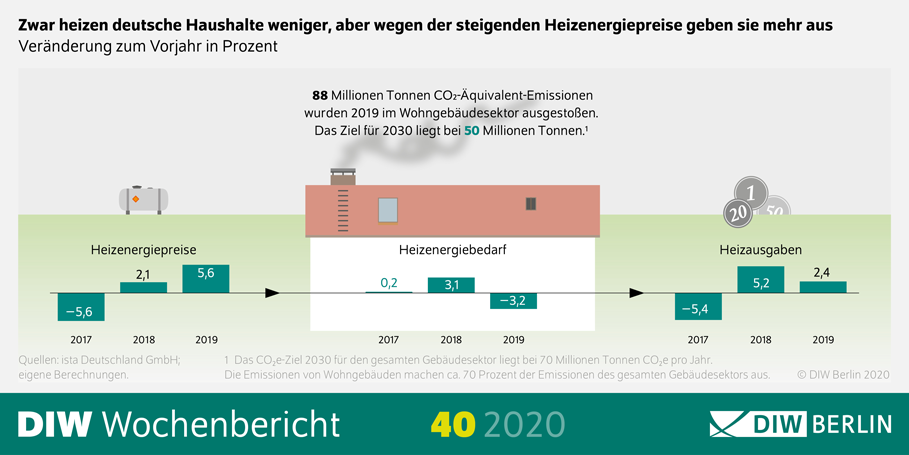
According to the study, there has been a significant overall reduction in CO2-emissions in the residential building sector have fallen by 20.7 per cent since 2010. However, this is largely due to the warmer winters. Adjusted for temperature and weather conditions, CO2-emissions have only fallen by 2.6 per cent over the past ten years.
"If we look at the absolute reduction in CO2-emissions, appearances are deceptive. The reduction of around 21 per cent, which would already make the climate targets unattainable, is hardly due to efforts to increase building efficiency. There is therefore no reason to scale back efforts to reduce emissions," says DIW economist Jan Stede, summarising the results.
"A sober assessment of ten years of building refurbishment shows that energy-efficient refurbishment does not automatically lead to less CO2. Climate policy measures must provide the right incentives for everyone involved: for landlords to invest and for tenant households to consume sparingly," comments Thomas Zinnöcker, CEO of energy and property service provider ista, on the results of the study. "More focus on results, unbureaucratic implementation and accompanying measures for consumers will make climate protection in buildings more effective."
Investment in the energy-efficient refurbishment of existing residential buildings is still too low to achieve the climate targets in the building sector. The plan was to increase the refurbishment rate to two per cent per year. Most recently, however, it was only one per cent. While energy-efficient refurbishment still accounted for a third of all measures in the building stock in 2010, in 2019 it was only a quarter.
The authors of the DIW study are therefore calling for stronger incentives for energy-efficient building renovations. "The higher subsidy rate for energy-efficient refurbishment and the planned CO2-pricing from next year could create additional incentives to invest more in this area again," hopes study author Franziska Schütze. With the CO2-However, care should be taken to ensure that social effects are cushioned. Tenants, especially those on low incomes, are disproportionately burdened by higher energy prices and have little influence on the building's energy efficiency and energy source. "Reimbursement of the income from the CO2-pricing in the form of a climate premium would relieve the burden on low and middle incomes and at the same time minimise the incentive effect of higher CO2-prices," suggests Jan Stede.
A commentary by the German Solar Energy Society (DGS) from 2 October 2020:
www.dgs.de/news/en-detail/021020-lediglich-effizient-klimaschutz-im-gebaeude/
Source: DIW press release from 30 September 2020
Keywords:
Stock, DE-News, Research, Climate protection, New books and studies, Thermal insulation
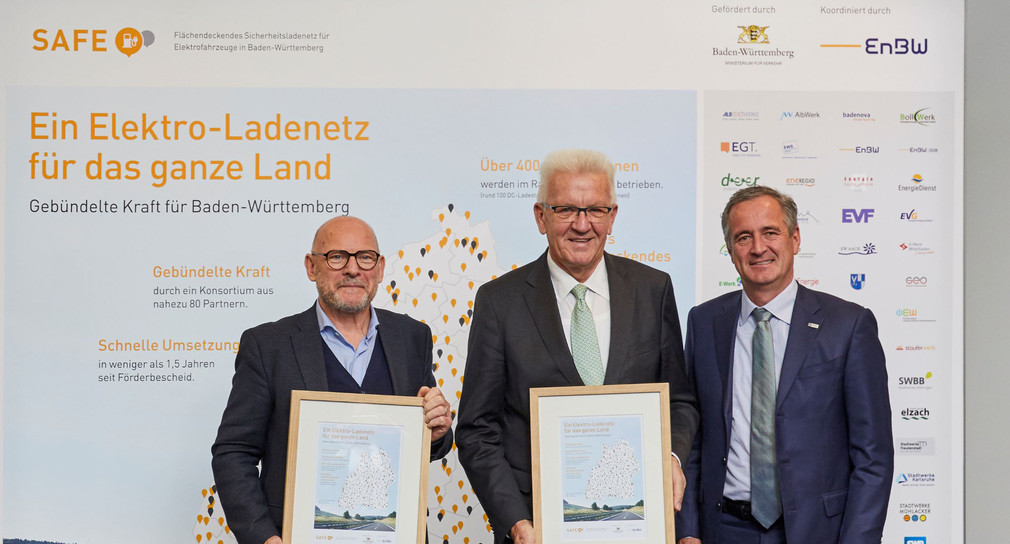
With the successful implementation of the state program "Area-wide Safety Charging Network for Electric Vehicles" (SAFE), Baden-Württemberg is the first state to have an area-wide charging network for electric cars in a 10-kilometer grid. The SAFE charging network consists of more than 450 charging stations.
While the construction of public charging infrastructure for electric cars is still being discussed elsewhere, Baden-Württemberg has built up a comprehensive charging network in recent months. A reliable charging infrastructure with more than 450 charging points now covers the entire state in a 10-kilometre grid. A consortium of 77 municipal utilities and suppliers as well as three municipalities had joined forces under the leadership of EnBW and successfully implemented the state programme "Area-wide Safety Charging Network for Electric Vehicles" (SAFE). The final event was held today (04.11.2019) in Stuttgart to take stock.
"I am extremely pleased that we have taken electric mobility in Baden-Württemberg an important step forward with the SAFE project. Because with the nationwide expansion of the charging infrastructure, we are showing: Electromobility is not only suitable for the big city! I was able to see this for myself during my charging stop in Bad Urach today. SAFE, which was realised within the framework of Baden-Württemberg's strategy dialogue on the automotive industry, thus illustrates that electric mobility in the state is not only a clean and efficient, but also a reliable form of mobility," said Minister President Kretschmann. A consortium led by EnBW had been awarded the contract for the project in May 2018. "The parties involved have managed to set up a nationwide network of charging stations in one and a half years. I would like to thank EnBW as the project leader and its many project partners for this remarkable achievement. Together we are showing that we are pushing ahead: We are stepping on the gas and advancing electromobility in Baden-Württemberg step by step," Kretschmann continued.
Transport Minister Winfried Hermann explained: "E-charging must be as safe as it is simple. Above all, the charging points must work. With the nationwide SAFE charging network, we are creating the basis for the electrification of passenger car traffic in cities and rural areas. In this way, we are facilitating the switch to climate-friendly e-mobility."
The SAFE charging network consists of more than 450 charging stations and will be operated by the project partners for at least six years. More than 250 already existing normal charging stations and more than 60 fast charging stations could be included in the network. But the consortium also built around 40 new fast charging stations and 88 normal charging stations. In addition, twelve existing charging stations were upgraded.
"This is how the mobility revolution must be managed," says EnBW CEO Dr. Frank Mastiaux, summing up the cooperation in the project. "With clout and teamwork, 81 partners have built up a powerful and reliable charging network within just 18 months. Complex infrastructure projects not only need a reliable framework, but also a planned and coordinated interaction between different players. SAFE is an example of how this can be achieved: through a high level of prioritisation by each project partner on site, as well as with the state of Baden-Württemberg as the key driver and funding provider."
The central requirement of the SAFE programme was: In a grid of ten by ten kilometres, there is at least one charging station with 22 kilowatts of power. In a second grid of 20 by 20 kilometres, there is also at least one fast charging station with 50 kilowatts of power. SAFE thus provides an area-wide charging network for drivers of electric cars: On average, there is a charging station every ten kilometres throughout the province - even in rural areas. All e-car drivers have easy access to the SAFE charging stations via the connected electromobility providers.
SAFE has laid another foundation stone for the expansion of the charging infrastructure in Baden-Württemberg. In order to drive this forward, the Charging Infrastructure Network BW will bundle the exchange in the state even more strongly. Current challenges will be discussed and solutions developed via this open platform. The state agency for new mobility solutions and automotive Baden-Württemberg e-mobil BW GmbH is coordinating the new network, in which the experiences and findings of SAFE will be taken up and continued. In addition to its own commitment to the rapid expansion of charging infrastructure, EnBW will also remain closely associated with the new network as a partner. The state of Baden-Württemberg is thus directly taking the next step to prepare the charging infrastructure in the southwest of the republic for the ramp-up of e-cars. To this end, it had also launched the Charge@BW funding programme for non-public charging points launched.
Project SAFE - An electric charging network for the whole country
On the SAFE website you will also find a Map overview of all SAFE charging stations between Wertheim in the north and Constance in the south, and Kehl in the west and Giengen an der Brenz in the east of Baden-Württemberg.
Source: PM Land Baden-Württemberg 4.11.2019
Keywords:
100% EEs, DE-News, Renewable, Research, Climate protection, Media, Sustainable management, New books and studies, News Blog Baden-Württemberg, Environmental policy