Shortly after the shutdown of the Swiss old reactor Mühleberg it goes Philippsburg 2 nuclear power plantfrom the grid on 31.12.2019 as planned. This will be followed in a few months by Fessenheimthe two oldest reactors in France. In addition, at the end of the year in Sweden, the 45-year-old "Ring neck 2" from the grid. Shutting down nuclear reactors significantly reduces the risk of accidents and avoids masses of radiating nuclear waste and its transport in Castor containers.
In 1989, there were still 177 nuclear reactors in Europe. An interactive map of the remaining 126 still in operation (As of 1 January 2019, there should still be 121 after the shutdown of the above-mentioned nuclear power plants) can be found here: www.global2000.at/karte-atomkraft-europa
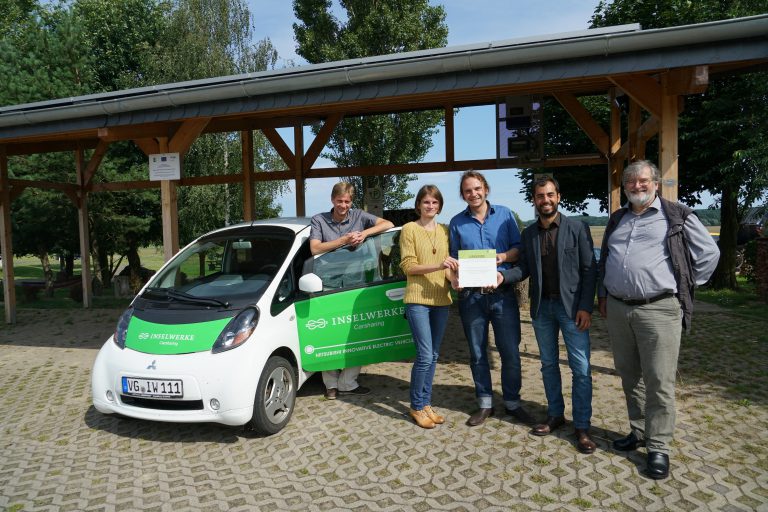
Inselwerke eG has been named Citizen Energy Project of the Year 2017. Photo: Matthias Gründling / Inselwerke eG
In future, three citizens' energy cooperatives will bear the award "Citizens' Energy Project 2017". A total of 17 projects nationwide took part in the competition for the title. The three winning projects received a particularly large number of votes during a two-month internet voting process, in which around a thousand interested people took part, and also prevailed in the evaluation of the jury consisting of committee representatives of the Bündnis Bürgerenergie (BBEn). The jury, consisting of five BBEn committee members, was impressed by the large number of applications to the competition, which was held for the first time, as well as the diversity of the applicant projects. According to the jury, the high level of the winning projects also shows how versatile the citizen energy companies in Germany currently are. This can be seen in the very different activities of the three winning cooperatives and the projects they submitted.
Development of a charging network According to the jury, the project of Inselwerke eG to set up an e-charging network on the Baltic Sea island of Usedom combines sustainable mobility and the expansion of the regional infrastructure so that "a strengthening of the important economic factor of tourism is achieved", as Thomas Banning, member of the jury and BBEn supervisory board member, emphasises. The professional concept of the cooperative convinced the jury and shows which business models are open to citizen energy companies. In particular, the possible duplicability of the charging network and the associated high reach of this approach are aspects that the jury considers worthy of an award. The Inselwerke eG developed a special Usedom model for a multi-stage expansion of the charging infrastructure for electric vehicles - not only on the Baltic Sea island, but also for the entire state of Mecklenburg-Vorpommern. Since April 2016, the cooperative has been able to set up 16 charging stations at 12 locations in cooperation with 11 partners, and more are currently being planned.
Noise barrier with integrated photovoltaic system The second winner, the EnergieGenossenschaft Inn-Salzach eG, is awarded for its noise barrier with integrated PV system. The energy cooperative in the Upper Bavarian region had erected a noise barrier together with the town of Neuötting. The 230-metre-long and almost five-metre-high structure along a busy road is also equipped with solar power panels. The modules together have a maximum output of 64 kilowatts, which can cover half of the electricity needs of a nearby school during the day. In addition, the wall also separates the school from traffic noise. In addition, the project flows into the lessons and thus ensures a tangible integration of the topic for the pupils.
According to the jury, this integrative concept reflects the current progress of the energy transition and uses dormant potential. Thomas Banning emphasises the recognisable double benefit of the solar noise barrier as follows: "The noise barrier combines the generation of clean energy with protection from the negative consequences of car traffic. The whole thing also has a high aesthetic value and is easy to communicate. That's how you move more!"
Innovative municipal energy concept The third winner, BürgerEnergiegenossenschaft Emmendingen eG, is awarded for its activities as a cooperative. According to Kai Hock, member of the jury and BBEn supervisory board member, it strives for a holistic energy transition from a technical point of view. It achieves a strong local impact with its activities, which can be seen, for example, in the number of 180 members. Thus, the cooperative has a high reach of the energy transition with its projects and achieves this with different forms of application and technologies, which is why a high innovative character can also be attributed to it.
For example, Emmendinger eG gave schools and residential buildings an all-round energy upgrade, consisting of heating systems, CHP systems and solar systems. It has also equipped buildings such as the adult education centre with photovoltaic systems on a lease model. In addition, a PV system on a goat shed with 250 kWp is currently being planned.
According to the jury, the three winners are particularly representative of the high level of activity of the many citizens' energy associations in Germany. They are therefore rightly awarded the title "Citizen Energy Project of the Year", on which the jury congratulates them warmly.
Short info: "How will our cities develop? And who actually determines this - the city administration alone or also the citizens? In three European metropolises the reportage City of the Future - Future of the City looks for answers: In London we get to know the concept of the city as a profit-oriented enterprise that has to prove itself in global competition with other metropolises. In Hamburg, we follow the transformation of a problem neighbourhood as part of the IBA 2013, while the residents of a small, still original artists' quarter create their own living space. In Madrid, the problems of a constantly growing city are becoming concrete: an illegally built district has emerged just 20 kilometres from the city centre, which the residents manage independently. The area has become economically interesting for the city of Madrid in recent years. So the authorities have houses demolished - leaving families on the street. But there is resistance."
Running time: 45 min.
Year of production: 2013
Media type: DVD
Language version: de, en
Wuppertal is making waves when it comes to sustainable and modern transport systems. It is not only the 100-year-old suspension railway that has long symbolised the city as an innovative mode of transport. The new northern railway line for cyclists and pedestrians above the rooftops of the city has brought great recognition nationwide. A modern urban cable car is planned as a new mode of transport and is hotly debated.
And now the renowned Wuppertal Institute for Climate, Environment and Energy has presented the study "Car-free city centre Wuppertal Elberfeld", which provides further impetus for the mobility turnaround in Wuppertal and builds on a changed mobility culture.
URBAN MINING - The city as an eternal source of raw materials
Director: Sandra Czeczelitz
Production: Christoph Gretzmacher | twovisions Filmproduction
45 min. A 2012 Broadcast from 29.10.2012. 3sat
While the mountains of waste in our cities are growing, raw materials are becoming increasingly scarce and expensive worldwide. For decades, mineral resources have been shipped to the industrial nations and used in high-rise buildings, mobile phones and cars, for example. Today, metropolises are gigantic raw material mines. Researchers and companies are now starting to mine.
We use cookies to optimize our website and services.
Functional
Always active
Technical storage or access is strictly necessary for the legitimate purpose of enabling the use of a particular service explicitly requested by the subscriber or user or for the sole purpose of carrying out the transmission of a communication over an electronic communications network.
Preferences
The technical storage or access is necessary for the legitimate purpose of storing preferences that have not been requested by the subscriber or user.
Statistics
The technical storage or access, which is solely for statistical purposes.Technical storage or access used solely for anonymous statistical purposes. Without a subpoena, voluntary consent from your Internet service provider, or additional records from third parties, information stored or accessed for this purpose cannot generally be used alone to identify you.
Marketing
Technical storage or access is necessary to create user profiles, to send advertising or to track the user on a website or across multiple websites for similar marketing purposes.