Explained in just under 10 min. The video is from April 2019 and shows two larger aquaponics facilities in Berlin.
Keywords: DE-News, Movies, Movies 4 to 10 Min, Sustainable management, News Blog Berlin, Transition Town, Urban production
Explained in just under 10 min. The video is from April 2019 and shows two larger aquaponics facilities in Berlin.
By a large majority, the city council has instructed the administration to increase the use of wooden building materials in new municipal buildings such as schools and day-care centres. Complete wooden buildings are to be erected wherever possible.
The joint motion initiated by the Greens, the CDU, the Greens, the FDP and the Gut group (https://ratsinformation.stadt-koeln.de/getfile.asp?id=725502&type=do&) was unanimously approved by the Council on 9/7/2019.
Keywords:
Stakeholders, Building materials / Construction, DE-News, Wood construction, Climate protection, Communities, Cologne, Sustainable management, News Blog NRW, Quarters, Settlements, Environmental policy, Ecology
Short info: "How will our cities develop? And who actually determines this - the city administration alone or also the citizens? In three European metropolises the reportage City of the Future - Future of the City looks for answers: In London we get to know the concept of the city as a profit-oriented enterprise that has to prove itself in global competition with other metropolises. In Hamburg, we follow the transformation of a problem neighbourhood as part of the IBA 2013, while the residents of a small, still original artists' quarter create their own living space. In Madrid, the problems of a constantly growing city are becoming concrete: an illegally built district has emerged just 20 kilometres from the city centre, which the residents manage independently. The area has become economically interesting for the city of Madrid in recent years. So the authorities have houses demolished - leaving families on the street. But there is resistance."
Running time: 45 min.
Year of production: 2013
Media type: DVD
Language version: de, en
Authors: Irja Martens, Katja Grundmann
Production company: fechnerMEDIA: GmbH
Producer: Carl-A. Fechner
Director: Irja Martens
Link
http://shop.fechnermedia.de/katalog/filme/stadt-der-zukunft-zukunft-der-stadt
Keywords:
DE-News, Movies, Movies > 45 Min, IBA, City
 Author of the book review: Roman Schaurhofer, Vienna
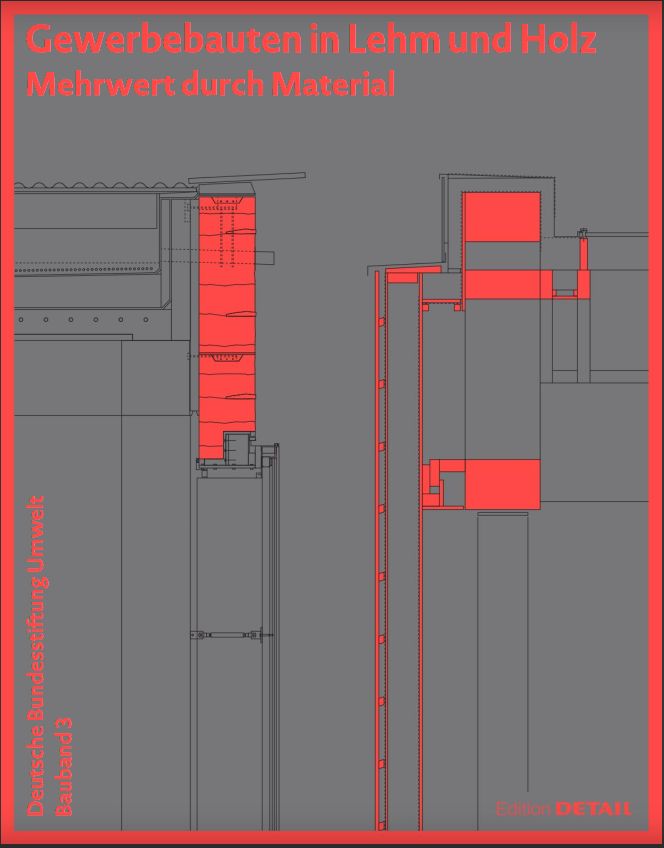
The construction volume "Commercial Buildings in Clay and Wood - Added Value through Material" was published in 2020 by Sabine Djahanschah of the Deutsche Bundesstiftung Umwelt (German Federal Foundation for the Environment) at Verlag Detail. The publication, which appeared in book form, deals with the use of the building materials wood and clay in the construction of commercially used buildings. To this end, six buildings with commercial use were analysed in terms of their architectural construction and technical quality features and evaluated with the help of measurements, surveys and life cycle assessments.
By way of introduction, the different techniques, construction and production methods as well as the advantages of wood and clay are discussed. After this presentation of the understanding of the different building materials as well as fossil and renewable raw materials, the authors go into more detail on the life cycle assessment or life cycle analysis. They explain the components of a life cycle assessment for buildings. Furthermore, the calculation steps and methods for the life cycle phases, the period under consideration and the final energy demand are defined. This is followed by a naming of the balances created and evaluations.
The concept, the design and the constructive aspects are examined in more detail for each of the objects examined (two office buildings, two warehouses and two workshops). In addition, the acoustics, the energy concept, the fire protection and the added value of the building are evaluated. Monitoring values for temperature, CO2-concentration or air humidity underpin the results. Finally, the life cycle assessment, the material balance, the life cycle phase comparison and the DGNB rating are explained.
Ultimately, the researchers make a case for the use of wood and clay in commercial buildings with their results and conclusions from their detailed investigations, as well as their presentation of the effects on quality of stay, indoor climate, changeability and expression.
The building examples studied also convince with impressive results when the materials are applied well. Due to the interdisciplinary approach and the wide-ranging investigations by the researchers, technically sound results and arguments that can be discussed were achieved.
At the same time, however, it must be noted that due to the different building use and material selection, the selected example projects can hardly be compared with each other. In addition, other aspects relevant to construction, such as economic possibilities or monetary aspects, are not taken into account.
They are to be understood as pilot projects, but serve as exemplary examples for increased use in commercial construction.
Nevertheless, the investigations of the buildings show the relevance of sustainable building materials in the construction of buildings.
In any case, the authors provide sound evidence why wood and/or clay should be increasingly used in the construction of buildings for commercial use and make a professionally relevant contribution to the promotion of sustainability.
First edition: 2020
Format: 167 pages, German, 21 x 27 cm, Swiss brochure
Publisher: Detail Business Information GmbH, Munich
Reading sample and ordering option:
https://shop.detail.de/de_de/dbu-bauband-3-gewerbebauten-in-lehm-und-holz
Keywords:
Building Biology, Building materials / Construction, DE-News, Business, Wood construction, Earth Building, NaWaRohs, Sustainable management, New books and studies, Resource efficiency, Urban production, Life cycle assessment
► Consistently tap alternative heat sources such as wastewater heat
► Convert public buildings to renewable heat and form district heating networks
Ambitious energy-efficient refurbishment, even in areas protected by the Milieu, so that warm rents remain affordable
BMBF project "Urban Heat Turnaround" by the Institute for Ecological Economy Research, law firm Becker Büttner Held and Berliner Wasserbetriebe presents recommendations
The advancing climate crisis, the war in Ukraine, the associated uncertainties and price increases - there are many reasons to get out of oil and natural gas as quickly as possible when it comes to heating. In order for the heat transition in cities to progress faster and more effectively, energy experts of the project "Urban Heat Transition" recommend a mix of measures: cities should develop a spatial heat planning and tap all sustainable heat potentials such as wastewater heat. In addition, they should expand district heating, create neighbourhood heating networks - especially around public buildings - and support fair energy refurbishments in protected areas. Funded by the Federal Ministry of Education and Research (BMBF), the Institute for Ecological Economy Research (IÖW) developed recommendations for states, cities, municipalities and neighbourhood managers together with the law firm Becker Büttner Held (BBH) and the Berliner Wasserbetriebe as well as representatives of the Berlin Senate and district administration.
Using Berlin as an example, the research project investigated central aspects of a climate-neutral heat supply. So far, the capital still depends on natural gas for two-thirds of its heating, heating oil for 17 per cent and coal for five per cent. "Berlin is facing challenges in the heat transition that other cities are also familiar with: Rising rents fuel fears of expensive renovation projects, the change has not yet reached the neighbourhoods despite funding pots and technologies such as the use of wastewater heat are only slowly being implemented," explains project manager Dr Elisa Dunkelberg from the IÖW. "In two and a half years of practice-oriented research, we have compiled solution strategies that should not be missing from any urban heat planning."
Higher thermal insulation standards also in areas protected by urban development law
The next heating bill will show tenants how expensive it is to depend on fossil fuels. Even if the markets calm down, the CO2 price will rise. That's why energy-efficient renovation that goes beyond the legal minimum standards can also be worthwhile from the tenants' point of view: If landlords use subsidies and allocate the modernisation costs fairly, the warm rent remains stable or can even decrease, as the researchers have calculated.
Especially in areas of social preservation, municipalities should allow more ambitious refurbishments: "In Berlin's 70 or so social preservation areas, ambitious energy refurbishments have rarely been approved so far. The same applies to a change from gas floor heating to renewable energies or district heating," says Charlotta Maiworm from BBH. "In order to keep rents affordable in the long term, these projects should be approved - but only under certain conditions or stipulations, such as that the costs for tenants may not be higher than the measures according to the regulatory minimum standard." The research team summarises in a guideline what municipalities and neighbourhood managers should pay attention to.
Alternative heat sources: Wastewater heat & Co.
In order to use resources efficiently and minimise energy imports, local heat sources must be used extensively. While some cities have great potential in individual areas, such as Munich with geothermal energy and Hamburg with industrial waste heat, other cities such as Berlin must exploit all potential and aim for a broad mix of environmental heat pumps, commercial waste heat, direct electricity use and biomass.
One heat source that is available all year round in all cities and only needs to be "tapped" is wastewater heat: it could be an important building block in the future energy mix and, for example, cover up to five per cent of the heat demand in Berlin in the future. "For their municipal heat planning, cities need information about where and to what extent wastewater heat is available and how it could be used," says Michel Gunkel from Berliner Wasserbetriebe. "In the 'Urban Heat Turnaround' project, we have therefore prepared this data in a geo-based tool - the wastewater heat atlas - which we are currently testing in an internal test phase."
Heat planning and district heating networks
The information from the wastewater heat atlas must be merged with other data, such as heat demand, for heat planning. The goal of heat planning is to find out where climate neutrality can best and most cost-efficiently be achieved with which future heat supply. District heating makes sense where renewable heat and waste heat potentials exceed the demand of individual buildings. "To shoot for local heat sources, public buildings play a central role," Elisa Dunkelberg emphasises. "If a large wastewater heat pump is installed there, for example, it can also supply surrounding houses via a neighbourhood heat network." Whenever public buildings are due for heating changes or renovations, it should therefore be checked whether a district heating system is possible. Sample calculations show that with the planned federal subsidy for efficient heating networks, neighbourhood heating can be offered at competitive prices. The researchers also propose measures to facilitate implementation - such as model contracts and criteria catalogues.
At the conference "Urban heat transition - How cities can supply themselves with climate-neutral heat" at the end of March, more than 300 administrative staff and neighbourhood managers from various cities learned about the current state of research on the urban heat transition. Guides, infographics, publications and materials on the conference: www.urbane-waermewende.de.
~~~~~~~~~~~~~~~~~~~~~~~~~~~~~~~~~~
More information
Guide: Energy-efficient refurbishment in Berlin's protected neighbourhoods: How tenant and climate protection go together (www.urbane-waermewende.de/publikationen-1)
Research report: Dunkelberg et al. (2022): Public buildings as nuclei for climate-neutral district heating (ibid.)
► Infographics of the project: www.urbane-waermewende.de/publikationen/infografiken
About the project
The Urban Heat Turnaround project was coordinated by the Institute for Ecological Economy Research (IÖW). The joint partners were Berliner Wasserbetriebe and the commercial law firm Becker Büttner Held (BBH). The Senate Department for the Environment, Mobility, Consumer and Climate Protection, the district of Charlottenburg-Wilmersdorf and the district of Neukölln were involved as municipal partners. The project was funded by the Federal Ministry of Education and Research (BMBF) in the funding initiative "Sustainable Transformation of Urban Spaces" of the Social-Ecological Research (SÖF) funding priority.
Source: IÖW-PM of 26 April 2022
Keywords:
DE-News, Renewable, Climate protection, Communities, New books and studies, Quarters, Solar thermal, Thermal insulation