From February 2021 in Bavaria: timber construction for all building classes
Published
On 1 February 2021, the amendment to the Bavarian Building Code came into force. In the future, the building material wood can be used in all building classes. The legal changes make building in Bavaria easier and faster, more space-saving and more cost-effective.
Prinz-Eugen-Park wooden housing estate in Munich. Photo: Johann Hartl
There is a shortage of housing in Europe's conurbations; Germany alone lacks about 1.5 million residential units (WE). For this reason, the federal government has decided to build 400,000 WE annually. At the same time, the federal government's climate protection plan foresees a significant decrease in building emissions from 209 million to 67 million tonnes of CO2-equivalents by 2030, which would correspond to an emission reduction of 68 % since 1990. Other European countries have also committed to implementing far-reaching climate protection targets. Against this background, many of those involved in construction are increasingly relying on wood as a renewable building material, in addition to energy-efficient construction and the use of renewable energies.
The Construction cost study on large timber housing estates and quarters in Europe (short Wooden housing study), financed from funds of the funding programme FUTURE CONSTRUCTION of the Federal Ministry of Transport, Building and Urban Affairs (BMWSB) and based at the Rottenburg University of Applied Sciences (HFR), systematically researches and records those projects in timber and timber hybrid construction that have already been realised or are currently in planning. In the process, the construction costs of the buildings are analysed as well as the motives of the investors and clients to build with wood. Another goal is to show how timber construction methods can be further established in the segment of housing estates and urban districts in order to expand the range of large-volume housing projects with an environmentally and climate-friendly variant.
5:18 min, First broadcast: 11/19/2020, Available until 11/20/2021.
Wir im Saarland - The Magazine ∙ SR Television
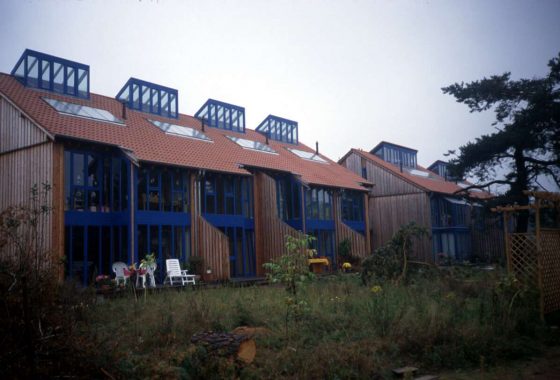
"A quarter of a century ago, Bernd Janes looked for like-minded comrades-in-arms and founded an ecologically oriented housing estate on the outskirts of Kohlhof. At first, the new neighbors were eyed critically by the surrounding community. No wonder, because the houses were built in wood, four families shared one house and the gardens were not separated from each other by fences, but merged seamlessly into each other."
On 30.6. the field test started in Herten, North Rhine-Westphalia. For one year, scientists coordinate the operation of three combined heat and power plants with the use of three heat pumps, a PV system, a large lithium-ion storage unit and a private electric storage heating system to balance the PV and wind feed-in.
For this purpose, the combined heat and power plants use the heat storage capacity of the connected consumers: a leisure pool, an indoor swimming pool and a local heating network. Current weather forecasts are used to calculate optimal schedules for the individual plants. These schedules are sent to the plants via the internet and implemented on site. The loads on the electricity grid can also be taken into account, so that the much-discussed expansion of power lines in the electricity grid can be reduced in the long term.
Source: The city as a repository on
(the website was deactivated in February 2021)
Typologically organised overview with 24 current timber buildings
Various typologies and constructions in timber: wide-span halls, lightweight densification and prefabricated building elements
Current timber engineering at a glance
There are many reasons for and advantages to building with wood compared to conventional construction methods: Wood is a renewable building material and, as a CO2 sink, helps to protect the climate. At the same time, thanks to modern calculation and production methods, it can be used for numerous construction tasks. Wood has excellent structural and indoor climate properties and can be easily combined with all other common building materials.
Based on 24 international projects, this specialist book provides an overview of the variety of possibilities currently realised in modern timber construction. In texts, images and plans, the contributions document both the architectural and structural qualities of contemporary timber constructions, from the design planning to the supporting structure right down to the last detail.
- Typologically organised overview with 24 current timber buildings
- Various typologies and constructions in timber: wide-span halls, lightweight densification and prefabricated building elements
NEW November 2015 Authors: Lennartz, Marc Wilhelm / Jacob-Freitag, Susanne
28.0 x 22.0 cm
192 pages
approx. 240 illustrations in colour, 100 line drawings
Hardcover
Language: German
ISBN: 978-3-0356-0455-9
We use cookies to optimize our website and services.
Functional
Always active
Technical storage or access is strictly necessary for the legitimate purpose of enabling the use of a particular service explicitly requested by the subscriber or user or for the sole purpose of carrying out the transmission of a communication over an electronic communications network.
Preferences
The technical storage or access is necessary for the legitimate purpose of storing preferences that have not been requested by the subscriber or user.
Statistics
The technical storage or access, which is solely for statistical purposes.Technical storage or access used solely for anonymous statistical purposes. Without a subpoena, voluntary consent from your Internet service provider, or additional records from third parties, information stored or accessed for this purpose cannot generally be used alone to identify you.
Marketing
Technical storage or access is necessary to create user profiles, to send advertising or to track the user on a website or across multiple websites for similar marketing purposes.



 On 30.6. the field test started in Herten, North Rhine-Westphalia. For one year, scientists coordinate the operation of three combined heat and power plants with the use of three heat pumps, a PV system, a large lithium-ion storage unit and a private electric storage heating system to balance the PV and wind feed-in.

