Book review "Wohnquartier in Holz - Mustersiedlung in München" DBU Bauband 4
Published
Publisher: German Federal Foundation for the Environment / Sabine Djahanschah
The ecological model settlement "Prince Eugene Park"on a former barracks site in Munich sets new standards in timber construction. Various timber construction methods and building types up to seven storeys are being tested side by side in eight building projects with the aim of a final scientific evaluation. Timber frame, timber frame and timber hybrid construction methods are being used.
Close cooperation with the Deutsche Bundesstiftung Umwelt (DBU) and research commissions from the Ruhr Universität Bochum (RUB) and the Technische Universität München (TUM) ensure a sound evaluation of the monitoring accompanying construction. Beyond the realization of living space, the project makes an active contribution to climate protection and sustainable urban development.
Embedded in the surrounding parkland, the new quarter will also offer an attractive range of social, cultural and commercial infrastructure. Building volume 4 presents the eight building types and examines the potential of the different construction methods in detail.
Authors: Zeno Dietrich, Sabine Djahanschah, Annette Hafner, Wolfgang Huß, Ulrike Klar, Wolf Opitsch, Arnim Seidel and Michael Storck
First edition: 2020 Format: 112 Pages, German, 21 x 27 cm, Swiss brochure Publisher: Detail Business Information GmbH, Munich
Aerial photos taken by a drone show the status of implementation in May 2019. The Platensiedlung in Ginnheim (Frankfurt am Main) will have 2 storeys added without additional land sealing and the existing buildings will be renovated to make them more energy efficient.
The project is the largest redensification of a housing estate in Frankfurt for many years and currently probably the largest project of its kind in Germany (as of 28.05.2019).
In a recently written short study, scientists from the Department of Energy System Analysis at the Fraunhofer Institute for Solar Energy Systems ISE prepared an evaluation of the Market Master Data Register (MaStR) and the EEG system master data for photovoltaics (PV). Important findings of the analyses were that with 38 percent of the newly installed capacity, the increase in capacity in Germany is increasingly taking place in the segment of rooftop systems larger than 100 kW, 22 percent of the newly built PV systems are erected in a west, east or east-west direction and 19 percent of these systems have tilt angles smaller than 20 degrees.
Relative shares of the different orientations in the construction of new plants. Source: Own calculation based on MaStR data registered as of 31.01.2019 (as of 03.03.2020).
The Market Master Data Register (MaStR) is the register for the German electricity and gas market. Since January 2021, all electricity generation units connected to the general supply grid must be entered in it. This also applies to the steadily growing number of photovoltaic systems in Germany. In addition to the master data on output and location of a PV system, which has already been recorded in the Renewable Energy Sources Act register (EEG system master data), the market master data register records further information such as orientation, inclination and output limitation.
These parameters have now been analyzed by scientists at Fraunhofer ISE. The evaluation covers the period from 2000 to the present day and shows the development over time in terms of number, power, location by federal state, orientation, inclination and power limitation. Different evaluation criteria were taken into consideration, which allow statements to be made on the following aspects: Plant addition, power addition by plant class, plant addition by federal state, plant orientation and inclination angle.
Fraunhofer ISE evaluates these central parameters at regular intervals and makes the results publicly available. In addition, the Institute offers further evaluations of this database on request.
82 percent of the added systems are smaller than 10 kW
The evaluation of the installation of new systems by system class essentially shows that the <10 kW size range has remained constant since 2014 with an average share of 82 percent. Rooftop systems over 10 and up to 100 kW had a heyday between 2004 and 2011, when their share of new installations - in relation to the number of systems - averaged 43 percent.
Growing part of the added capacity is due to large rooftop systems
When examining the increase in capacity by plant class, it becomes clear that the high share of the <10 kW plant class in terms of the number of plants is only reflected in a high increase in capacity to a limited extent. The share of the plant class has remained fairly constant at an average of 19 percent since 2014. One system segment whose relative share of capacity growth has increased sharply is the system class of rooftop systems from 100 to 750 kW. From 17 percent in 2012, their share has more than doubled to 38 percent in 2019. In contrast, the importance of ground-mounted systems has declined from 45 percent in 2012 to 20 percent in 2019.
More than half of the PV systems will no longer be built in Bavaria and Baden-Württemberg
The two states of Bavaria and Baden-Württemberg accounted for an average of 59.6 percent of new installations in Germany between 2000 and 2009, and this share declined to an average of 44.5 percent between 2010 and 2019. Over the same periods, North Rhine-Westphalia increased its average contribution from 14.1 to 18.3 percent, Lower Saxony's share rose from 6.5 to 9.2 percent, and Brandenburg's share increased from 0.7 to 2.2 percent. All the remaining federal states also recorded increases, albeit to a lesser extent. Despite the decline in their share, Bavaria and Baden-Württemberg remain in first and second place in terms of new installations in 2019, with 24.4 percent and 18.6 percent respectively. This is followed by North Rhine-Westphalia, Lower Saxony and Hesse with 17.9 percent, 9.2 percent and 6.1 percent respectively.
73 percent of newly installed PV systems are limited in their capacity
Only around a quarter of the newly installed plants in 2019 do not have any output limitation. According to the EEG, 66 percent of newly installed plants may only feed a maximum of 70 percent of their output into the grid because they do not have remotely controllable feed-in management. This proportion has grown by an average of 4 percentage points per year since 2014. The remaining output-limited plants have even higher limitations of 60 to 50 percent as a result of the combination with a battery storage system.
Increasing proportion of PV systems facing east and west
While the share of PV systems with southern orientation decreased from 61 percent in 2000 to 42 percent in 2019, the share of systems with eastern and western orientation increased at almost the same rate: east from 1 percent in 2000 to 7 percent in 2019, west from 3 percent in 2000 to 9 percent in 2019, east-west from 1 percent in 2000 to 6 percent in 2019.
Plants are increasingly being built with a lower angle of inclination.
The share of added PV systems (rooftop and ground-mounted) with a tilt angle of less than 20 degrees averaged 10 percent between the years 2000 and 2009. Subsequently, between 2010 and 2019, the share increased to an average of 19 percent. Systems with 20 to 40 degrees of tilt accounted for an average of 63 percent between 2000 and 2009, falling to 54 percent between 2010 and 2019.
In the run-up to the UN World Human Settlements Summit Habitat III, the German Advisory Council on Global Change (WBGU) points to the major challenges posed by increasing urbanisation. In its report "The Relocation of Humanity: The Transformative Power of Cities", the WBGU emphasises that a brief window of opportunity will open up in the coming decades of urbanisation "to set the course towards sustainability" - see Printed matter 18/9590. In this context, the Council recommends shortening the Habitat conference cycle from 20 to four years. The upcoming Habitat conference will take place from 17 to 20 October in Ecuador. The topic of "urbanisation and transformation" should also become a permanent item on the G20 agenda.
"The report is impressive in view of its wealth of arguments and diverse examples of urbanisation phenomena and the description of their effects. The Association of German Cities feels - not least due to its contributions to the success of the HABITAT III conference in Quito in October 2016 - in complete agreement with the report regarding the central role of cities in mastering the upcoming transformation challenges and utilising their opportunities. The challenges to urban transformation are clearly expressed: the call for a sustainable, globally coded urban development policy is a mandate to the global community and national policies to make cities capable of taking action and to urban societies to utilise this capacity for the benefit of the urban population."
Lord Mayor Dr Eva Lohse President of the Association of German Cities
In its report, the WBGU presents a transformation strategy for the sustainable and "people-oriented design" of urbanisation. Cities play a particularly key role in this, as "the relocation of humanity could become the most powerful process of social change in the 21st century".
The force of the current urbanisation dynamic and its effects are so great that cities, urban societies, governments and international organisations worldwide must face up to this trend. A "business as usual" approach would lead to an unsustainable global urban society if urbanisation policy is not shaped. Only if cities and urban societies become sufficiently capable of acting can they realise their potential for sustainable development: It is in the cities that it will be decided whether the Great Transformation towards sustainability will succeed. This book discusses the conditions for success.
The report identifies five transformative, interlinked fields of action:
Decarbonisation, energy and climate protection,
Mobility and transport,
the structural and spatial design of cities,
Adaptation to climate change and
Poverty reduction and socio-economic disparities.
With regard to climate protection, for example, fossil CO₂ emission sources must be replaced by 2070, writes the WBGU. There would also have to be a "move away from a large part of the current infrastructure patterns" in order to reduce the temperature increase to significantly less than two degrees Celsius.
Europe's largest passive house in timber construction is located in Lübeck. It serves as a new workplace for 430 employees of the local public utility company. According to the client, the timber construction method was no more expensive than a conventional mineral wet construction method - also because an intelligent fire protection concept meant that it was not necessary to clad the timber components.
We use cookies to optimize our website and services.
Functional
Always active
Technical storage or access is strictly necessary for the legitimate purpose of enabling the use of a particular service explicitly requested by the subscriber or user or for the sole purpose of carrying out the transmission of a communication over an electronic communications network.
Preferences
The technical storage or access is necessary for the legitimate purpose of storing preferences that have not been requested by the subscriber or user.
Statistics
The technical storage or access, which is solely for statistical purposes.Technical storage or access used solely for anonymous statistical purposes. Without a subpoena, voluntary consent from your Internet service provider, or additional records from third parties, information stored or accessed for this purpose cannot generally be used alone to identify you.
Marketing
Technical storage or access is necessary to create user profiles, to send advertising or to track the user on a website or across multiple websites for similar marketing purposes.
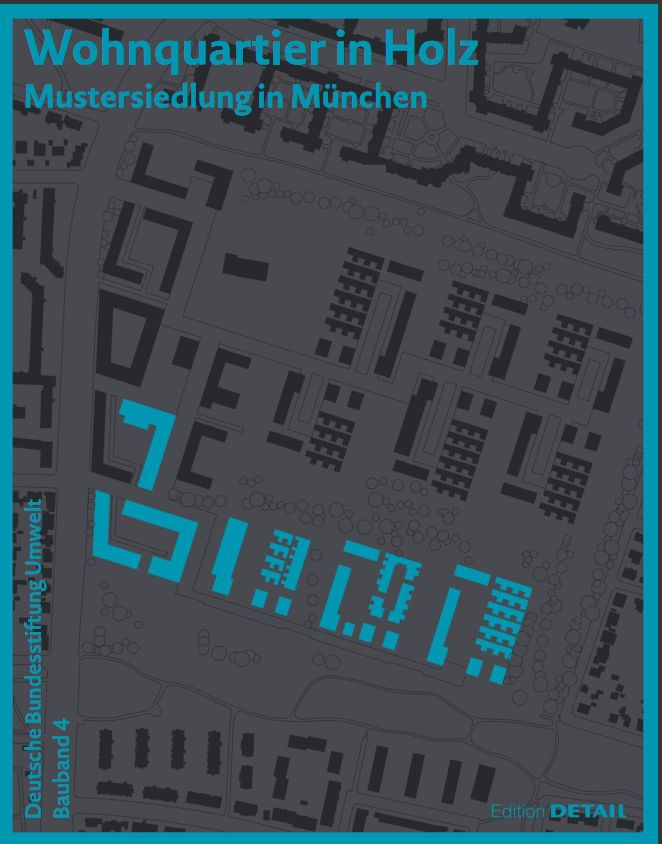 The ecological model settlement "Prince Eugene Park"on a former barracks site in Munich sets new standards in timber construction. Various timber construction methods and building types up to seven storeys are being tested side by side in eight building projects with the aim of a final scientific evaluation. Timber frame, timber frame and timber hybrid construction methods are being used.


![Extension.JPG [ JPG 0,13 MB ]](https://www.ise.fraunhofer.de/content/dam/ise/de/images/presseinfos/2021/Zubau.JPG)
