Passive house timber construction XXL: Municipal utilities in Lübeck
Published
Europe's largest passive house in timber construction is located in Lübeck. It serves as a new workplace for 430 employees of the local public utility company. According to the client, the timber construction method was no more expensive than a conventional mineral wet construction method - also because an intelligent fire protection concept meant that it was not necessary to clad the timber components.
Over the past three years, the City of Munich has purchased 950 apartments from GBW's former holdings through its subsidiaries GWG and Gewofag. This is revealed in the answer to a question by City Council members Cetin Oraner and Brigitte Wolf (Die Linke).
On 27 September 2017, the IBA_LAB, the symposium of the International Building Exhibition (IBA) Heidelberg, will take place for the fifth time in a row. This year, for the first time, discussants and guests will meet in the German capital Berlin to broaden their perspective and discuss the question of the "Knowledge City of Tomorrow" in conversation - all in preparation for the IBA's major interim presentation in 2018.
The keynote speech at the evening reception will be given by Wolfgang Lotter, co-founder of brand eins. We will discuss the city in the knowledge society with Theresia Bauer, Minister of Science of the State of Baden-Württemberg, Undine Giseke, Head of the Department of Landscape Architecture and Open Space Planning at the TU Berlin, Volker Hassemer, former senator and board member of the Stiftung Zukunft Berlin, Jürgen Odszuck, Mayor of the City of Heidelberg, philosopher and author Rebekka Reinhard and Alexander Rieck from the Fraunhofer Institute.
The LAB deals in particular with the IBA Heidelberg's guiding question: How must the European city transform itself to meet the demands of tomorrow's knowledge society? From 2012 to 2022, the IBA wants to initiate and implement building projects and processes around the knowledge society and its guiding theme Knowledge | Creates | City. The primary aim is to focus questions of social change on their urban planning and architectural dimensions. In cooperation with the board of trustees, the IBA Heidelberg developed 4+1 more precise focal themes: Sciences, Learning Spaces, Networking, Material Cycles and overarching Co-production. Until 2022, the building projects are intended to give a selective impression of how the "knowledge city of tomorrow" will look in terms of architecture and planning.
Discourse at international level on the knowledge city of tomorrow is indispensable. That's why the IBA is looking for answers with appropriate knowledge transfer via existing and new networks - as was the case at this year's IBA_LAB N°5.
Theses on the "Knowledge City of Tomorrow" are also presented in the IBA Heidelberg's first publication, the recently published IBA_LOGBook N°1 thematised.Participation in IBA_LAB N°5 is free of charge. Please register by 20 September 2017 at www.iba.heidelberg.de.
The event is recognised by the Baden-Württemberg Chamber of Architects as continuing education for three hours.
The flame retardant HBCD, which was mainly used in polystyrene insulation boards, has been banned since March 2016. But trouble looms from the many millions of cubic meters of HBCD-containing insulation material that have already been installed in Germany.
The flame retardant hexabromocyclododecane (HBCD) has been largely banned from trade and use in the EU since spring 2016. For a long time, HBCD was the economically most important flame retardant for polystyrene insulation materials - accordingly, there are still transitional rules for insulation materials made of expanded or extruded polystyrene (EPS/XPS).
While the industry in Germany has largely replaced HBCD with allegedly less problematic flame retardants since the end of 2014, homeowners in Germany are now threatened with considerable costs when converting their buildings and removing insulation materials containing HBCD: This is because these will be classified as "hazardous waste" from October 2016 and can only be disposed of at great expense in special waste incineration plants or plants specially approved for this purpose. According to estimates by the Federal Environment Agency, "considerable disposal costs" are to be expected for homeowners.
How can a consumer tell if a polystyrene insulation material contains HBCD?
Since HBCD has already been identified as a substance of very high concern under the REACH Regulation since 2008, the manufacturer and also the distributor must provide information on the use of the substance in all articles. An online form from the Federal Environment Agency can be used to ask the manufacturer, dealer or importer whether HBCD has been used as a flame retardant. In addition, since 2011, the Construction Products Regulation has also required the information to be provided to end users with the declaration of performance for the CE mark. However, for all polystyrene insulation boards used in the past, it must be assumed that they contain HBCD.
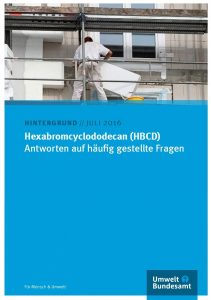
In the brochure "Frequently asked questions and answers on hexabromocyclododecane (HBCD) - Answers to frequently asked questions".
of the Federal Environment Agency of July 2016 provides further explanations: www.umweltbundesamt.de/...oekologische-kriterien-fuer
In Sweden, a residential building is being built that is specially designed for cyclists. Malmö is considered the most bicycle-friendly city in Sweden. 30 percent of the inhabitants here use a bicycle every day, and bike sharing is booming. Soon, however, Malmö will have even more to offer cyclists: In the middle of the city centre, the first house is currently being built that is completely adapted to the needs of cycling residents.
We use cookies to optimize our website and services.
Functional
Always active
Technical storage or access is strictly necessary for the legitimate purpose of enabling the use of a particular service explicitly requested by the subscriber or user or for the sole purpose of carrying out the transmission of a communication over an electronic communications network.
Preferences
The technical storage or access is necessary for the legitimate purpose of storing preferences that have not been requested by the subscriber or user.
Statistics
The technical storage or access, which is solely for statistical purposes.Technical storage or access used solely for anonymous statistical purposes. Without a subpoena, voluntary consent from your Internet service provider, or additional records from third parties, information stored or accessed for this purpose cannot generally be used alone to identify you.
Marketing
Technical storage or access is necessary to create user profiles, to send advertising or to track the user on a website or across multiple websites for similar marketing purposes.


 The flame retardant HBCD, which was mainly used in polystyrene insulation boards, has been banned since March 2016. But trouble looms from the many millions of cubic meters of HBCD-containing insulation material that have already been installed in Germany.

