(42 min.) from November 2015:
www.spiegel.tv/filme/intelligente-haeuser
Keywords: IBA, News Blog Hamburg, Quarters, Settlements

(42 min.) from November 2015:
www.spiegel.tv/filme/intelligente-haeuser
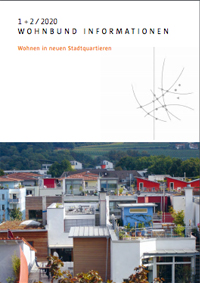 In the current publication, the wohnbund takes a look at the development of new urban quarters. Backwards - with the question of what became of the goals that were set for individual projects. To the present day - to the concepts that are being implemented in response to current challenges. It writes in more detail about at least ten new housing estates and neighbourhoods, five of which (Freiburg Vauban, which French Quarter, Hanover Kronsberg, Ackermannbogen Munich and the Heidelberg Railway City) are listed in the sdg21.web database.
An impression of the 88-page brochure is provided by the
Table of contents with reading sample
The publication can be ordered for € 20 plus postage at info@wohnbund.de
Keywords:
Bike-/Velo-City, Cohousing, DE-News, Barracks conversion, Communities, Near-natural open space design, New books and studies, Mix of uses, Participation, Affordable housing, Quarters, Settlements, Housing policy, Housing projects, Aesthetics / Architecture / Building Culture
 Sustainable development in Germany is inconceivable without a resource-efficient construction industry. The new expert recommendation VDI-EE 4802 Sheet 1 explains in a practical way how to apply the concept of resource efficiency in the life cycle of buildings. To this end, it breaks down the tasks and scope for action of the individual players in the construction process. Using examples of increased material, energy and space efficiency, the expert recommendation supports the entire planning process towards a resource-efficient building.
Modern construction must be sustainable, and keep the many different aspects in mind: the use as well as the costs, the consumption of resources and the cultural background. The energy used for new buildings and facilities must be planned precisely, and the subsequent energy requirements must also be calculated in such a way that they can be met with as little input as possible. Last but not least, the construction processes themselves should also be resource-efficient. In Germany, the Resource Efficiency Program (ProgRess) exists for this purpose.
Aim of the expert recommendation VDI-EE 4802 Sheet 1 is to enable those involved in construction to design their building projects in a resource-efficient manner, and in particular to minimise the use of fossil energy raw materials and the emission of greenhouse gases. The aim is to achieve an optimal, contemporary compromise between economic efficiency and sustainability.
Resource efficiency can be planned and measured. The VDI has developed the VDI 4800 series of guidelines which contains basic principles and methodology, strategies and evaluation procedures. The new VDI expert recommendation VDI-EE 4802 Sheet 1 fleshes out the contents of the directive and helps with its application in practice. The expert recommendation is aimed at those responsible in the construction and real estate industry, politics and administration.
VDI-EE 4802 Sheet 1 provides guidance on the determination of resource efficiency, which results from the determination of the quantitative use of resources. In this sheet, the spatial level of a building is considered, primarily for residential and non-residential buildings, as well as temporary buildings. Further sheets of the expert recommendation will deal with resource efficiency in neighbourhoods or cities.
Publisher of the VDI expert recommendation VDI-EE 4802 Sheet 1 "Resource Efficiency in Construction - Buildings" is the VDI Society for Construction and Building Technology (GBG). The expert recommendation was published in March 2021 and can be ordered at a price starting at EUR 110.90 from Beuth Verlag. Online orders can be placed at www.vdi.de/4802 or www.beuth.de possible. VDI members receive a 10 percent discount on all VDI guidelines. VDI guidelines can be ordered in many public display free of charge.
Technical contact:
Dr. Frederike Wittkopp
VDI Society for Construction and Building Technology (GBG)
Phone: +49 211 6214-466
Email: wittkopp@vdi.de
Keywords:
DE-News, Faktor X / ResScore, Resource efficiency
How can Bonn become climate neutral by 2035? This is the question that the participatory project "Bonn4Future - We for the Climate!" would like to discuss together with Bonn citizens over the next two years. Since mid-2019, the climate emergency has been in effect in Bonn; in November 2019, the Council decided that Bonn should become climate neutral by 2035. The city and the non-profit association Bonn im Wandel have now signed a cooperation agreement and thus launched "Bonn4Future".
Very important in "Bonn4Future" is a new culture of mutual listening and good cooperation. All those involved are looking for solutions on how climate neutrality can succeed for our city. Everyone takes responsibility and makes their contribution.
"In order to achieve climate neutrality in Bonn by 2035, it is not only a question of setting the right course at international and national level, but also of all of us here on site," says Mayor Katia Dörner. "On politics, administration, companies and the people of Bonn with their ideas and decisions. We want to enter into dialogue with them in the participatory process 'Bonn4Future', because only in this way can this great transformation process for Bonn succeed. I am very much looking forward to working with Bonn in transition and our committed urban society!"
At Climate Day - which will be scheduled and planned depending on the pandemic situation - citizens are invited to develop a joint climate vision and action plan for a climate-neutral Bonn. The ideas and findings from this Climate Day will flow into a total of four planned Climate Forums - The first is to take place in the first half of 2021. There, 100 randomly selected citizens will work together with experts from business, science, associations, culture, administration and politics to develop strategies and concrete proposals for the path to climate neutrality in 2035.
Results and ideas from the forums are reflected in the administration and in politics. They serve as orientation and support for the further development of the already existing catalogues of climate protection measures.
An Project Advisory Board and an accompanying scientific evaluation ensure a high quality of the participation process.
"Climate change is on people's minds in Bonn, we notice that every day in our work," says Dr. Gesa Maschkowski, board member of the Bonn in Transition association. "Many people want to do something and want effective measures. Now we bring them together. The citizens, people from business, science, culture and the social sector as well as politicians from all parties. Because we have to plan and act now if Bonn is to be climate neutral by 2035 at the latest."
The broadest possible participation should produce constructive ideas and results over the next two years. To kick off the process, citizens can already express their views today at the urban portal www.bonn-macht-mit.de inform about the process and contribute their ideas on how to make the process work well.
"Bonn4Future - Wir fürs Klima!" already received a lot of support from more than 50 Bonn initiatives before the official start of the project. However, it is important to the creators to bring people from all areas of the citizenry on board. The process is to be supported by all social groups.
An accompanying Communication and education concept is dedicated to building up a communication network. In this way, multipliers are won over and care is taken to ensure that "Bonn4Future" remains a topic of conversation and that many people are motivated to participate.
An important communication tool is also the city-wide, interactive Sustainability platform. It will make visible initiatives, activities and dates on the topic of climate-neutral city, commitment to sustainability and citizen participation in the context of the Sustainable Development Goals (SDGs).
The cooperation agreement that has now been concluded was preceded by a citizens' application for participation in achieving the goal of climate neutrality. Bonn in Transition and the Climate Watch Bonn introduced this at the beginning of the year. In the meantime, the participation concept is supported by about 50 initiatives, companies and organisations. The citizens' committee agreed to it. Bonn im Wandel then developed a concept for the multi-stage procedure with the support of experts for citizen participation and further developed it in cooperation with the city administration.
With a resolution in September 2020, the Council of the City of Bonn finally commissioned the administration to conclude a cooperation agreement with Bonn im Wandel for the coordination and implementation of the two-year process. Funds of up to 719,000 euros will be made available for this until the end of 2022. The project will be implemented in the "Bonn4Future" project office. Here, four experienced experts for communication and participation work on 2.4 positions, supported by the Bonn in Change core team. On the part of the city administration the project is coordinated and accompanied by a half position. There is also a close connection to the citizen participation portal "Bonn macht mit". The participation portal bundles all information on participation offerings of the city of Bonn and provides opportunities for direct participation.
Bonn im Wandel sees itself as an ideas and project laboratory for a sustainable city. The association brings a large network as well as nine years of experience in the initiation and organization of civil society projects and change processes into the process.
Further information under www.bonn-macht-mit.de and www.bonnimwandel.de
Source: PM of the city of Bonn from
Keywords:
Bonn, Communities, SDG 2030, Transition Town, Environmental policy
On 22.12.2020, the Senate passed the first legal ordinance on the Hamburg Climate Protection Act. This regulates the concrete implementation of the solar roof obligation and the integration of renewable energies when replacing heating systems. With these regulations, Hamburg is one of the pioneers in climate protection in the building sector nationwide.
Together with the Climate Protection Act, the Climate Plan was adopted. This comprises more than 400 individual measures and is one of the city's most important climate and economic stimulus projects. The Climate Protection Act provides, among other things, for an obligation to install photovoltaic systems on the roofs of new buildings in Hamburg from 2023. For existing buildings, where the roof cladding is completely renewed, the obligation will take effect from 2025. From mid-2021, a minimum proportion of the heating energy requirement must be covered by renewable energies when the heating system is replaced. The details and exemptions to the new requirements are set out in the legal ordinance that has just been issued. . BUKEA estimates the potential savings from the photovoltaic obligation at 60,000 tons of CO2 by 2030.
The principle of economic efficiency also applies to the roofs: solar energy should pay for itself, for which the environmental authority bases an amortisation period of 20 years for photovoltaic systems. If, in individual cases, the payback period should be longer, the obligation does not apply. However, the environmental authority assumes that many systems will pay for themselves in a much shorter period and will also run for longer than 20 years. Exceptions are provided for in individual cases where the installation of a photovoltaic system is technically impossible or competes with other unavoidable uses.
A minimum size for the photovoltaic system was not specified, so that the obligated parties can choose a system that corresponds to their economic interests and allows a coexistence with other roof uses, such as the combination with a green roof.
Jens KerstanSenator for the Environment, Climate, Energy and Agriculture: "The EU, the federal government and also Hamburg must make great efforts to achieve the climate targets from the Paris Agreement. The public sector is just as much in demand here as industry, commerce and private individuals. We can and must all make a significant contribution to buildings through renewable electricity and climate-friendly heating. Especially in densely built-up urban areas, it is important to use suitable areas, preferably several times.
Hamburg's roofs offer enormous potential for the expansion of solar energy. The technology is mature, proven and has become increasingly economical and efficient over the past 20 years. It is now standard practice in more ambitious building projects. With the Climate Protection Act we have introduced the obligation that the solar energy potential on the roofs of our city is used. In the future, at least 15 percent of the heat for buildings must be produced from renewable energies when heating is replaced - with the legal ordinance passed by the Senate today, we are defining the content of the legal criteria.
With the support of renowned experts, we now have a legal regulation with a sense of proportion and comprehensible criteria for the evaluation of exceptions. It is now a matter of implementing these with all those involved. The city's skilled trades will play an important role in this. With regard to the minimum share of 15 percent renewable energies in new heating systems, we are relying on reliable and proven technologies such as the use of biomass, solar thermal energy and environmental heat, but also on technical innovations such as fuel cell technology in the future.
Wherever there is the possibility of connecting to a heating network that can supply heat with a corresponding share of renewable energies, this simple option can and should also be used. The expansion of heating networks and heat production with more renewable energies is another important component of the heat transition in Hamburg. With a view to the financial implications for owners and tenants in this city, we link the obligation to the economic viability of the measures. The use of more renewable energies should also prevent the costs of electricity and heating in Hamburg from rising in the long term. The housing industry can make so-called tenant electricity offers to its tenants and thus allow tenants to participate in the energy transition. This is already expressly permitted by the Climate Protection Act, and the conditions for tenant electricity models have just been considerably improved in the Renewable Energies Act (EEG) of the Federal Government. With these regulations, Hamburg is one of the pioneers in climate protection nationwide."
Dr. Veit Bürger, Deputy Head of the Energy & Climate Protection Division (Freiburg) at the Öko-Institut advised the environmental authority on the drafting of the ordinance and explains: "The obligation to use renewable energies is an important step for Hamburg's climate protection. The heat turnaround will only succeed if more renewable heat energies are used in existing buildings. Our calculations show that for each of the building types examined, there are different variants with which a homeowner can meet the new obligation in an economical way."
Gerhard Stryi-Hipp, Head of the Smart Cities Group at the Fraunhofer Institute for Solar Energy Systems in Freiburg and also an expert for the legal ordinance, says of Hamburg's photovoltaic obligation: "With the PV obligation designed in this way, Hamburg has created a well-founded set of regulations that stimulates the necessary expansion of solar energy without overburdening the obligated parties."
In view of the economic and cyclical consequences of the Corona pandemic, an increased expansion of solar systems and renewable heat systems offers a great opportunity to strengthen the local and regional economy and value creation, while at the same time advancing the energy transition even faster. This applies to the entire value chain, from planning to installation by craftsmen and women. Every new building and every building renovation offers an opportunity for the economy and for climate protection. The environmental authority will support the implementation of the new obligations with accompanying information materials and advisory services.
Info on the net:
Background information on the climate protection law: www.hamburg.de/klimaschutzgesetz
Legal ordinance on the Climate Protection Act: t.hh.en/14762816
Hamburg Climate Protection Act (HmbKliSchG)
Source: PM of the City of Hamburg from 22 December 2020
Keywords:
DE-News, Renewable, Climate protection, Communities, News Blog Hamburg, PV, Transition Town, Environmental policy, Housing