
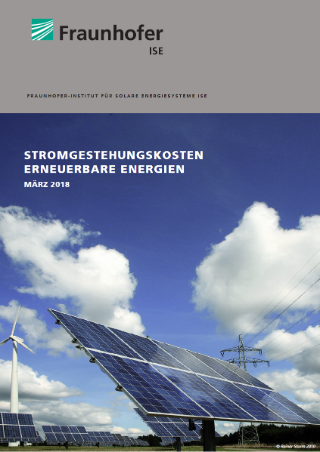
Fraunhofer study: PV and onshore wind are the cheapest technologies in Germany
Published
Researchers at the Fraunhofer Institute for Solar Energy Systems ISE presented the fourth edition of their study on the cost price of electricity from renewable sources on March 20, 2018. In it, they analyze current costs and forecast further developments based on technology-specific learning rates and market scenarios up to the year 2035. "The cost forecasts of the previous studies have been confirmed.
The cost price of electricity from renewable energies is falling continuously and is no longer an obstacle to CO₂-free electricity generation. Newly constructed photovoltaic plants and onshore wind turbines at favourable locations are already cheaper than fossil-fuel power plants, and this trend will increase significantly by 2035," says project manager Dr Christoph Kost.
The ever-improving competitive position of renewables is leading to new applications and rapidly growing markets that are no longer dependent on subsidies. On the other hand, the full-load hours of conventional power plants continue to decline due to a higher share of renewables, which drives up their costs. In addition, fuel and CO2-certificate prices. "It can be assumed that not necessarily the cheapest conventional form of generation will exist on the market to complement the fluctuating renewables, but the one that can show a high flexibility in terms of start-up and shut-down variability, i.e. preferably power plants based on natural gas", says Dr. Christoph Kost.
Currently, PV systems achieve electricity production costs of between 3.71 and 11.54 € cents/kWh, depending on the system type and global radiation - which in Germany is between 950 and 1,300 kWh/(m²a). The specific system costs are between €600 and €1,400/kWp, depending on the system type.
From 2030 onwards, the LCOE for PV systems will fall below 4.7 cents/kWh for
rooftop systems or 2.41 € cents/kWh for ground-mounted systems. The specific system costs will fall to between €350 and €815/kWp by 2035.
State government of Schleswig-Holstein launches climate protection support programme for citizens
Environment Minister Jan Philipp Albrecht: "Climate protection starts within our own four walls. Let's be the regenerative engine of our time together!"
KIEL: Environment Minister Jan Philipp Albrecht today presented the state's new funding programme for private investment in climate protection. It starts on Tuesday, 9 June, and includes a bundle of support measures.
"Climate protection starts within your own four walls. With the new funding programme, we are supporting citizens in making sustainable investments in the future. In this way, we can tackle climate change and develop society in a positive way. Let's be the regenerative engine of our time together!" said Albrecht. Every single investment in climate protection is important because it helps to achieve climate protection targets and conserve natural resources. "But not every investment can be afforded financially by private households. That's why we support all those who contribute to climate protection on a small scale, which helps us on a large scale. Because we can only tackle climate change together," said the Minister.
The purchase of cargo bicycles, e-charging stations, electricity storage systems, photovoltaic balcony systems, solar thermal systems, non-fossil heating systems and rainwater cisterns is subsidised. The installation of a district heating connection and a green roof are also subsidised.
The state government is providing 1.6 million euros over three years for this purpose. The amount of funding varies depending on the object and can be up to 50 per cent - in individual cases even 75 per cent - of the eligible costs. A cargo bike, for example, is subsidised with a maximum of 400 euros. An electricity storage unit can be subsidised with 800 euros and an additional 200 euros for installation and connection costs.
Private individuals who have their primary residence in Schleswig-Holstein are eligible to apply. No economic activity may be carried out in connection with the object of this grant. Only one application per person is possible for the same measure. The same measure cannot be subsidised more than once.
For the fifth time and in keeping with its 120th birthday, Spar- und Bauverein Solingen eG awarded the nationwide Klaus Novy Prize for innovations in cooperative building and living in July. This prize was established by SBV eG as a stimulus for cooperative ideas on the occasion of its 100th anniversary. This year, the prize was awarded to projects that "socially and innovatively" strengthen membership in a cooperative and coexistence in neighborhoods.
Impressed by the award's namesake: SPD State Chairman NRW Michael Groschek in front of the picture of the cooperative theorist Professor Klaus Novy. Photo: SBV/Kastner
"From children's cooperatives to housing projects for refugees: housing cooperatives today are more colourful, dynamic, open-minded and sustainable - innovative and social." SBV Board Chairman Ulrich Bimberg was enthusiastic about the "exciting exchange of knowledge" that took place in the cooperative's own historic washhouse Weegerhof.
Michael Groschek, Chairman of the NRW SPD and former Minister of State, was impressed by the award's namesake: Professor Klaus Novy had imagined the ideal society as a cooperative. The housing market in Germany is a long way from that, he said. "Unless you are lucky enough to live in Solingen, where every tenth apartment is cooperative." During his visit, Michael Groschek paid tribute to the innovative cooperative projects - as former NRW Minister for Construction, he has a special connection to the subject.
Eight cooperatives from all over Germany presented their ideas to the expert audience after a pre-selection from 31 submitted entries. In the end, the new Zurich housing cooperative "Mehr als Wohnen eG" prevailed in the democratic selection process. Their forward-looking and sustainable project was convincing from a social, technical and ecological point of view and received 4000 euros. Second place and 2000 euros went to "Inklusiv Wohnen Köln e.V.", the house project of an association of parents with disabled children. "Bellevue di Monaco eG" from Munich, a housing and social cooperative for refugees, was pleased with third place and 1000 euros. There were no losers in the innovative performances, but a win for all. SBV Chairman Ulrich Bimberg: "Every participating cooperative has something very special." For co-organiser Arno Mersmann, what is typical of a cooperative is: "What one person can't achieve alone, one can achieve together.
The winners of the Klaus Novy Award 2017 with SBV Supervisory Board Chairman Hans-Werner Bertl and SBV Board Chairman Ulrich Bimberg (r.). From left to right: Antje Günther (3rd prize Munich), Claudia Thiesen (1st prize Zurich), Christiane Strohecker, Michaela Mucke, Pascal Schumacher (2nd prize Cologne), Beatrix Novy, Photo: SBV/Kastner
Laureate 2017
Prize "Mehr als Wohnen eG", Zurich
new cooperative, supported by 55 Zurich housing cooperatives, is testing the future of living with 380 residential units. Their project was convincing in social, technical and ecological terms. www.mehralswohnen.ch
Prize "Inklusiv Wohnen Köln e.V." (Inclusive Living Cologne)
House project of an association of parents with disabled children. The building owner is the Cologne municipal housing company GAG, and the association has the right of use and occupancy. www.inklusiv-wohnen-koeln.de
Prize "Bellevue di Monaco eG", Munich
Housing and social cooperative for refugees, who are prepared for an independent life through a concept of care and co-responsibility. www.bellevuedimonaco.de
Klaus Novy Prize
The prize is dedicated to Prof. Klaus Novy (Professor of Building Economics, born 1944 in Vienna; died 1991 in Seattle, USA), who championed the renewal of cooperative housing culture. To mark its centenary in 1997, Spar- und Bauverein Solingen eG launched the nationwide competition. Every five years, current innovations are honored - also as an inspiration for others. Competition theme 2017: "Innovative social cooperative". Contact: Arno Mersmann, telephone 0202/563 20 58, e-mail: amersmann@hotmail.com
Savings and building society Solingen eG
With over 13,600 members, SBV eG is the largest housing cooperative in the Rhineland and one of the largest in Germany; almost one in eight people in Solingen live in an SBV eG house. The claim for 120 years: to offer modern and safe living space at fair conditions to all classes of the population. Contact: SBV Board of Directors, Ulrich Bimberg, Tel. (0212) 20 66-201, e-mail: bimberg@sbv-solingen.de
The 88th Conference of Environment Ministers has just passed a resolution in Bad Saarow on the "Promotion of Building with Wood", which was introduced by Rhineland-Palatinate. The document calls on the federal government to improve the framework conditions for timber construction. The German Timber Industry Council e. V. (DHWR) expressly welcomes this initiative.
According to the Rhineland-Palatinate Minister of the Environment, the positive climate protection properties of renewable raw materials are to be taken into account in building energy law, among other things.
This would be more than desirable, because the draft bill for the Building Energy Act (GEG) recently presented by the Federal Ministry for the Environment, Nature Conservation, Building and Nuclear Safety (BMUB) missed the opportunity to finally take the entire life cycle of buildings into account in the amendment.
In the manufacturing, recycling and disposal process of certain building materials, a large amount of CO2 is released - often more than is consumed in the entire use. In terms of climate policy, it is therefore incomprehensible that this is neither taken into account in the draft Building Energy Act, nor in the energy balance of the building according to the Thermal Insulation Ordinance, nor in the preparation of the energy certificate.
"The Federal Government and the Länder have an equal role to play in sustainable management and the future-oriented use of resources. We see the current resolution of the Conference of Environment Ministers as an important step in the right direction - this should serve as a signpost for both the current and the future federal government."
Read more:
Press release of the Ministry of Environment, Energy, Food and Forestry of Rhineland-Palatinate (May 5, 2017)
Following China and the USA, India now also wants to approve the Paris Climate Agreement. Prime Minister Narendra Modi announced the date as 2 October. It is the birthday of Mahatma Gandhi. India is the world's third largest producer of greenhouse gases.
We use cookies to optimize our website and services.
Functional
Always active
Technical storage or access is strictly necessary for the legitimate purpose of enabling the use of a particular service explicitly requested by the subscriber or user or for the sole purpose of carrying out the transmission of a communication over an electronic communications network.
Preferences
The technical storage or access is necessary for the legitimate purpose of storing preferences that have not been requested by the subscriber or user.
Statistics
The technical storage or access, which is solely for statistical purposes.Technical storage or access used solely for anonymous statistical purposes. Without a subpoena, voluntary consent from your Internet service provider, or additional records from third parties, information stored or accessed for this purpose cannot generally be used alone to identify you.
Marketing
Technical storage or access is necessary to create user profiles, to send advertising or to track the user on a website or across multiple websites for similar marketing purposes.