Mayors for Future: For mayors, climate protection is a top priority
Published
Stuttgart. The Baden-Württemberg Association of Cities is in favour of a CO 2 -pricing. At the most recent board meeting, the committee spoke unanimously in favour and called on the state government to develop a concept together with the municipalities.
"Cities and municipalities have been working hard on the topic of climate protection in recent years - and yet we are finding that it has not been enough in terms of results ", said the President of the Association of Cities and Towns, Dr Peter Kurz, Lord Mayor of Mannheim, citing examples: "Energy saving, renewable energies, energy refurbishment and environmentally friendly mobility have long been on the energy policy agenda of cities," Kurz said, "and there are several networks on climate impact adaptation at both European and international level in which many cities and municipalities in Baden-Württemberg are also involved, such as the EU Covenant of Mayors."
"Proven instruments of municipal climate protection policy are independent and ambitious climate protection concepts in our larger member municipalities and the proven instruments of the European Energy Award," added Gudrun Heute-Bluhm, executive board member of the Association of Cities. The heating plans that will be required in future by the state for the larger municipalities are also available in four places and offer great potential for climate protection with municipal funds.
In order to reduce CO2 -emissions, other incentives are needed than those currently in place, according to the Executive Committee of the Association of German Cities. Following on from the resolution of the German Association of Cities, the board therefore advocates a CO2 This would allow costs to be shifted in favour of climate-friendly energy sources. In any case, the desired restructuring of the state tax and levy system must be socially balanced. "Climate-damaging behaviour must have a price, so we should also examine with the state how we can implement this in the municipal levy system. This is in the interest of the municipalities, which want to actively participate in the achievement of national and international climate protection goals," says the board.
"No one can achieve climate protection alone - neither the federal government, nor the state, nor the municipalities. We can only do it hand in hand, which is why the climate targets can only be achieved if the federal and state governments live up to their responsibility by creating suitable framework conditions and taking action themselves," stressed Mayor Kurz. The state government should therefore come to an agreement with the municipalities on a concept that takes into account the municipal options for action. Climate protection-relevant support programmes should be examined for their effect and adapted if necessary.
President Kurz: "We see climate protection as the challenge of the future and it is a matter for the bosses in our cities - 'mayors for future', so to speak!"
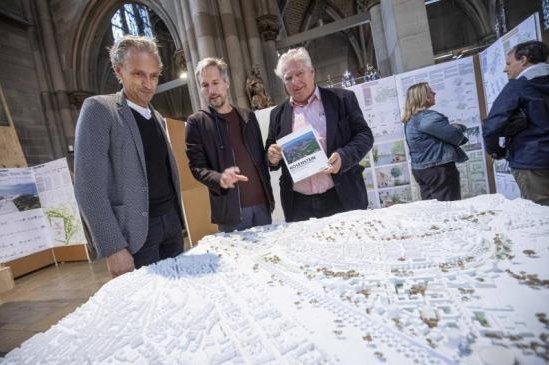
The Rosenstein urban planning competition recently ended with the decision on the winning design. First place went to the Stuttgart-based asp Architekten/Koeber Landschaftsarchitektur consortium. Detlef Kron, Head of the Office for Urban Planning and Housing, opened the exhibition on the Rosenstein competition in the Church of St. Maria at Tübinger Straße 36 in Stuttgart on Friday, 27 September, at 5 pm.
Dr. Detlef Kron (right), Head of the Office for Urban Planning and Housing, opened the exhibition on the urban planning competition. Also present were Cem Arat from the winning Stuttgart consortium asp Architekten/Koeber Landschaftsarchitektur (centre) and Domenik Schleicher, lay chairman of the St. Maria parish council. Photo: Thomas Wagner/City of Stuttgart
At the opening event, Kron said: "The Rosenstein urban planning competition was a complete success: with over 50 submissions from international planning offices, the city of Stuttgart has received a wide range of design ideas for the future Rosenstein quarter. So that the people of Stuttgart can now also get a picture of them, we will be exhibiting the results in the Church of St. Maria over the next four weeks."
The Office of Urban Planning and Housing is displaying all the submitted works from the competition in the exhibition. In addition to plans, drawings, and information about each submitted proposal, revised first and second place models will also be on display. The exhibition will be open for viewing daily (except October 3) between 10am and 6pm until October 25, 2019. Admission to the exhibition is free of charge.
Since 2017, the parish of St. Maria in the south of Stuttgart has made its church available for events other than church services. Whether theatre, café, gallery or marketplace - for two years now, the church of St. Maria has been tested as a space for togetherness with the implementation of various event formats.
Urban planning competition 2018 and public participation
In summer 2018, the city of Stuttgart announced the "international open urban planning competition Rosenstein - Ideas for the new district". The aim of the planning competition was to obtain an urban and open space planning design as a model for the future development of the Rosenstein district. A total of 54 international planning offices took part. Beforehand, citizens were able to contribute their own wishes and ideas for the Rosenstein Quarter at various information events and workshops held by the City of Stuttgart. These were incorporated into the competition.
The Rosenstein development area is currently considered the largest construction project to be realized in Stuttgart in the near future. It stretches between the main railway station, Nordbahnhofviertel, Rosensteinpark and Schlossgarten and offers 85 hectares of space for future-oriented living and working in the heart of the city. The Rosenstein Quarter is to be developed into an urban and mixed district with a high diversity of uses, attractive public spaces and internationally renowned cultural offerings. In addition, the quarter is to be developed under climate-friendly aspects. In addition to the expansion of the parks, the guiding principle of the energy-plus quarter plays a major role: the future buildings should generate more energy than they consume.
Exhibition in the Glass Office
Currently, the designs of the winning office asp Architekten/Koeber Landschaftsarchitektur are also on display at the Info-Laden Rosenstein auf der Prag e.V.. The exhibition in the Gläsernes Büro at Nordbahnhofstraße 81 can be seen until October 12, always on Mondays and Wednesdays between 5 and 7 p.m., Saturdays from 10 a.m. to 12 p.m. and by appointment.
At SZ article from 17.5.2016 will report on the effects of the new EU directive on property loans, which will come into force on 21. March was transposed into German law. It is intended to protect builders and buyers from over-indebtedness. Since its introduction, fewer loans have been granted. The German Banking Industry is sounding the alarm: the directive is jeopardising the granting of property loans in many cases.
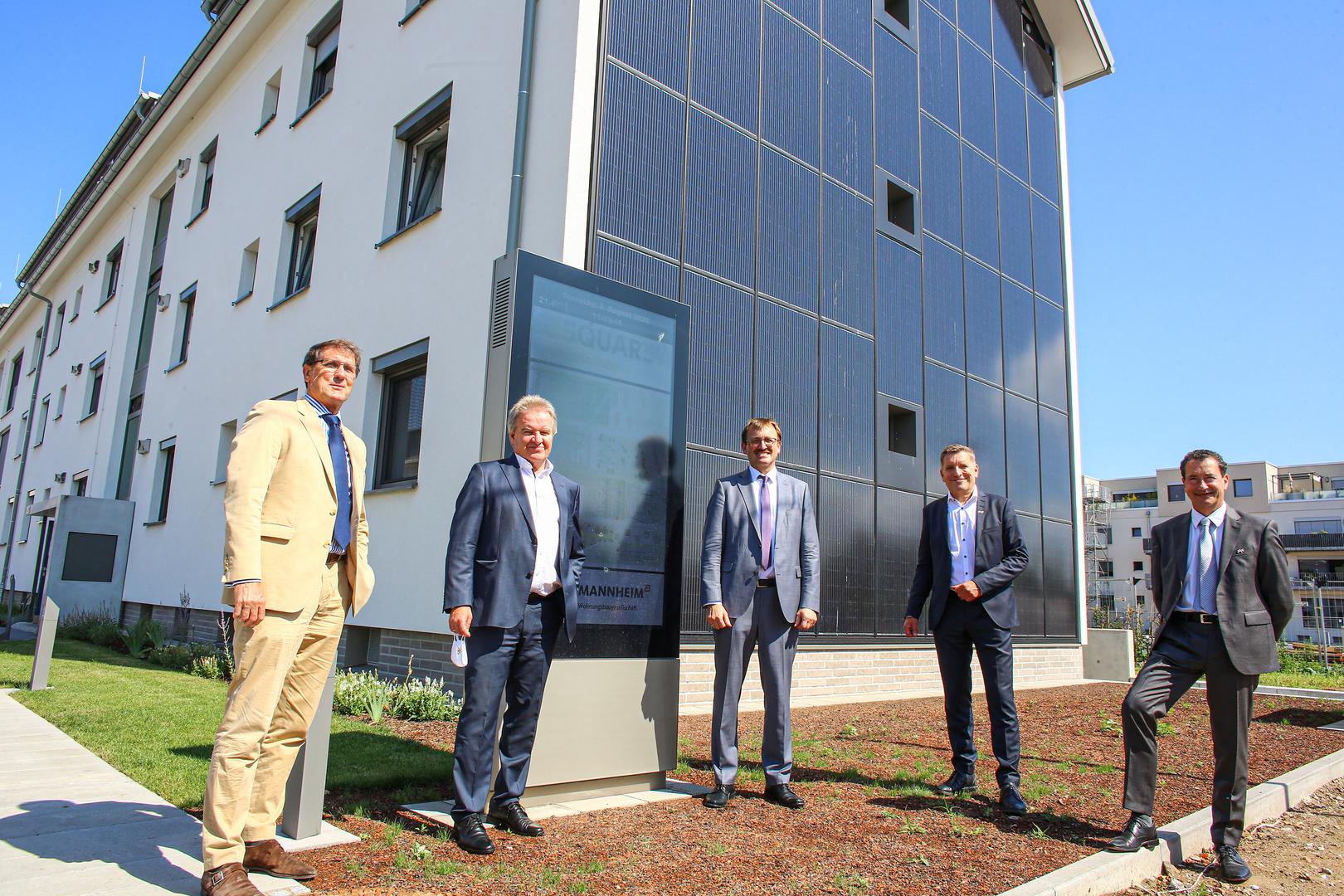
Mayor Michael Grötsch; State Environment Minister Franz Untersteller; Karl-heinz Frings, Managing Director of GBG; Martin in der Beek, Technical Managing Director of rnv; Gregor Kiefer, Head of Construction Management, GBG. Photo: City of Mannheim / Markus Proßwitz
The city is to become cleaner and quieter: Under the heading "blue_village_Franklin", important future topics such as new mobility, energy efficiency, climate-optimised living or smart grids are being tested with the conversion of the former military area FRANKLIN. The SQUARE project, two model houses renovated according to the latest energy standards, and the electromobile bus lines 66 and 67 are part of this master plan. Franz Untersteller MdL, State Minister for the Environment, Climate and Energy Management, visited the two model projects in the new urban quarter on Tuesday, 4 August, as part of his summer tour "Environmental Future".
"With SQUARE, the city of Mannheim and the Mannheim housing association are showing a way to design climate- and energy-optimised living in existing buildings," said the Environment Minister during his visit. "It is impressive to see what has been implemented here in terms of building refurbishment, electromobility and smart grids. And it will be exciting to evaluate the results of this model project and make them usable for other projects."
Lord Mayor Dr. Peter Kurz explains: "With Franklin, an ecological urban quarter for over 9,000 people is being created that will set new standards. Our goal is to consume as little energy as possible throughout the district, to generate as much renewable energy locally as possible and to cause as few emissions as possible. In this context, the SQUARE model project presents two interesting approaches to solutions."
Back in 2014, the model project for energy-efficient building refurbishment SQUARE (smart quarter and urban area reducing emissions) was awarded a prize in the "Klimaschutz mit System" (Climate Protection with a System) competition run by the Baden-Württemberg Ministry of the Environment. The SQUARE project application was prepared by the City of Mannheim's Economic Development Department in cooperation with the Climate Protection Control Centre. Thanks to the award, SQUARE was able to be included in the ERDF funding programme at the time and supported with three million euros. "SQUARE stands for one of the most ambitious projects in the field of GreenTech and climate protection in the city of Mannheim in the past decade. It is one of the pioneering projects developed from the "Blue City Mannheim" strategy concept of the Economic Development Department. The green tech innovation strategy from 2013 is still highly topical and sets the course for climate-neutral mobility and smart grids," emphasizes Mayor Michael Grötsch.
GBG - Mannheimer Wohnungsbaugesellschaft finally successfully implemented the model project on FRANKLIN. The first tenants moved in at the end of 2019. The two almost identical buildings were renovated according to different standards, one building according to the EnEV standard (SQUARE now), the second building with passive house elements according to an EnerPhIT standard (SQUARE next). Technologies such as smart grids, seasonal heat storage using ice storage and intelligent mobility concepts are being tested. The total of 48 rental apartments are spread across 3- to 5-room apartments between 84 and 109 sqm. "We are very excited about the insights we will gain through SQUARE. According to the calculations and simulations, we can achieve a CO2 saving of more than 50 percent in the comparison of the two buildings. In order to be able to save even more CO2, we are relying on the generation of regenerative energies. The ENEV building therefore received a photovoltaic system, the EnerPhIT building a solar thermal system," explains Karl-Heinz Frings, Managing Director of GBG.
"This is where the city of the future with the energy system of the future is being created," explains Bernhard Schumacher, head of the Smart Cities business unit at Mannheim-based energy company MVV. To this end, MVV is using smart technologies and the new possibilities of digitalisation on Franklin and is linking the various sectors intelligently and efficiently with each other - "not only to bring electricity, water, heat and mobility to the district, but also to make the new district the beacon of a necessary energy turnaround at the same time". MVV is also demonstrating what is already possible today in terms of electromobility on Franklin. In addition to environmentally friendly car-sharing solutions, such as FRANKLIN mobil, publicly accessible charging points are being set up, which will be networked with the energy management system and made more flexible. At the same time, the heating sector also plays an indispensable role. MVV has therefore built an innovative low-temperature heating grid here, which also enables the efficient integration of renewable energies.
Another item on the agenda of the visit is the three electric buses of the type E-Citaro, which have been in operation in Franklin on line 67 since April 2019. One of the buses was also funded under SQUARE. The environmentally friendly buses run every 20 minutes between the conversion areas on Franklin and the Käfertal Bahnhof stop. This will give people who already live, work or go to school in Franklin a direct connection to the rnv public transport network. "We are delighted to have EvoBus as a strong partner for this forward-looking project right on the spot," says Martin in der Beek, Technical Managing Director of rnv. "Over the past year, we have gained a lot of valuable knowledge in the operation of conventional electric buses and at the same time proved that the technology can stand up to the rigours of everyday public transport." In the future, however, other forms of propulsion will also be examined, he added. "We are currently looking intensively at the use of hydrogen buses in public transport and will soon be testing this technology at the rnv," reveals in der Beek. "Traveling by public transport is already more environmentally friendly per se than traveling by car, but we want to do even more for climate protection and therefore also convert our vehicle fleet to emission-free drives as far as possible."
We use cookies to optimize our website and services.
Functional
Always active
Technical storage or access is strictly necessary for the legitimate purpose of enabling the use of a particular service explicitly requested by the subscriber or user or for the sole purpose of carrying out the transmission of a communication over an electronic communications network.
Preferences
The technical storage or access is necessary for the legitimate purpose of storing preferences that have not been requested by the subscriber or user.
Statistics
The technical storage or access, which is solely for statistical purposes.Technical storage or access used solely for anonymous statistical purposes. Without a subpoena, voluntary consent from your Internet service provider, or additional records from third parties, information stored or accessed for this purpose cannot generally be used alone to identify you.
Marketing
Technical storage or access is necessary to create user profiles, to send advertising or to track the user on a website or across multiple websites for similar marketing purposes.