Many thanks to Johann Hartl for the photos of the "Neue Wege" housing project from 25 March 2017. The Augsburg model project for multi-generational living in cost-effective timber construction was completed in 2000.
Click here for further information: http://sdg21.eu/db/wohnprojekt-neue-wege
17 Sustainable Development Goals - 17 figures: The dove stands for the goal "peace". Photo: Federal Government
The German government is presenting striking figures for the 17 global SDG 2030 sustainability goals. The "Glorious 17" campaign launched at the beginning of December is intended to arouse curiosity and encourage participation. An animated peace dove, for example, promotes peace and justice. Other figures stand for the fight against hunger and the protection of life under water.
The campaign is aimed in particular at young people between the ages of 18 and 30, as surveys show that knowledge of the Sustainable Development Goals is particularly low in this age group. The campaign is to be expanded in the coming year.
The Magnificent 17 and the website www.deutsche-nachhaltigkeitsstrategie.de also provide information on how the Federal Government is committed to sustainable development.
BN - Is the roof of my house or company building suitable for a photovoltaic system or a solar thermal system? This question can now be answered quickly and conveniently online with the help of the new solar roof cadastre of the city of Bonn. In a building-specific map display, a coloured marker indicates whether and to what extent a roof is suitable for energy generation by means of solar power. Step by step, further information, for example on the economic efficiency, can be retrieved via a yield calculator.
The suitability of the roofs of all 129,000 buildings in the city for solar energy generation was recalculated using the latest, improved data. For this purpose, elevation grid data was used, which was determined by the district government of Cologne by means of laser scanning in spring 2016. Compared to the previous version from 2010, the new Bonn solar roof cadastre features, among other things, a fourfold higher resolution and a more differentiated designation of the roof areas.
The suitability of the roof surfaces for electricity generation via photovoltaic systems as well as for domestic water heating and, for the first time, also for supporting building heating via solar thermal collectors was calculated. The calculations also took into account the current changes in the framework conditions with regard to feed-in tariffs and self-consumption of generated solar power.
How the application works
In the city map, the installable system size and many additional data such as yields and savings potentials can be displayed for each building. In a newly developed yield calculator, costs and yields can be calculated and compared by entering additional user-specific information such as electricity consumption or household size. In this way, every owner can quickly gain an overview of the suitability of his or her building for the use of solar energy. Detailed instructions are available at www.bonn.de/...solardachkataster.php.
The City of Bonn points out that the information from the solar roof cadastre is an initial non-binding assessment. Essential prerequisites for a decision to build a system, such as the condition of the roof or the static suitability, can only be clarified by suitable specialist companies or qualified consulting organisations. Information on this can be found on the website of the solar roof register.
Bonn roofs have potential
According to the potential analysis of the solar roof cadastre, 6,800,000 square metres in Bonn are suitable for solar power generation. This corresponds to about the size of 950 football fields. Approximately 800,000 megawatt hours of electricity could be generated on this area. This could cover about 50 percent of the total electricity consumption in Bonn. For solar thermal energy, the result of the potential analysis shows 88,461 buildings in Bonn that could be used for this form of energy generation. This corresponds to about 70 percent of the buildings in Bonn.
In the Ecological model settlement in Prinz Eugen Park in Munich, a total of more than 600 residential units are to be built in timber or timber hybrid construction. According to the Mikado article, all plots of land for the model housing estate, which is up to seven storeys high, have already been allocated.
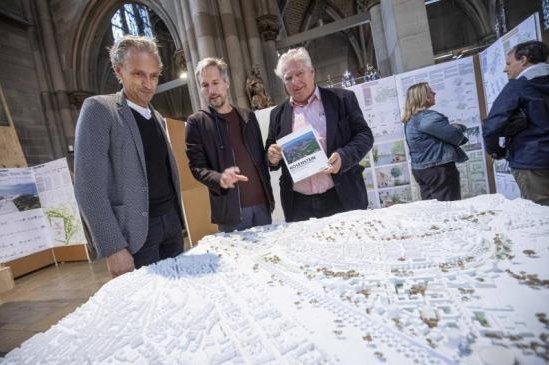
The Rosenstein urban planning competition recently ended with the decision on the winning design. First place went to the Stuttgart-based asp Architekten/Koeber Landschaftsarchitektur consortium. Detlef Kron, Head of the Office for Urban Planning and Housing, opened the exhibition on the Rosenstein competition in the Church of St. Maria at Tübinger Straße 36 in Stuttgart on Friday, 27 September, at 5 pm.
Dr. Detlef Kron (right), Head of the Office for Urban Planning and Housing, opened the exhibition on the urban planning competition. Also present were Cem Arat from the winning Stuttgart consortium asp Architekten/Koeber Landschaftsarchitektur (centre) and Domenik Schleicher, lay chairman of the St. Maria parish council. Photo: Thomas Wagner/City of Stuttgart
At the opening event, Kron said: "The Rosenstein urban planning competition was a complete success: with over 50 submissions from international planning offices, the city of Stuttgart has received a wide range of design ideas for the future Rosenstein quarter. So that the people of Stuttgart can now also get a picture of them, we will be exhibiting the results in the Church of St. Maria over the next four weeks."
The Office of Urban Planning and Housing is displaying all the submitted works from the competition in the exhibition. In addition to plans, drawings, and information about each submitted proposal, revised first and second place models will also be on display. The exhibition will be open for viewing daily (except October 3) between 10am and 6pm until October 25, 2019. Admission to the exhibition is free of charge.
Since 2017, the parish of St. Maria in the south of Stuttgart has made its church available for events other than church services. Whether theatre, café, gallery or marketplace - for two years now, the church of St. Maria has been tested as a space for togetherness with the implementation of various event formats.
Urban planning competition 2018 and public participation
In summer 2018, the city of Stuttgart announced the "international open urban planning competition Rosenstein - Ideas for the new district". The aim of the planning competition was to obtain an urban and open space planning design as a model for the future development of the Rosenstein district. A total of 54 international planning offices took part. Beforehand, citizens were able to contribute their own wishes and ideas for the Rosenstein Quarter at various information events and workshops held by the City of Stuttgart. These were incorporated into the competition.
The Rosenstein development area is currently considered the largest construction project to be realized in Stuttgart in the near future. It stretches between the main railway station, Nordbahnhofviertel, Rosensteinpark and Schlossgarten and offers 85 hectares of space for future-oriented living and working in the heart of the city. The Rosenstein Quarter is to be developed into an urban and mixed district with a high diversity of uses, attractive public spaces and internationally renowned cultural offerings. In addition, the quarter is to be developed under climate-friendly aspects. In addition to the expansion of the parks, the guiding principle of the energy-plus quarter plays a major role: the future buildings should generate more energy than they consume.
Exhibition in the Glass Office
Currently, the designs of the winning office asp Architekten/Koeber Landschaftsarchitektur are also on display at the Info-Laden Rosenstein auf der Prag e.V.. The exhibition in the Gläsernes Büro at Nordbahnhofstraße 81 can be seen until October 12, always on Mondays and Wednesdays between 5 and 7 p.m., Saturdays from 10 a.m. to 12 p.m. and by appointment.
We use cookies to optimize our website and services.
Functional
Always active
Technical storage or access is strictly necessary for the legitimate purpose of enabling the use of a particular service explicitly requested by the subscriber or user or for the sole purpose of carrying out the transmission of a communication over an electronic communications network.
Preferences
The technical storage or access is necessary for the legitimate purpose of storing preferences that have not been requested by the subscriber or user.
Statistics
The technical storage or access, which is solely for statistical purposes.Technical storage or access used solely for anonymous statistical purposes. Without a subpoena, voluntary consent from your Internet service provider, or additional records from third parties, information stored or accessed for this purpose cannot generally be used alone to identify you.
Marketing
Technical storage or access is necessary to create user profiles, to send advertising or to track the user on a website or across multiple websites for similar marketing purposes.
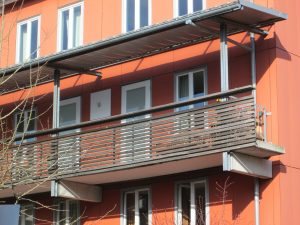 Many thanks to Johann Hartl for the photos of the "Neue Wege" housing project from 25 March 2017. The Augsburg model project for multi-generational living in cost-effective timber construction was completed in 2000.