New publication: So that we do what we think is right
Published
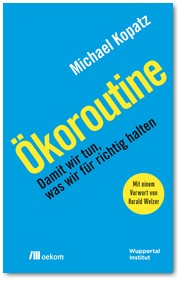
The gap between knowledge and action is often wide. At the beginning of his book "Ökoroutine", Michael Kopatz explains why we often don't do what we think is right: out of routine. Because the here and now determines our actions. Because it is difficult to avoid advertising. Or because living sustainably seems more expensive and more inconvenient in everyday life. Why should I, of all people, cycle more often, fly less, spend more money on organic products?
Appeals and campaigns alone will not bring the necessary change any closer
Kopatz recommends political intervention and raising standards - in animal husbandry, for example, or in agriculture. Appliances must be repairable and energy-efficient refurbishments must be socially just. Kopatz also makes an imaginative plea for new political framework conditions with regard to mobility or regional economic models.
Further information on the "eco-routine" can be found at www.oekoroutine.de.
Michael Kopatz: Ökoroutine - Damit wir tun, was wir für richtig halten, 2016. 416 pages, €24.95
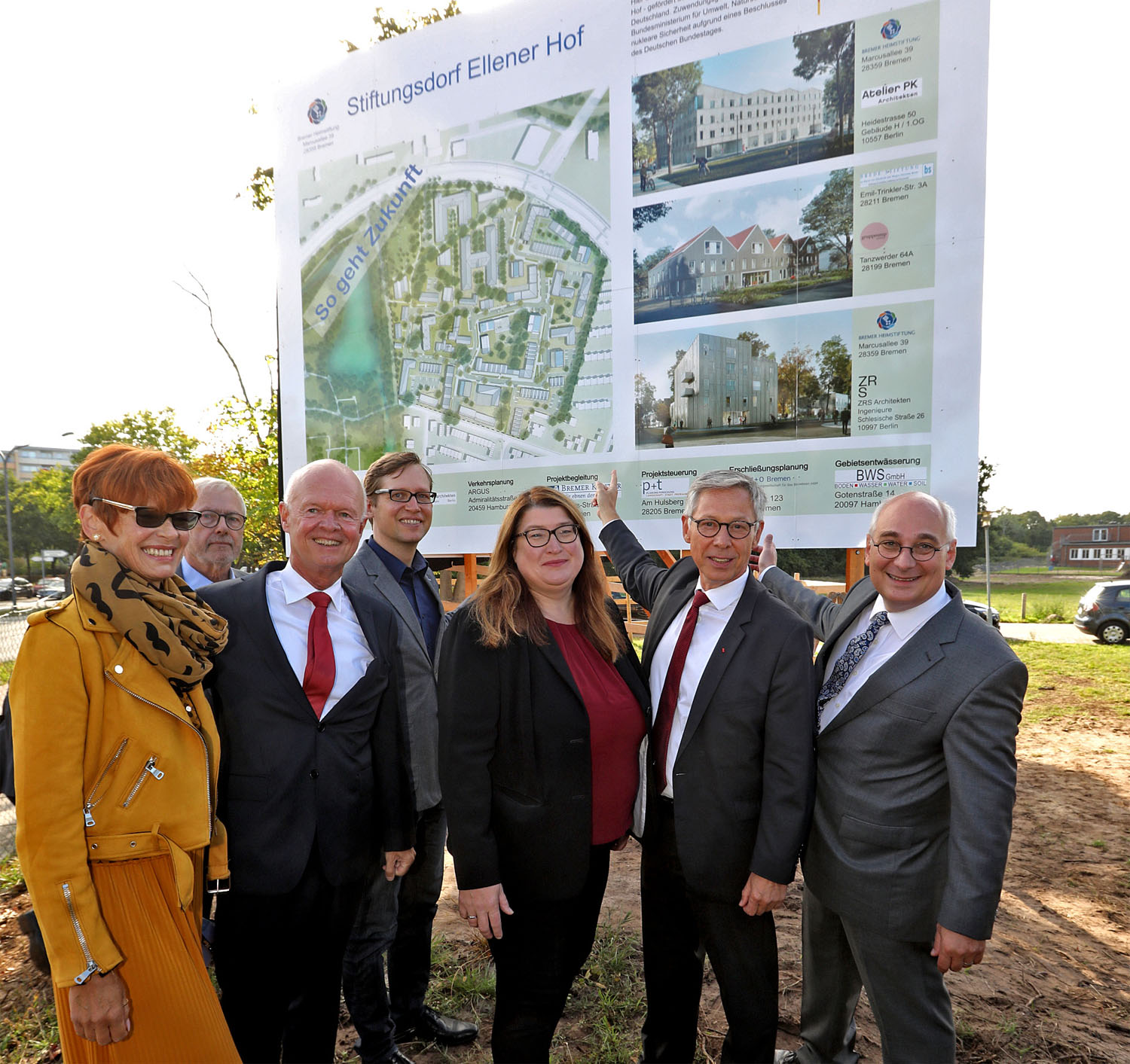
Together with the unveiling of the building sign, they heralded the start of construction on the grounds of the Ellener Hof Foundation Village: (from left) Sabine Schöbel.) Sabine Schöbel, Head of the Ellener Hof Foundation Village, Wolfgang Haase, Speaker of the Advisory Board in Osterholz, Alexander Künzel, Senior Director of the Bremen Home Foundation, Jens Deutschendorf, State Councillor at the Senator for the Environment, Construction and Transport, Anja Stahmann, Senator for Social Affairs, Youth, Women, Integration and Sport, Bremen's Mayor Dr. Carsten Sieling and André Vater, Chairman of the Board of the Bremen Home Foundation. Photo: Bremer Heimstiftung, Photographer: Martin Rospek
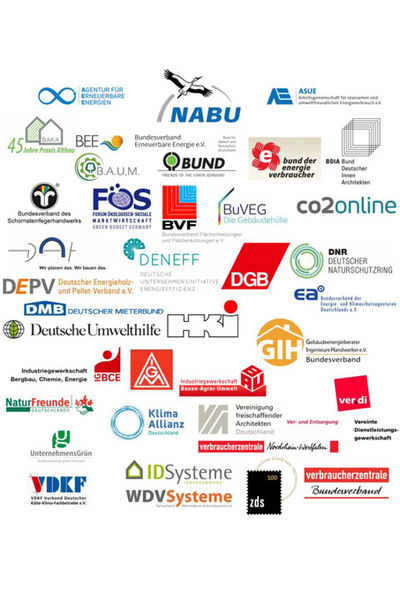
The associations and organisations involved in the Building Alliance (Graphic: NABU)
The energy transition in the building sector has stalled. Less and less is being invested in energy-efficient refurbishment and the Paris climate protection targets are in jeopardy. The reason for this is inadequate advice and the uncertainty of many consumers on the one hand, as well as inadequate government regulations and poorly managed subsidies on the other. For almost two years now, the Building Alliance, an association of environmental and consumer organisations with energy consultants, tradesmen, trade unions, the building industry, architects' associations and the construction industry, has been positioning itself against this. Under the leadership of the Nature and Biodiversity Conservation Union (NABU), numerous natureplus members such as BUND, BAUM e.V. and IG Bau are also working together in favour of more climate protection in the building sector.
In a recent statement, the Building Alliance calls on a new German government to "make the neglected third of the energy transition in the building sector an integral part of an integrated climate protection and energy policy". So far, politicians have "missed the opportunity to make energy-efficient building refurbishment the largest value creation and value retention programme in Germany and thus a real job engine for the domestic economy", criticises Jörg-Andreas Krüger, Deputy Federal Managing Director of NABU. Residential and non-residential buildings must now be addressed more strongly and more specifically than before by the three pillars of "information and advice", "support" and "demand".
A "lack of prioritisation and reliability" has unsettled investors, homeowners, tradespeople and businesses. In order to create reliability, "more transparency is needed in the assessment of buildings" through a standardised, optimised energy performance certificate. In addition, "high-quality, quality-assured advice from trained experts" in accordance with national standards is needed. Politicians must "set the course for reliable and permanent funding for high-quality consulting services and refurbishment measures". The refurbishment costs should be "shared equally between the state, landlords and tenants". At the same time, however, "new, market-based incentives are needed to mobilise additional investment and provide smart incentives", concludes NABU.
2.35 min, 26.01.2015, broadcast on 5.7.2016 on ZDF
Documentary film by Anna Ditges
When a major investor announces plans to build a shopping mall on a former industrial site in the middle of Cologne-Ehrenfeld, citizens' protests are heard. In her feature film "WEM GEHÖRT DIE STADT - Bürger in Bewegung" (90 min., 2014), filmmaker Anna Ditges tells of an existential confrontation between people with very different, often incompatible lifestyles and values on the Helios site in Cologne. "In the tension between commitment, self-interest and the creation of meaning, it explores the question of how democracy can function in everyday life and how much political responsibility one's own home means to each individual."
We use cookies to optimize our website and services.
Functional
Always active
Technical storage or access is strictly necessary for the legitimate purpose of enabling the use of a particular service explicitly requested by the subscriber or user or for the sole purpose of carrying out the transmission of a communication over an electronic communications network.
Preferences
The technical storage or access is necessary for the legitimate purpose of storing preferences that have not been requested by the subscriber or user.
Statistics
The technical storage or access, which is solely for statistical purposes.Technical storage or access used solely for anonymous statistical purposes. Without a subpoena, voluntary consent from your Internet service provider, or additional records from third parties, information stored or accessed for this purpose cannot generally be used alone to identify you.
Marketing
Technical storage or access is necessary to create user profiles, to send advertising or to track the user on a website or across multiple websites for similar marketing purposes.

 The gap between knowledge and action is often wide. At the beginning of his book "Ökoroutine", Michael Kopatz explains why we often don't do what we think is right: out of routine. Because the here and now determines our actions. Because it is difficult to avoid advertising. Or because living sustainably seems more expensive and more inconvenient in everyday life. Why should I, of all people, cycle more often, fly less, spend more money on organic products?