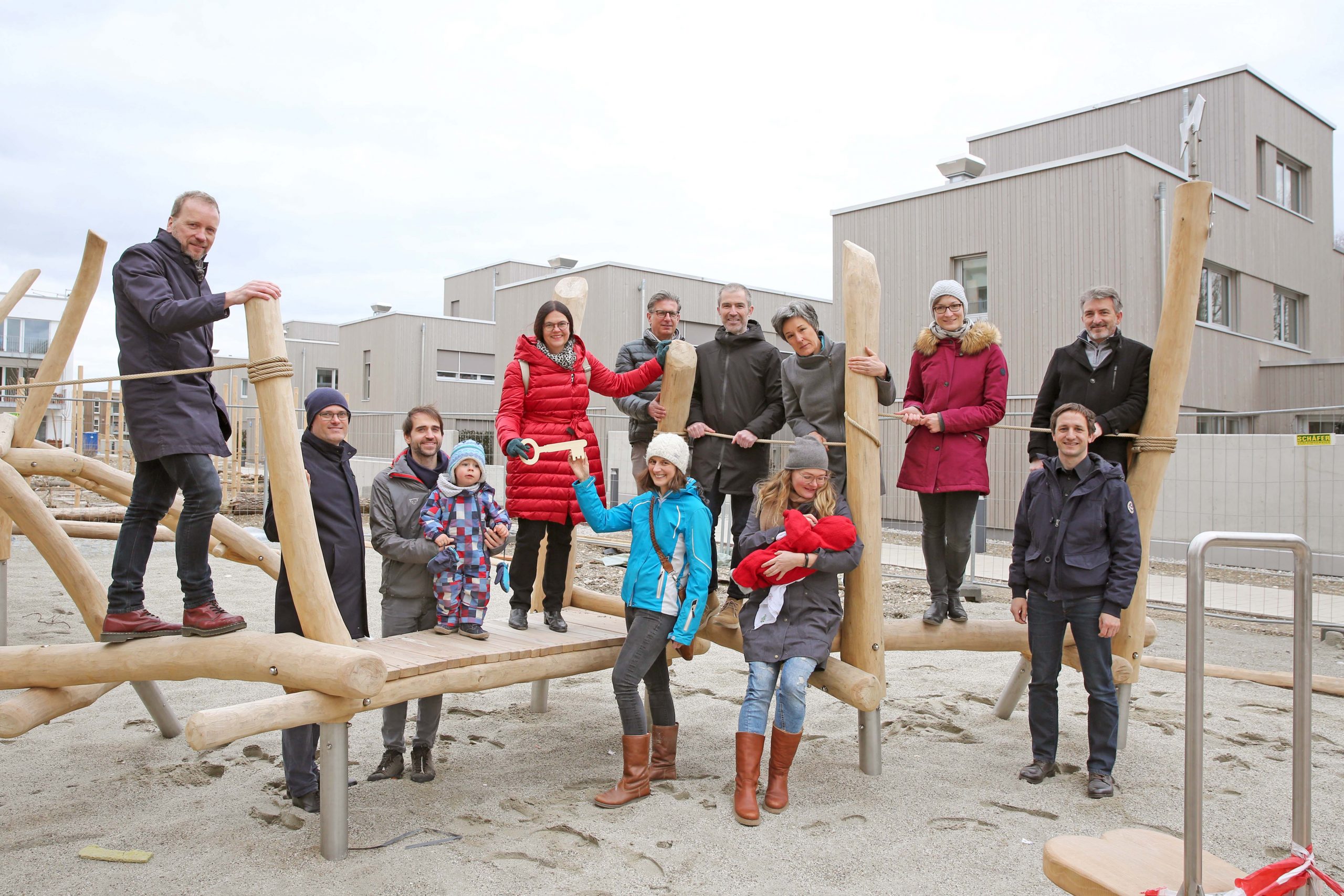
5.3.2020 Munich: City Planning Councillor Professor Dr. (l) Elisabeth Merk has now symbolically handed over the key to the members of the building association "Der Kleine Prinz" in Prinz Eugen Park. Their new building ensemble of atrium and point houses on Jörg-Hube-Straße is part of the ecological model settlement there. In addition to flats, two guest flats, an ice cream café and a bicycle repair workshop were built.
"The ecological model housing estate is a kind of initial spark for further timber construction projects in the city, and with the 'Kleiner Prinzen' project, an outstanding showcase project for high-quality timber construction has been created - beyond the city's borders. This is due not least to the great commitment of all those involved and the successful cooperation as and with the building consortium," Merk emphasised at the handover of the keys, which was attended not only by the members of the building consortium but also by the architects involved from the architectural firm Dressler Mayerhofer Rössler.
Around 1,800 flats as well as a primary school, kindergartens and other facilities are being built in the new Prinz-Eugen-Park urban quarter. Among the developers are a total of six cooperatives and five joint building ventures. The ecological model settlement is made up of eight individual projects. Approximately 570 flats are being built here in timber construction, 407 of which are rental flats, and various community facilities.
One million electric cars are to be on the road in Germany by 2020, at least that's what the German government wants. Sales figures are still lagging behind expectations. In addition, important questions arise about the origin of electricity and raw materials. ZDF has devoted a report to these questions in the series "planet e" entitled "Electric cars - top or flop?" and also interviewed ifeu Heidelberg. The programme is available in the ZDF Mediathek until 28.1.2017.
In addition to important aspects of the environmental balance, the paper also discusses the App My eDrive which is currently being developed by ifeu and the ADAC Technical Centre with funding from the Federal Ministry for the Environment (BMUB).
Link to video:
www.zdf.de/…Elektroautos—Top-oder-Flop%253F
Strengthen energy refurbishment of buildings and demand responsibility from landlords.
Housing policy must create supportive framework conditions and thus contribute to the reduction of living space.
"For a necessary energy turnaround in the housing industry, conditions must be created that demonstrate noticeable incentives for owners and users to consume less energy in the future," says DAI President Dipl.-Ing. Architekt Arnold Ernst. On the occasion of the Federation Day of the German Associations of Architects and Engineers (DAI), a declaration on current topics of building and planning culture is published in annual succession. For previous DAI statements, see below.
In Germany, CO2 emissions from buildings are equivalent to the pollution caused by traffic. The intensity of the public discussion does not reflect this. This is all the more reason why architects and engineers are called upon to show responsibility in their field and to demonstrate ways in which they intend to make their contribution to sustainable climate protection.
The technical solutions are available, and we need to develop better methods, especially for the sustainable retrofitting of existing buildings. However, there is a lack of incentives for owners and users to implement and tolerate energy-efficient refurbishment. It is easier to demand climate protection than to pay for it. The environmental impact of CO2 emissions is (still) free, but avoiding it costs money, a lot of money in existing buildings. The landlord shies away from the investment because only a small part can be passed on to the rents. The tenant has an understandable insistence on not changing the size and location of his flat, especially as long as the parties keep deciding on new socially undifferentiated benefits in the competition for the cheapest rents. Both landlords and tenants must make their economic contribution in order to finance the comprehensive energy-efficient refurbishment of the housing stock.
The benchmark for all participants must be the Polluter pays principle be. Those who contribute to the release of CO2 must have an economic advantage if they actively participate in the reduction; those who refuse to participate must have an economic disadvantage as a result.
The DAI demands:
A CO2 levy for each sqm of heated floor space according to the information in the energy performance certificate from level B. This levy is covered by the Owner to pay.
A CO2 levy on the energy used according to consumption and specific CO2 emissions. This levy is determined by the Tenant to pay.
Both levies make it more expensive to live in buildings that are not optimised in terms of energy efficiency. Weighing up the direct financial burden on those affected and the long-term burden of climate change, the DAI considers the additional costs incurred to be justified. Support for economically weak households in line with the social market economy must ensure that the entitlement to adequate housing is met.
As appropriate in the sense of social indigence 30 sqm per person + 20 sqm for each additional person in a dwelling are considered. Appropriate transitional periods should on the one hand avoid social hardship and on the other hand continuously stimulate stronger incentives for the adaptation of housing conditions to economic performance. In order to also stimulate the corresponding adjustment processes above the level of social need, the regulation of the rent level should be waived, but in the case of existing tenancies with an appropriate limitation of the annual increase, also in order to facilitate the adjustment to economic performance.
DAI Presidium
Note sdg21: the statement presented here does not reflect the opinion of the sdg21 editorial team.
"Europe's largest rental scheme for e-load bikes has started in Cologne. The initiators see the project as an active contribution to the energy transition and want to transfer the system - if it is successful - to other cities."
Cooperation between municipal utilities and berlinovo for largest German tenant electricity project
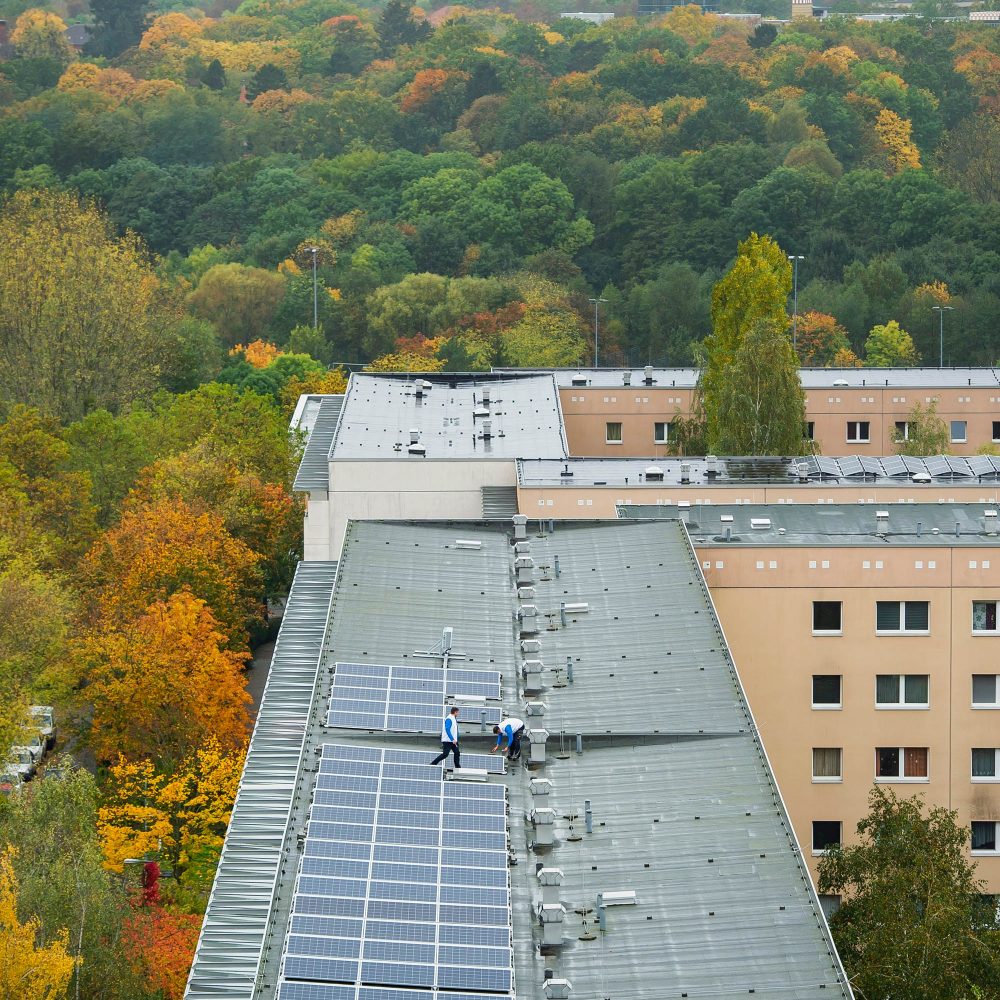
Mietersonne Kaulsdorf, Germany's largest tenant power project with almost 3.4 megawatts (MW) of capacity, is being built by Berliner Stadtwerke for the Berlin housing association berlinovo in Marzahn-Hellersdorf. Tenants of 4,300 apartments will be able to benefit from the green electricity generated directly on their roofs.
The dimensions of the project, consisting of 39 solar systems on one hundred residential buildings in the district between Wuhletal and Hellersdorfer Strasse, speak for themselves: a total of 27,000 m² are covered with modules, which corresponds to 3.8 times the area of a football pitch. The yield is estimated at around 2.9 million kilowatt hours per year, which is equivalent to the entire electricity requirements of 1,200 two-person households. This means that approx. 1,580 tons of CO2-emissions were avoided. Berliner Stadtwerke is investing around €3.75 million in this project. This year, 2.0 MW of the total 3.4 MW will be installed, around 60 percent of which have already been installed on the roofs since May. A further 1.4 MW is to follow in 2020 and 2021.
Photos: Pritzkuleit
"Berlin is catching up," says Berlin's energy senator Ramona Pop. "We still have a lot of space on our roofs that we can use to work sustainably and efficiently for the energy transition here in the city. Until the federal government finally meets the requirements of the urban energy transition, we cannot wait, after all, the climate crisis is not waiting either. We are working at full speed to expand solar energy in Berlin. With the Mietersonne project, we are taking the biggest step on this path so far."
Finance Senator Dr. Matthias Kollatz explains: "In order to achieve Berlin's ambitious climate protection goals, we must double the speed of the energy transition. Relying on private initiatives alone is not enough. The commitment of the public sector is required. This example of municipal cooperation is exemplary - and an important driver in a very central climate protection area."
"We built the largest part of the facility this year," says Stadtwerke Managing Director Dr. Kerstin Busch. "Important for the success of the project is a high level of acceptance among the tenants, which we are also promoting on site with our own customer center at the Spree Center, among other things." Including the Mietersonne Kaulsdorf project, Stadtwerke will install around 4 MWp on Berlin roofs this year.
"Thanks to the cooperation with Berliner Stadtwerke, berlinovo tenants in the Kaulsdorf district will in future be able to obtain cheap local and clean electricity 365 days a year. At the same time, we are making the plat-ten buildings fit for the future and helping to achieve Berlin's climate targets," emphasises Alf Aleithe, Managing Director of berlinovo.
Berlin public utility company
Berliner Stadtwerke is a subsidiary of Berliner Wasserbetriebe. They are committed to consumer-oriented energy generation and environmentally friendly supply concepts based on renewable energies. To date, Berliner Stadtwerke has invested €30.4 million in renewable energies, in Berlin primarily in new solar power plants in the districts. This means they have built more than 40 percent of the solar capacity installed in Berlin since 2016. Information about and registration for the environmentally friendly "berlinStrom" at www.berlinerstadtwerke.de
About berlinovo
berlinovo was formed in 2012 from BIH Berliner Immobilien Holding GmbH, founded in 2006, and its subsidiaries. berlinovo is an investment of the State of Berlin. The portfolio includes 246 properties, one of which is abroad. Nationwide, berlinovo manages 23,500 rental units with a total rental area of 2.55 million m² and an annual target rent of over €249.0 million. These include around 15,200 apartments, 6,500 furnished apartments and 1,800 commercial units (as of 31 December 2018). berlinovo employs around 340 people.
We use cookies to optimize our website and services.
Functional
Always active
Technical storage or access is strictly necessary for the legitimate purpose of enabling the use of a particular service explicitly requested by the subscriber or user or for the sole purpose of carrying out the transmission of a communication over an electronic communications network.
Preferences
The technical storage or access is necessary for the legitimate purpose of storing preferences that have not been requested by the subscriber or user.
Statistics
The technical storage or access, which is solely for statistical purposes.Technical storage or access used solely for anonymous statistical purposes. Without a subpoena, voluntary consent from your Internet service provider, or additional records from third parties, information stored or accessed for this purpose cannot generally be used alone to identify you.
Marketing
Technical storage or access is necessary to create user profiles, to send advertising or to track the user on a website or across multiple websites for similar marketing purposes.

 Video available until 28.01.2017, 16:30