Visions for the Future: Shaping Urban Neighborhoods Participatively and Sustainably
Published
How can cities develop sustainably? How do they limit traffic, reduce pollutants and make attractive use of urban spaces, how do they create affordable attractive housing for all? These and other questions are at the centre of a project just launched by the Öko-Institut in cooperation with the Institute for Regional and Urban Development Research (ILS, Dortmund), the German Institute of Urban Affairs (difu, Berlin) and the City of Darmstadt, which has the working title "Transformative Strategies for Integrated Neighbourhood Development - TRASIQ".
Visions for the Future: Shaping Urban Neighborhoods Participatively and Sustainably
How can cities develop sustainably? How can they limit traffic, reduce pollution and make attractive use of urban space - in short, be liveable for their inhabitants? How can they meet the needs of an ageing population and the influx of younger people in equal measure, and how can they create affordable, attractive housing for all? What role do possible conflicts between ecology - more forest - and economy - more living space - play and how can they be resolved? These and other questions are at the centre of a project just launched by the Öko-Institut in cooperation with the Institute for Regional and Urban Development Research (ILS, Dortmund), the German Institute of Urban Affairs (difu, Berlin) and the City of Darmstadt, which has the working title "Transformative Strategies for Integrated Neighbourhood Development - TRASIQ".
In the two cities of Darmstadt and Griesheim, the project partners discuss sustainability requirements together with planners - for example with a view to limited budgets - and develop concepts and strategies for liveable neighbourhoods. How exactly such visionary ideas could be implemented is then to be co-developed by the future residents. team ewen and the Schader Foundation support the project in communicating and shaping the dialogue. The project is funded by the Federal Ministry of Education and Research.
Darmstadt and Griesheim - testing sustainable neighbourhoods
Darmstadt is one of the so-called "swarm cities" - that is, one of the 18 municipalities in Germany where the age group of 20 to 35-year-olds is concentrated far above average. The city has been growing continuously since 1997, currently at a rate of around 2,000 people per year. In this context, Darmstadt set itself targets for sustainable urban development early on and wants to test new settlement concepts in pilot projects such as on the site of the former Cambrai-Fritsch barracks.
"Precisely because we are a city of science, we rely on the dialogue between research and practice in urban development. We are particularly pleased to be cooperating with the Öko-Institut within the framework of TRASIQ, which is one of the most important players in the field of Green Smart City in Darmstadt's scientific landscape," explains Lord Mayor Jochen Partsch.
"Conflicts arise in the conception of an ecologically, socially and economically sustainable urban area - for example, in high-quality, energy-saving construction that nevertheless has to remain affordable," says Dr Dietlinde Quack, one of the two project leaders of the transdisciplinary project at the Öko-Institut, explaining the challenge. "Discussing such conflicts in the municipalities with those politically responsible, the citizens and future investors and finding a fair way for as many parties as possible is our task for the next three years. In doing so, the exchange about common visions of the future of design will help us. If all stakeholders agree on this, we can then align ideas for the concretisation of the development areas with it."
Contact persons at the Öko-Institut
Dr Dietlinde Quack
Head of the Consumer and Society Group
in the area of products & material flows
Öko-Institut e.V., Freiburg Office
Phone: +49 761 45295-248
E-mail: d.quack(at)oeko.de
Dr Bettina Brohmann
Research Coordinator Transdisciplinary
Sustainability Science
Öko-Institut e.V., Darmstadt Office
Phone: +49 6151 8191-135
E-mail: b.brohmann(at)oeko.de
The Öko-Institut is one of Europe's leading independent research and advisory institutes for a sustainable future. Since its foundation in 1977, the Institute has been developing principles and strategies on how the vision of sustainable development can be implemented globally, nationally and locally. The Institute has offices in Freiburg, Darmstadt and Berlin.
The gap between knowledge and action is often wide. At the beginning of his book "Ökoroutine", Michael Kopatz explains why we often don't do what we think is right: out of routine. Because the here and now determines our actions. Because it is difficult to avoid advertising. Or because living sustainably seems more expensive and more inconvenient in everyday life. Why should I, of all people, cycle more often, fly less, spend more money on organic products?
Appeals and campaigns alone will not bring the necessary change any closer
Kopatz recommends political intervention and raising standards - in animal husbandry, for example, or in agriculture. Appliances must be repairable and energy-efficient refurbishments must be socially just. Kopatz also makes an imaginative plea for new political framework conditions with regard to mobility or regional economic models.
Further information on the "eco-routine" can be found at www.oekoroutine.de.
Michael Kopatz: Ökoroutine - Damit wir tun, was wir für richtig halten, 2016. 416 pages, €24.95
Federal Ministry for Climate Protection announces comprehensive emergency programme
Introduction
After a significant decline in the previous year, greenhouse gas emissions in Germany are on the rise again. Thus, around 762 million tonnes of greenhouse gases were released in 2021 - a good 33 million tonnes or 4.5 percent more than in 2020. Overall, emissions in Germany have thus fallen by 38.7 percent since 1990. The increase in the last year is particularly noticeable in the energy sector: This shows an increase of 27 million tonnes CO2-equivalents, as increased demand for electricity, lower electricity generation from renewable energies and the higher gas price led to increased use of coal for electricity generation. Electricity generation from renewables fell by seven per cent, mainly due to poor wind conditions. In the transport and building sectors, emissions were above the annual ceilings set by the Federal Climate Protection Act. This is shown by the latest calculations of the Federal Environment Agency (UBA), which are based on the specifications of the Federal Climate Protection Act and the EU-Renewable Energy Directive (RED) were presented today.
Climate State Secretary Patrick GraichenThe increase in greenhouse gas emissions has unfortunately become apparent. The Federal Government will now quickly counteract this with an immediate climate protection programme. The key is a much faster pace in the expansion of renewable energies. We must manage to install three times as much capacity as before in order to increase the share of renewables in electricity generation to 80% by 2030. There must be no more of the kind of stalemate we have seen in recent years. The Russian war of aggression on Ukraine has also made it dramatically clear to us how closely security and energy supply are linked. We can no longer afford to ignore this. That is why we must now quickly remove every stumbling block on the path to more wind and solar power. The faster shift away from fossil energies must encompass all sectors - from industrial production and buildings to mobility and agriculture. It is crucial to maintain the social balance in the process."
UBA-President Dirk Messner: "Almost half of the 2020 reduction in greenhouse gas emissions has already been lost. Our figures clearly show that the federal government's targets must be addressed as quickly as possible. We need to build more solar and wind power plants quickly. We must convert our buildings to heat pumps and stop installing oil and gas heating systems as soon as possible. We can also achieve a lot with our houses by saving energy, especially by making them more energy-efficient. This will also help to reduce our energy dependence on Russia. Each and every one of us can do something here that also helps the climate: heat a little less, leave the car parked more often or, if it is necessary, drive more slowly."
Current emission data in detail
Since 1990, emissions in Germany have fallen by 38.7 percent. The target for 2030 is a reduction of 65 percent. In 2021, there were increases in emissions compared to the previous year in almost all sectors. The available data show that since 2010, the energy transition in particular has contributed to the reduction of emissions. All other significant sectors have more or less stagnated since 2010.
In the sector Energy industry are with around 27 m. tonnes - this corresponds to 12.4 per cent more than in 2020. With around 247 tonnes, the m. Tons CO2-equivalents, however, emissions were still a good 11 m. There is no annual emission quantity for 2021 in the Federal Climate Protection Act for the energy sector. Emissions from hard coal and lignite-fired power generation increased particularly significantly due to the increased use of coal. The use of lower-emission natural gas, on the other hand, decreased in the second half of the year due to the significant increase in gas prices. The main reason for the increased use of fossil energy sources for electricity generation is the 17.5 TWh Significantly reduced electricity generation from renewable energies, in particular the lower wind power generation, and a 13.5 TWh increased gross electricity consumption.
At Traffic in 2021, around 148 m. Tons CO2-equivalents are emitted. This means that greenhouse gas emissions from this sector are both 1.2 per cent above the 2020 value and around 3 m. tonnes above the annual emission quantity of 145 tonnes permitted in the Federal Climate Protection Act for 2021. m. Tons CO2-equivalents. One reason for this is road freight traffic, which has risen again on the motorways to a level slightly above that of 2019. The CAR-In contrast, the level of traffic is still lower than before the Corona pandemic (2019), which is reflected in fuel sales figures and data from counting stations on motorways and trunk roads.
In the sector Industry emissions rose by a good 9 % compared to the previous year. m. Tons CO2-equivalents increased (plus 5.5 per cent). With around 181 m. Tons CO2-equivalents, they were almost at the 2019 level again, but just below the annual emission quantity of 182 m. Tons CO2- equivalents. Catching-up economic effects in the wake of the Corona crisis and increased use of fossil fuels play an important role here. The most significant percentage increase was in the steel industry, where crude steel production rose by around 12 percent. In the manufacturing industry (energy-related share), emissions increased by around seven m. Tons CO2-equivalents respectively 6.4 per cent.
At Buildings In 2021, there was an emission reduction of just under 4 m. Tons CO2-equivalents (minus 3.3 per cent) to around 115 m. Tons CO2-equivalents. Despite this reduction in emissions, the building sector, as in the previous year, exceeds the permitted annual emission quantity according to the Federal Climate Protection Act, which is 113 m. Tons CO2-equivalents. The reduction in emissions is mainly due to a special effect of significantly reduced heating oil purchases. Heating oil stocks were already increased extensively in 2019 and 2020 due to the favourable prices and in anticipation of the Fuel Emissions Trading Act. Natural gas consumption, on the other hand, increased due to the weather.
In the sector Agriculture Greenhouse gas emissions decreased by a good 1.2 m. Tons CO2-equivalents (minus 2.0 per cent) to 61 m. Tons CO2-equivalents. The sector thus remains significantly below the annual emission level of 68 m. Tons CO2-equivalents. The decline in animal numbers continues. Cattle numbers fell by 2.3 percent, pig numbers by 9.2 percent. As a result, there was less manure, which is why the emissions associated with fertilisation also fell (-4.0 percent compared to 2020). However, the significant undercutting of the set annual emission quantity is mainly due to methodological improvements in the calculation of emissions.
The emissions of the Waste sector fell by around 4.3 per cent compared to the previous year to a good eight per cent. m. Tons CO2-equivalents. This means that the waste sector once again remains below the annual emission level of nine m. Tons CO2-equivalents. The trend is essentially determined by the decreasing emissions from landfilling as a result of the ban on landfilling organic waste.
Further procedure under the Federal Climate Protection Act
The emission data for the year 2021 will now be reviewed by the Expert Council on Climate Issues, as provided for in the law. The expert council submits an assessment of the data within one month. After that, according to the law, the respective responsible ministries have three months to submit an emergency programme containing proposals for measures to bring the building sector and transport sector onto the intended target path in the coming years. However, the federal government is already working on an emergency climate protection programme that is intended to meet these requirements as far as possible.
Dirk Messner: "In order to achieve the German government's goals by 2030, six percent of emissions must now be reduced per year. Since 2010, the average has not even been two percent. To achieve this, Germany now needs a joint energy effort. Together, we must put all our energy into making ourselves independent of Russian energy and protecting our climate.
Current data on renewable energies
As early as 2020, the project, which was launched as part of the EU-Renewable Energies Directive (Renewable Energy DirectiveRED), Germany's binding target of 18 percent of gross final energy consumption was exceeded with 19.3 %. In 2021, the gross final energy consumption from renewable energies in the electricity, heating and transport sectors rose according to the calculation specifications of the RED further slightly to 483 Billion kWh an. This corresponded to a share of 19.7 per cent of total gross final energy consumption.
The main reason was that more renewable energies were used for heating and cooling due to the cold winter. For this reason - and because heating oil sales, which are decisive for the calculation of the share, also declined due to high inventories and rising oil prices - the share of renewable heat increased significantly from 15.3 to 16.5 percent in 2021. The heating and cooling sector accounts for more than half of Germany's total gross final energy consumption.
Electricity generation from renewable energies declined by seven percent in 2021 due to a comparatively poor wind year. At the same time, the expansion of onshore wind energy plants stagnated in recent years. The renewable share of gross electricity consumption fell accordingly from 45.2 percent in 2020 to 41.1 percent. Electricity consumption represents about a quarter of Germany's total gross final energy consumption. For the European monitoring according to RED the real decline in renewable electricity generation is, however, mitigated by a normalisation rule for compensating for weather effects over several years.
In the transport sector, the share of renewable energies in total final energy consumption fell from 7.6 percent in the previous year to 6.8 percent in 2021. This decline can be explained by special carry-over arrangements from earlier years under the greenhouse gas reduction quota and a higher crediting of upstream emission reductions. Transport is responsible for a good quarter of total energy consumption.
These and many other up-to-date and quality-assured data have been published in the background paper "Renewable Energies in Germany - Data on Development in 2021" by the Working Group on Renewable Energies Statistics (AGEE-Stat), which appeared today. The first available data on the use of renewable energies in the electricity, heat and transport sectors are supplemented by calculations on the associated avoided emissions and economic effects.
Further information: The accuracy of the data
The present emission data for the year 2021 represent the best possible calculation at present. They are associated with corresponding uncertainties, in particular due to the limited statistical calculation basis available at this time. The calculations are derived from a system of model calculations and trend updates of the detailed inventories of greenhouse gas emissions for 2020 published in January 2022.
The complete, official and detailed inventory data on greenhouse gas emissions in Germany for the year 2021 is published by the UBA in January 2023 with the transmission to the European Commission.
At least 18 million birds die each year from bird strikes on glass. It is more than disconcerting that the 100,000 to 200,000 victims of wind energy are discussed so intensively, but the main causes of bird deaths are not.
"Glass kills non-specifically, i.e. potentially all bird species, because it is obstructed at almost any flight altitude. It kills birds regardless of species, age, sex and time of day. Studies from the USA prove this. Of course, one can say that birds that occur often ("common species") are naturally affected often, birds that occur rarely not so often, but this is only due to the number of birds present. Many bird stations regularly have glass bird strike victims from a wide variety of species: birds of prey, woodpeckers (even very often), songbirds, woodcocks, migratory birds, site-faithful birds... simply everything ... up to a stork where the collision was even observed live," says Dr. Judith Förster, project manager of the BUND NRW project "Avoiding bird strikes on glass".
Two other major causes of bird population decline:
The number of insects has already decreased by up to 80% in some areas of Germany and this of course also has an impact on bird life. Birds such as swallows or swifts live on insects. Insects are particularly important for a large number of small birds in the rearing phase. The massive and alarming global and nationwide insect mortality is depriving (not only) swallows, swifts and bats of their food basis and leading to a massive decline in populations. When an important part of the food base disappears, this has extreme effects on all species at the bottom of the food chain. The lobbyists of the agro-poison industry have a massive (and well-organised) interest in ensuring that this does not become an issue.
The loss of nature and habitats and the increasingly intensive agriculture in the context of globalisation and free trade pose a particular threat to birdlife.
In 2015, a historic double success was achieved for sustainability and climate policy. The 2030 Agenda for Sustainable Development with its Sustainable Development Goals (SDGs) and the Paris Agreement on climate protection define an ambitious global target system. The group of the twenty most important industrialised and emerging countries (G20) should now resolutely press ahead with the implementation of both agreements and perceive the Great Transformation towards sustainability as a unique modernisation project that offers considerable economic development opportunities. For example, the complete decarbonisation of the global economy needed to avoid the greatest climate risks can only be implemented with a profound transformation of energy systems and other emissions-intensive infrastructures. The transformation inspires innovation and directs investments towards sustainability and climate protection, including in the sustainable infrastructures to be built and expanded. At the same time, the transformation can be used to fight inequality, i.e. to advance inclusion within societies as well as globally, and thus become a justice project.
The main recommendations of the report can be found here. Download the report. Order the print version
We use cookies to optimize our website and services.
Functional
Always active
Technical storage or access is strictly necessary for the legitimate purpose of enabling the use of a particular service explicitly requested by the subscriber or user or for the sole purpose of carrying out the transmission of a communication over an electronic communications network.
Preferences
The technical storage or access is necessary for the legitimate purpose of storing preferences that have not been requested by the subscriber or user.
Statistics
The technical storage or access, which is solely for statistical purposes.Technical storage or access used solely for anonymous statistical purposes. Without a subpoena, voluntary consent from your Internet service provider, or additional records from third parties, information stored or accessed for this purpose cannot generally be used alone to identify you.
Marketing
Technical storage or access is necessary to create user profiles, to send advertising or to track the user on a website or across multiple websites for similar marketing purposes.


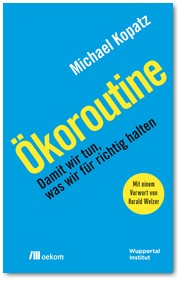 The gap between knowledge and action is often wide. At the beginning of his book "Ökoroutine", Michael Kopatz explains why we often don't do what we think is right: out of routine. Because the here and now determines our actions. Because it is difficult to avoid advertising. Or because living sustainably seems more expensive and more inconvenient in everyday life. Why should I, of all people, cycle more often, fly less, spend more money on organic products?