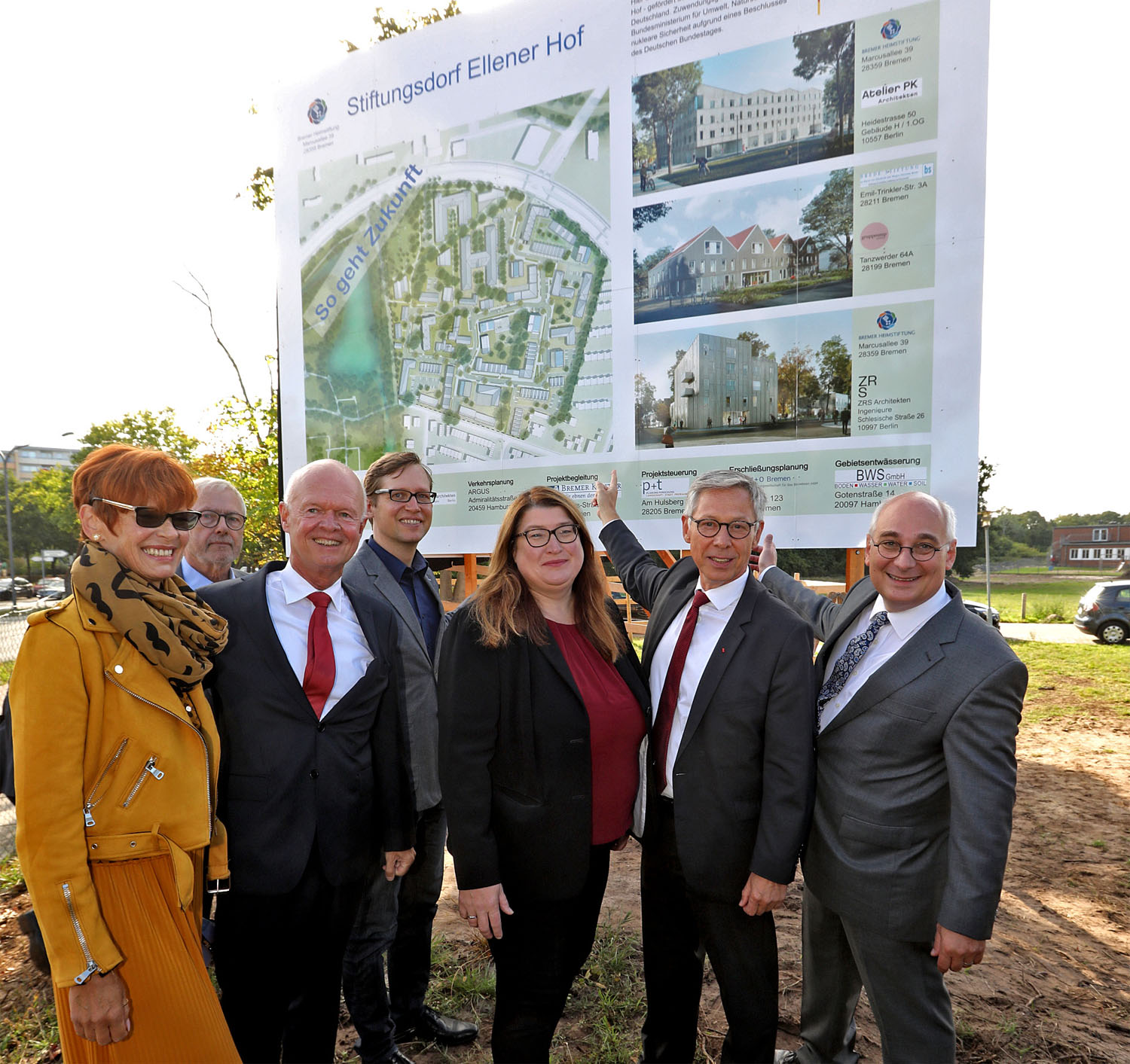
Together with the unveiling of the building sign, they heralded the start of construction on the grounds of the Ellener Hof Foundation Village: (from left) Sabine Schöbel.) Sabine Schöbel, Head of the Ellener Hof Foundation Village, Wolfgang Haase, Speaker of the Advisory Board in Osterholz, Alexander Künzel, Senior Director of the Bremen Home Foundation, Jens Deutschendorf, State Councillor at the Senator for the Environment, Construction and Transport, Anja Stahmann, Senator for Social Affairs, Youth, Women, Integration and Sport, Bremen's Mayor Dr. Carsten Sieling and André Vater, Chairman of the Board of the Bremen Home Foundation. Photo: Bremer Heimstiftung, Photographer: Martin Rospek
Climate protection targets can only be achieved by investing in green technologies of the future and sustainable investment strategies / Energy Agency to support municipalities with divestment strategies in future.
"To be climate neutral by 2050, we not only need to make additional investments in green and innovative technologies of the future. Above all, we also need a shift from existing investments in 'brown' raw materials such as coal, oil and gas to 'green' climate-friendly technologies. The phase-out of fossil fuels must be global and rapid, in line with the goals of the World Climate Conference. Only in this way can we realistically achieve the climate protection goals. Churches, municipalities and also companies are setting new standards here and demonstrating the feasibility of the changeover in both ecological and economic terms," said Environment Minister Ulrike Höfken today at the event "Divestment and Sustainable Finance", which took place during the Climate Protection Weeks in Rhineland-Palatinate.
Höfken discussed new sustainable financing approaches together with Saori Dubourg, member of the Board of Executive Directors of BASF SE and member of the Council for Sustainable Development, Oberkirchenrat Heinz Thomas Striegler, Head of Church Administration of the Protestant Church in Hesse and Nassau and Chairman of the Working Group of Church Investors of the Protestant Church in Germany, as well as Christoph Bals, Political Director at Germanwatch e.V. and member of the Sustainable Finance Advisory Council of the German Federal Government.
According to the Potsdam Institute for Climate Impact Research, the financial sector in particular has one of the greatest levers of influence in the short term to encourage other sectors of the economy to do more to protect the climate. The central tool here is divestment, a withdrawal of capital from markets and products that violate sustainability criteria, such as fossil-intensive industries, Höfken continued. "Rhineland-Palatinate is one of seven German states that has already passed a divestment resolution: The special assets of the state and the funds of state foundations are invested according to sustainable criteria," the minister explained. The Energy Agency Rhineland-Palatinate will support municipalities in the state in establishing divestment approaches in the future, Höfken announced. Here, the discussion is still in its infancy and further development in terms of content is necessary.
Whether municipalities, churches or companies: All players are called upon to examine their investment strategies and invest in a sustainable future. The City of Bonn is one of the pioneer cities with its path to sustainable financial investment. Carsten Buschmann, Head of Department at the City of Bonn, said: "The City of Bonn is pursuing a holistic approach that will be further expanded. Our experience in Bonn has shown that sustainable investing and returns are not mutually exclusive."
Climate Protection Weeks Rhineland-Palatinate:
During the Climate Protection Weeks Rhineland-Palatinate from 12 November to 11 December 2020, experts will discuss concrete instruments and measures against the climate crisis. From climate-efficient construction to climate funds and sustainable management, the events will highlight numerous approaches to achieving climate protection goals. In addition to top-class experts such as Prof. Hans Joachim Schellnhuber, Prof. Claudia Kemfert or Christoph Bals, renowned companies and organisations such as BASF, Boehringer Ingelheim and the European Investment Bank, numerous national and international politicians from Germany, Luxembourg, Rwanda, Canada and the EU will be represented.
Detailed information on the climate protection weeks can be found at here
Funding is available for greening facades and roofs and for unsealing on private, public (with the exception of municipal) and commercial properties in the Hannover urban area.
- Facade greening - funding of up to 3,500 euros
- Green roofs - subsidies of up to 10,000 euros
- Unsealing - funding of up to 10,000 euros
Application deadline: from May 2013 until 31.12.2020
A new "Export Initiative for Environmental Technologies" of the Federal Ministry for the Environment is to support the foreign business of the German environmental industry and thus promote the development of environmental infrastructure. Interested companies and organisations can apply until the end of April. In total, the BMUB five million euros available this year.
Federal Environment Minister Barbara Hendricks: "Germany is the world export champion in environmental protection. We want to maintain this position. In the meantime, other countries have also recognised that environmental protection goods are a key market of the future. With the export initiative, we want to support our companies in developing their Know-How continue to successfully market internationally while driving sustainable development."
Applications are open to institutions from Germany that are working on the development of environmental infrastructure abroad. Funding is available, for example, for projects in the field of circular economy, sustainable water management, sustainable, efficient construction, mobility or sustainable and nature-friendly regional infrastructure development. The initiative will also specifically provide funding for urbanisation partnerships and international "Smart City-projects" will be used. The initiative is also intended to help accelerate the application of global environmental standards abroad.
We use cookies to optimize our website and services.
Functional
Always active
Technical storage or access is strictly necessary for the legitimate purpose of enabling the use of a particular service explicitly requested by the subscriber or user or for the sole purpose of carrying out the transmission of a communication over an electronic communications network.
Preferences
The technical storage or access is necessary for the legitimate purpose of storing preferences that have not been requested by the subscriber or user.
Statistics
The technical storage or access, which is solely for statistical purposes.Technical storage or access used solely for anonymous statistical purposes. Without a subpoena, voluntary consent from your Internet service provider, or additional records from third parties, information stored or accessed for this purpose cannot generally be used alone to identify you.
Marketing
Technical storage or access is necessary to create user profiles, to send advertising or to track the user on a website or across multiple websites for similar marketing purposes.